
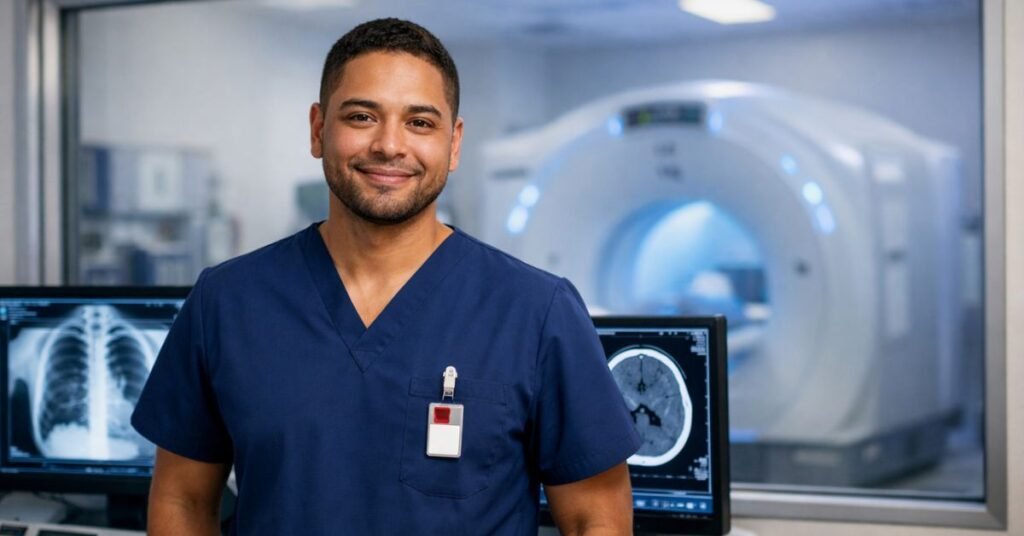
The gentle hum of the CT scanner is a sound I know as well as my own breath. After 15 years working as a radiologic technologist—progressing from nervous new graduate to department manager to clinical educator—I’ve positioned thousands of patients, mentored dozens of students, and witnessed the field transform in ways I never imagined on my first day in scrubs.
If you’re researching a career in radiologic technology, you’re likely swimming in conflicting information. Generic job boards tell you it’s just “taking X-rays.” Well-meaning advisors might confuse it with nursing or suggest you need a four-year degree when you don’t. And the alphabet soup of credentials—ARRT, RT(R), JRCERT—can feel deliberately obscure.
This guide cuts through that noise with something most career articles lack: real experience from the control room. I’ll walk you through what this profession truly entails, the honest pathway to certification, the specializations that can shape your career, and the realities that no textbook mentions. Whether you’re a high school student exploring options or a career-changer seeking meaningful work, you deserve clear answers from someone who’s lived this career, not just researched it.
Choosing to enter radiologic technology means choosing a profession with genuine ethical weight. You’ll be entrusted with patient safety, radiation exposure, and often the first images that lead to life-changing diagnoses. Let’s explore whether this demanding, rewarding field is right for you.
What is a Radiologic Technologist? More Than “Just” Taking X-Rays
When I tell people I’m a radiologic technologist, I usually hear, “Oh, so you take X-rays?” It’s not wrong, but it’s like saying a chef “just cooks food.” The definition barely scratches the surface.
A radiologic technologist is a licensed medical imaging professional who operates sophisticated diagnostic equipment to create images of the human body’s internal structures. But here’s what that clinical definition misses: you’re simultaneously a patient advocate, a physics practitioner, a quality assurance specialist, and often the calm voice in someone’s scariest moment.
The Critical Triad: Patient Care, Technology, and Safety
Every exam you perform balances three competing demands. First, there’s patient care—explaining procedures to anxious patients, adapting positioning for those in pain, recognizing when someone is deteriorating and needs immediate help. I’ve held the hand of a terrified child, quickly repositioned a stroke patient who couldn’t follow instructions, and gently explained to families what’s happening during trauma cases.
Second, there’s the technology itself. Modern imaging equipment is remarkably complex. You’re adjusting kilovoltage, milliamperage, exposure times, and collimation while considering tissue density, pathology, and image quality. You’re troubleshooting equipment failures, calibrating systems, and understanding the physics behind why changing one variable affects image contrast or patient dose.
Third—and this is non-negotiable—there’s radiation safety. Every exposure you make carries responsibility. You’re constantly applying ALARA principles (As Low As Reasonably Achievable), shielding patients appropriately, positioning precisely to avoid repeat exposures, and protecting yourself and others from unnecessary radiation.
The profession lives at the intersection of these three domains. Miss one, and you’ve failed the exam, the patient, or both.
Key Organizations That Govern the Field (ARRT, ASRT, JRCERT)
Understanding the professional landscape requires knowing the major players:
The American Registry of Radiologic Technologists (ARRT) is the national certification and registration body. They develop and administer the certification exams, establish ethical standards, and maintain the registry of qualified technologists. When you see “RT(R)” after someone’s name, that R stands for ARRT Registered. This credential is recognized nationwide and required by most employers.
The American Society of Radiologic Technologists (ASRT) is the professional association. They advocate for the profession, provide continuing education, publish practice standards, and offer career resources. Think of ARRT as the licensing body and ASRT as the professional community.
The Joint Review Committee on Education in Radiologic Technology (JRCERT) accredits educational programs. This is crucial: only graduates from JRCERT-accredited programs are eligible to sit for the ARRT exam. I’ve seen students choose cheaper, non-accredited programs only to discover they’ve wasted two years and cannot become certified. JRCERT accreditation is your first checkpoint.
Additionally, most states have their own licensing boards with separate requirements beyond ARRT certification. You’ll need to understand both the national certification process and your specific state’s rules.
How to Become a Radiologic Technologist: A Real-World Roadmap
The pathway to becoming an RT(R) is more structured than many healthcare careers, which is both good and challenging. There’s a clear roadmap, but there’s little flexibility if you veer off it.
Step 1: Prerequisites – Beyond the Basic Checklist
Most radiologic technology programs require a high school diploma or GED plus specific prerequisite courses. The typical list includes anatomy and physiology, medical terminology, and algebra. Some programs also require physics or chemistry.
But here’s what the course catalogs don’t tell you: competitive programs often have entrance exams or GPA minimums because they receive far more applications than available seats. I’ve watched qualified applicants get waitlisted simply because the cohort was limited to 24 students. Many programs admit students only once per year, so missing a deadline can mean a full year’s delay.
My advice? Excel in your prerequisites. That anatomy course isn’t just a checkbox—it’s the foundation for understanding patient positioning and pathology recognition. Take it seriously. Also, many programs value healthcare experience or observation hours. Volunteering in a hospital or shadowing a technologist (which most departments allow with advance notice) strengthens your application and gives you realistic insight into whether you’ll actually enjoy the work.
Consider the physical requirements honestly. This job involves standing for hours, lifting and repositioning patients, working with those who are combative or confused, and responding to emergencies. If you have physical limitations, that doesn’t disqualify you, but you’ll want to discuss accommodations during the application process.
Step 2: Choosing an Accredited Program (JRCERT Matters)
JRCERT accreditation is non-negotiable. I cannot stress this enough. Only graduates from JRCERT-accredited programs are eligible for ARRT certification, which nearly every employer requires.
You’ll find two main program types:
Associate degree programs (typically two years) are the most common pathway. They provide focused training in radiographic procedures, patient care, radiation safety, and the physics of image production. Most of my colleagues, including myself, started with an associate degree.
Bachelor’s degree programs (four years) include the same core radiography curriculum but add general education and advanced coursework. They’re beneficial if you’re interested in management, education, or advanced practice roles later in your career. However, for entry-level positions, the associate degree is sufficient and gets you working—and earning—two years sooner.
When evaluating programs, look beyond the glossy brochures. Ask about:
- First-time ARRT pass rates (anything below 85% is concerning)
- Clinical site partnerships and variety (you want exposure to different settings)
- Program completion rates (high attrition might signal problems)
- Class sizes (smaller cohorts often mean more individualized attention)
- Equipment availability and modernity (learning on outdated technology is frustrating)
Visit if possible. Talk to current students honestly, away from faculty. Ask about clinical scheduling, support services, and whether the program prepares you for the realities of the job or just the exam.
Step 3: Surviving and Thriving in Clinical Rotations
Clinical rotations are where the classroom meets reality, and honestly, where many students struggle. You’ll spend significant time in actual radiology departments, working alongside registered technologists while building required clinical competencies.
The ARRT mandates that you perform a minimum number of procedures across various anatomical categories before you’re eligible to test. You’ll track every exam in a competency system, obtaining signatures from supervising technologists. This can feel tedious, but it ensures you have genuine hands-on experience.
Here’s what surprised me as a student: the emotional weight. You’ll encounter patients in pain, trauma victims, children who are scared, and families in crisis. Your first pediatric exam or trauma activation will shake you. I remember my hands trembling during my first portable chest X-ray in the ICU, terrified I’d harm the critically ill patient or produce a non-diagnostic image.
The best students learn to channel that nervousness into focus. They ask questions constantly. They volunteer for challenging cases even when it’s uncomfortable. They accept constructive criticism from technologists who might be blunt but are usually trying to help. They understand that some clinical instructors are naturally encouraging while others are tough-love teachers, and both have value.
Practical survival tips from someone who’s precepted dozens of students:
- Arrive early and stay engaged; enthusiasm is remembered when job openings arise
- Master patient communication first; perfect technique is useless if you can’t gain trust and cooperation
- When you make mistakes—and you will—own them immediately and learn from them
- Build relationships with multiple technologists, not just your favorites
- Take care of your body; compression socks, good shoes, and staying hydrated matter
- Keep organized competency records; scrambling at the end is miserable
Step 4: The ARRT Exam & State Licensure Process
The ARRT exam is a computer-based test covering radiation protection, equipment operation, image production, imaging procedures, and patient care. It’s 200 multiple-choice questions with a three-and-a-half-hour time limit.
The hardest part isn’t memorizing facts—it’s applying integrated knowledge under time pressure. Questions often combine patient care decisions with technical considerations and safety protocols. For example: “Your patient is a 23-year-old female with suspected appendicitis. She mentions she might be pregnant. What is your best course of action?” You need to balance clinical need, radiation safety, shielding protocols, and documentation requirements in one decision.
Pass rates hover around 85-90% for first-time test-takers from accredited programs, which sounds reassuring until you’re in that testing center. I recommend a structured study approach: review courses, practice exams, and study groups with classmates. The students who fail usually either crammed at the last minute or never mastered the fundamentals during their program.
After passing the ARRT, you’re not done. Most states require separate state licensure, which may include additional applications, fees, background checks, and sometimes state-specific jurisprudence exams. Research your state’s requirements early because processing times vary, and you cannot work until both credentials are complete.
Radiologic Technology Specializations: Finding Your Niche
One aspect I love about this field is the opportunity to specialize. You start as a general radiographer, but post-primary certifications allow you to focus on specific modalities or patient populations.
Computed Tomography (CT): Speed and Complexity
CT technologists operate computed tomography scanners that create detailed cross-sectional images. If you thrive under pressure and enjoy fast-paced environments, CT might suit you. Emergency departments rely heavily on CT for rapid stroke assessment, trauma evaluation, and acute abdominal issues.
The work is intellectually engaging. You’re determining scan parameters, timing contrast administration, reconstructing images in multiple planes, and adapting protocols for various clinical indications. Modern CT has become increasingly complex with advanced applications like CT angiography and cardiac imaging.
The pace can be relentless. During my time in CT, we’d complete 40-50 patients in a shift, with trauma activations interrupting scheduled cases. You need excellent time management and the ability to switch gears instantly. Salary-wise, CT technologists typically earn $5,000-$15,000 more annually than general radiographers, depending on location and shift differentials.
Magnetic Resonance Imaging (MRI): Physics and Patient Management
MRI appeals to those who love physics and problem-solving. Unlike X-ray-based modalities, MRI uses powerful magnetic fields and radiofrequency pulses to create images. The physics is completely different, requiring extensive additional education.
MRI technologists must be meticulous about safety screening. Any ferromagnetic object near the scanner becomes a dangerous projectile. I’ve witnessed near-misses from overlooked metal hairpins and oxygen tanks. The screening process is exhaustive: questioning patients about implants, previous surgeries, occupational metal exposure, and more.
The exams are longer than CT—often 30-60 minutes per patient—so patient management skills are crucial. You’re talking patients through the noisy, enclosed experience, managing claustrophobia, and maintaining image quality despite patient motion. It’s less frantic than CT but requires sustained focus and patience.
MRI positions often command premium salaries and sometimes offer more regular schedules since fewer emergency MRI exams exist compared to CT.
Mammography: A Career in Breast Health
Mammography is unique in several ways. It’s one of the few modalities focused on a single body part, involves primarily outpatient screening, and has significant patient interaction time. Mammographers develop ongoing relationships with patients who return annually.
The work requires exceptional positioning skills and attention to image quality, as subtle findings can mean early cancer detection. You’re also frequently the person who must keep patients calm during callbacks or additional imaging when something concerning appears.
This specialty demands emotional resilience. You’ll perform screening mammograms on healthy patients and diagnostic workups on those with palpable masses or suspicious findings. Striking the balance between thoroughness and compassion while managing your own emotions about potential cancer diagnoses is challenging.
Most mammographers genuinely love the patient connection and preventive care focus, but it’s not for everyone. The repetitive positioning can cause ergonomic strain, and the emotional weight of breast cancer imaging affects some technologists deeply.
Interventional Radiology (IR): The Surgical Suite of Radiology
Interventional radiology is where diagnostic imaging meets minimally invasive procedures. IR technologists assist radiologists performing procedures like angiography, biopsies, drain placements, and catheter-directed treatments—all guided by imaging rather than open surgery.
This is the most surgical-feeling specialty in radiology. You’re in sterile environments, scrubbing in for procedures, managing contrast injections, and monitoring patients throughout interventions that can last hours. The variety is incredible: one day you’re assisting with a liver biopsy, the next with a uterine fibroid embolization.
IR positions typically require significant experience first. Most radiologists prefer hiring seasoned technologists who are unflappable during emergencies and proficient in cross-sectional imaging. The learning curve is steep, but IR techs often describe their work as the most engaging in the field.
The schedule can be unpredictable with on-call requirements, but compensation reflects this with higher base salaries and call pay differentials.
A Day in the Life: Unfiltered Insights from the Control Room
Theory is valuable, but let me paint a realistic picture of what your days might actually look like.
A typical hospital shift involves a mix of scheduled outpatients and unpredictable inpatients. You might start with a straightforward chest X-ray, then get pulled into the emergency department for a trauma activation, return to complete a lumbar spine series on a patient with chronic pain, assist with a portable exam in the ICU, and squeeze in scheduled exams throughout.
You’re constantly triaging. When the emergency department calls for a portable chest X-ray while you’re positioning a knee, you assess urgency, communicate with colleagues, and adjust your workflow. Patient conditions change mid-exam—someone becomes dizzy, vitals drop, or they can no longer tolerate positioning—and you adapt in real-time.
The work is physically demanding. You’re moving equipment, transferring patients, standing for hours, and sometimes using body mechanics to support patients who cannot hold positions independently. My Fitbit regularly tracked 15,000+ steps during clinical shifts, and I’d collapse into bed exhausted.
But it’s also intellectually stimulating. You’re analyzing physician orders for appropriateness, determining optimal positioning for patients with limited mobility, troubleshooting equipment malfunctions, and evaluating image quality. Should you repeat an exposure? Is that artifact clinically significant? Does this finding require immediate radiologist notification?
Real-World Use Case: The Perfect Abdomen X-Ray (It’s Not Just Technique)
Let me illustrate the complexity with a single exam. A physician orders an abdominal X-ray for a patient with acute abdominal pain.
First, you greet the patient and assess their condition. They’re elderly, hard of hearing, clearly uncomfortable, and unable to stand. You need to adapt your communication—speaking clearly, maintaining eye contact, using simple terms. You verify the order, check for relevant history (previous surgeries that might appear on the image), and explain the procedure.
Now the technical decisions begin. Since they cannot stand, you’ll perform the exam supine instead of upright, but you might need to add a lateral decubitus view to detect free air. You select appropriate exposure factors based on their body habitus—too high and you’ll overexpose the image masking subtle findings; too low and increased noise obscures detail.
You position carefully, palpating anatomical landmarks despite their discomfort, because precision matters. A poorly centered abdomen might miss pathology or require a repeat exam. You apply gonadal shielding if possible without obscuring anatomy.
Before exposing, you ensure no one else is in the room, set your technique, position yourself behind protective barriers, and instruct the patient to hold still and suspend breathing. You expose, immediately evaluate the image for motion or technique errors, and decide whether it’s diagnostic.
Throughout this, you’re monitoring the patient’s condition, maintaining their dignity, and managing your own radiation exposure. One “simple” X-ray involves patient care, physics, anatomy, pathology recognition, radiation safety, and clinical judgment—usually completed in under ten minutes.
This is why I bristle when people say we “just push a button.”
Common New Grad Mistakes (And How to Avoid Them)
Every new graduate makes mistakes. Here are the most common ones I’ve observed while training students:
Hesitating to ask questions. Pride or embarrassment prevents new techs from seeking help, leading to poor images, repeated exposures, or even safety errors. The best new graduates ask constantly, even about things that seem basic.
Poor patient communication. Students often focus so intently on technique that they forget the human in front of them. Explaining what you’re doing, why it matters, and what sensations they might feel builds cooperation and reduces anxiety.
Inadequate image critique. You’ll develop image evaluation skills over time, but new techs often rush through this step. Learning to systematically assess each image for positioning accuracy, exposure appropriateness, and artifact presence is crucial.
Ignoring ergonomics. You’re young and resilient until suddenly you’re not. Improper body mechanics when lifting patients or moving equipment leads to chronic back pain that plagues technologists. Learn proper technique early.
Inefficient workflow. Organization matters. Preparing rooms between patients, anticipating needed supplies, and developing systematic approaches to exams improves efficiency without sacrificing quality.
The Art of Difficult Patient Interactions
Some patient interactions will challenge you. The combative dementia patient who doesn’t understand why you need them to hold still. The anxious parent questioning whether radiation is truly necessary for their child. The pain patient who’s been waiting hours in the emergency department and directs frustration at you.
Successful technologists develop emotional intelligence alongside technical skills. You learn to de-escalate tension, advocate for patients within system constraints, and maintain professional boundaries while remaining compassionate. You recognize when someone’s anger isn’t really about you but about their fear or pain or loss of control.
I’ve had patients scream at me, refuse exams, and make unreasonable demands. I’ve also had patients thank me tearfully for gentleness during frightening moments, apologize for being difficult when they were simply hurting, and ask for me specifically when they returned.
The emotional labor is real and rarely discussed in radiologic technology programs. Building resilience without becoming callous is an ongoing challenge.
Radiation Safety & Ethics: The Non-Negotiables
If there’s one area where I’m uncompromising, it’s radiation safety and ethical practice.
ALARA Isn’t a Slogan; It’s a Culture
ALARA—As Low As Reasonably Achievable—should guide every exposure decision. This means using the minimum radiation dose necessary to obtain diagnostic-quality images. Practically, this involves proper collimation, appropriate shielding, optimal positioning to prevent repeats, and careful technique selection.
You’ll face pressure to work faster. Busy departments might have patient backlogs and stressed colleagues. But rushing leads to positioning errors, which lead to repeated exposures, which increase patient dose unnecessarily. Quality and safety cannot be shortcuts.
You’ll also monitor your own occupational exposure through dosimetry badges. Consistently high readings suggest poor safety practices—inadequate distance from the X-ray source, insufficient shielding use, or too much fluoroscopy time. Pay attention to these indicators.
Ethical Dilemmas You Might Actually Face
Real ethical challenges are rarely the dramatic scenarios in textbooks. More often, they’re subtle pressures:
A physician orders an exam you believe is medically unnecessary or requests imaging on an area not covered by the order. Do you perform it anyway, question the order, or refuse?
A patient asks you what their images show, hoping to know results before their physician explains them. Do you share observations, redirect them to wait for the radiologist’s official report, or offer vague reassurance?
You notice a colleague regularly skipping required lead shielding to save time. Do you confront them, report to management, or ignore it?
Your department is understaffed, and you’re working mandatory overtime beyond safe fatigue levels. At what point does self-preservation outweigh duty?
These situations test your judgment, require understanding scope of practice boundaries, and demand courage to speak up when something isn’t right. The ARRT Standards of Ethics provides guidance, but applying principles to messy real-world scenarios is where integrity matters.
Trust Signals: Protocols, Audits, and Dose Reporting
Patients trust us with something invisible and potentially harmful—radiation. Maintaining that trust requires transparency and accountability.
Quality departments conduct regular audits: evaluating repeat rates, reviewing dose metrics, and assessing image quality. These aren’t punitive when done correctly; they’re educational tools to identify areas for improvement. High repeat rates might indicate equipment problems, inadequate training, or patient population challenges rather than individual technologist failure.
Modern equipment includes dose reporting features that track radiation exposure for each exam. We’re increasingly accountable for justifying exposures and optimizing technique. This transparency benefits patients and keeps practitioners honest.
If you’re someone who dislikes scrutiny or believes rules are guidelines rather than requirements, radiologic technology will frustrate you. If you value systematic approaches, evidence-based practice, and continuous improvement, you’ll thrive.
Radiologic Technologist vs. Similar Roles: Clear Comparisons
Career confusion often stems from overlapping titles and similar-sounding roles. Let me clarify key distinctions.
RT(R) vs. Radiology Nurse: Procedural vs. Holistic Care
Radiology nurses and radiologic technologists work alongside each other but have fundamentally different roles and training.
Radiologic technologists are imaging specialists. Our education focuses on physics, equipment operation, positioning, and image production. We operate the technology, position patients for optimal imaging, ensure radiation safety, and evaluate image quality.
Radiology nurses are registered nurses who work in imaging departments, particularly in interventional radiology or areas requiring conscious sedation. Their focus is holistic patient care: administering medications, monitoring vitals, managing IV access, providing pre- and post-procedure nursing care, and handling medical emergencies.
In an IR procedure, the radiologic technologist operates imaging equipment and assists the radiologist with technical aspects, while the radiology nurse manages the patient’s medical needs, medications, and overall wellbeing.
The education pathways differ significantly. Radiology nurses complete nursing school (ADN or BSN) then specialize in radiology settings. Radiologic technologists complete radiography-specific programs. Neither can do the other’s job without additional training and credentials.
RT(R) vs. Radiology Assistant: Role Boundaries and Advancement
The Radiology Practitioner Assistant or Radiologist Assistant (RA) is an advanced practice role requiring additional education beyond RT(R).
RAs are radiologic technologists who have completed bachelor’s and master’s level education to perform expanded duties under radiologist supervision. They might conduct fluoroscopic exams, assist with invasive procedures, evaluate images and provide preliminary impressions, and perform patient assessments beyond technologist scope.
Think of the relationship as similar to physicians and physician assistants. RAs extend radiologist capacity by taking on advanced tasks, but they work under radiologist supervision and don’t independently interpret images or make diagnoses.
This pathway interests technologists seeking expanded clinical roles without becoming radiologists themselves. However, RA programs are less common than general radiography programs, and not all states recognize the credential. Research carefully if this interests you long-term.
RT(R) vs. Limited X-Ray Technician: Scope and Setting
Limited X-Ray Technicians (sometimes called Limited Scope Radiographers) perform X-rays in restricted settings with limited credentials. They might work in chiropractor offices, podiatry clinics, or urgent care centers performing specific exam types like extremities or chest X-rays.
Their training is significantly shorter—often certificate programs of several months rather than associate degrees. They’re not ARRT registered and cannot perform the full range of radiographic exams. State regulations vary widely on what limited technicians can do and where they can work.
If you want maximum career flexibility, full RT(R) credentials through JRCERT-accredited programs are the better investment. Limited credentials might get you working faster but severely restrict your options.
Job Outlook, Salary Expectations, and Future Trends
Career sustainability requires understanding both current conditions and future trajectory.
Current Salary Data (BLS + Regional Nuances)
According to the Bureau of Labor Statistics, the median annual wage for radiologic technologists was approximately $73,000 as of recent data, but this figure masks significant variation.
Entry-level positions in rural areas or small facilities might start around $45,000-$50,000, while experienced technologists in major metropolitan hospitals or specialized modalities can earn $80,000-$100,000+. Factors affecting salary include:
Geographic location: Coastal urban areas typically pay more but have higher living costs. Some rural areas offer competitive wages to attract talent.
Shift differentials: Evening, night, weekend, and on-call shifts command premium pay, sometimes 15-30% above base rates.
Specialization: CT, MRI, and IR technologists generally earn more than general radiographers. Mammography salaries vary by setting.
Setting: Hospital employment often includes better benefits and advancement opportunities compared to outpatient imaging centers, though base pay might be similar.
Experience and credentials: Advanced certifications, additional modalities, and years of experience steadily increase earning potential.
The field offers middle-class stability rather than wealth. You won’t get rich, but you can earn comfortable living wages with solid benefits, reasonable job security, and opportunities for additional income through per diem work or overtime.
The Impact of AI on the Radiologic Technologist’s Role
I’m asked constantly whether artificial intelligence will eliminate radiologic technology jobs. The short answer: not in the foreseeable future, but the role will evolve.
AI is increasingly used in image interpretation, helping radiologists detect subtle findings, prioritize worklists by urgency, and reduce reading time. Some people assume this threatens technologists, but they’re confusing our roles. Technologists produce images; radiologists interpret them. AI impacts radiologists more directly.
However, AI is beginning to affect technical aspects of our work—automated positioning assistance, exposure optimization algorithms, and image quality enhancement. These tools make us more efficient rather than obsolete. Someone still needs to assess patient condition, adapt to individual circumstances, ensure safety, and operate equipment.
What might change is the skillset emphasis. As automation handles routine technical aspects, patient interaction skills, critical thinking, and complex problem-solving become more valuable. The technologists who thrive will be those who embrace technology while excelling at the human elements AI cannot replicate.
Sustainable Career Practices: Avoiding Burnout
Healthcare worker burnout is well-documented, and radiologic technology is not immune. Long shifts, physical demands, emotional labor, and sometimes understaffing create conditions for exhaustion.
I’ve watched colleagues leave the profession entirely, not because they lost interest in imaging but because the work environment became unsustainable. Others, including myself at times, have persisted while experiencing compassion fatigue, physical pain, or emotional depletion.
Sustainable practices include:
Setting boundaries: Learning to say no to excessive overtime, leaving work stress at work, and protecting personal time.
Physical self-care: Addressing ergonomic issues early, maintaining fitness, and seeking treatment for work-related injuries promptly.
Emotional processing: Finding healthy outlets for the stress of difficult cases, seeking professional support when needed, and building resilience skills.
Career variety: Changing specialties, settings, or roles periodically to maintain engagement and prevent stagnation.
Advocacy: Supporting workplace improvements, adequate staffing, and fair treatment rather than accepting poor conditions as inevitable.
The most satisfied technologists I know have either found exceptional work environments or developed strong boundaries and self-care practices. Both approaches are valid.
People Also Ask
What is the difference between radiologic technology and radiography?
The terms are often used interchangeably, which creates understandable confusion. Radiography specifically refers to using X-rays to create images, while radiologic technology is the broader umbrella including radiography plus other imaging modalities like CT, MRI, and fluoroscopy. When someone says they’re studying “radiologic technology,” they’re typically entering through radiography education first, then potentially specializing in other modalities later.
Is radiologic technology a stressful job?
Honestly, yes—though stress levels vary by setting and personality. The combination of patient care demands, technical precision requirements, physical exertion, and sometimes emotional situations creates inherent stress. Emergency departments are particularly intense with trauma cases and unpredictable volume. However, outpatient imaging centers tend to be more predictable and controlled. Whether this stress feels manageable or overwhelming depends on your coping skills, workplace support, and tolerance for fast-paced environments.
How long does it take to become a radiologic technologist?
The typical timeline is two to four years depending on your pathway. Associate degree programs—the most common route—take approximately two years of full-time study including clinical rotations. Bachelor’s degree programs require four years. Both prepare you for the same entry-level positions and ARRT certification. After completing your program, you’ll take the ARRT exam and apply for state licensure, which can add a few additional months before you’re fully credentialed and working.
Can you specialize in MRI right after school?
Not directly. You must first become a registered radiologic technologist through general radiography education and certification. After working as an RT(R)—usually for at least one to two years, depending on employer requirements—you can pursue additional MRI certification through ARRT or ARMRIT. Some employers offer on-the-job MRI training for experienced techs, while others require you to complete formal MRI programs first. The sequential pathway exists because MRI builds on foundational imaging knowledge and clinical competence you develop as a general radiographer.
Do radiologic technologists make good money?
“Good money” is subjective, but radiologic technology offers solid middle-class wages. The national median is around $73,000, though entry-level positions might start closer to $45,000-$50,000 and experienced specialists can exceed $90,000-$100,000. You’re unlikely to become wealthy, but you can earn stable income with benefits, job security, and opportunities for additional earnings through overtime or per diem work. Compared to many careers requiring similar education length, the compensation is competitive.
What are the biggest challenges in radiologic technology?
Beyond the technical learning curve, the biggest challenges are often unexpected. Physical demands lead to chronic pain for some technologists—back problems, foot issues, and repetitive strain injuries are common. Emotional labor drains others who didn’t anticipate the psychological impact of trauma cases, pediatric emergencies, or patient suffering. Difficult patient interactions test your patience and communication skills. Workplace challenges like understaffing, mandatory overtime, or equipment problems create frustration. Finally, the responsibility weight of radiation exposure and potential diagnostic importance of your images can feel heavy.
Is the radiation exposure dangerous for techs?
With proper safety practices, occupational radiation exposure for technologists is minimal and well below regulatory limits. We monitor our exposure through dosimetry badges, use shielding and distance principles, and follow ALARA protocols. The cumulative dose most technologists receive over careers is comparable to or less than natural background radiation. However, complacency about safety practices or working in high-volume fluoroscopy without adequate protection can increase exposure unnecessarily. Pregnancy requires special considerations and additional monitoring, but many female technologists work safely throughout pregnancies with appropriate precautions.
What personality traits make a good radiologic technologist?
The best technologists I’ve worked with share certain characteristics: patience with difficult patients and challenging situations, attention to detail when positioning and evaluating images, adaptability when clinical situations change unexpectedly, communication skills for explaining procedures and reassuring anxious patients, empathy without becoming emotionally overwhelmed, and physical stamina for demanding shifts. You don’t need all these traits perfectly developed, but if you’re naturally impatient, struggle with empathy, or dislike human interaction, this career will feel like constant friction rather than flow.
Can I become an RT with an associate’s degree?
Absolutely—in fact, the associate degree is the most common educational pathway. Most practicing radiologic technologists hold associate degrees from JRCERT-accredited programs. These two-year degrees fully prepare you for ARRT certification and entry-level positions. Bachelor’s degrees are valuable if you’re interested in management, education, or advanced practice roles eventually, but they’re not required to work as a radiologic technologist.
How does AI affect radiologic technologist jobs?
AI is changing the field but not eliminating technologist positions. Current AI applications focus primarily on image interpretation (radiologist work) rather than image acquisition (technologist work). When AI does touch our work—through exposure optimization, positioning assistance, or image enhancement—it typically makes us more efficient rather than redundant. The irreplaceable human elements of our work include patient assessment, communication, adapting to individual circumstances, ensuring safety, and handling unpredictable clinical situations. The technologists most future-proofed are those combining technical proficiency with strong patient care and critical thinking skills.
What is the hardest part of the ARRT exam?
Students consistently report that the integrated scenario questions are most challenging. These questions combine multiple knowledge domains—patient care, radiation safety, positioning, and technical factors—into single complex situations requiring you to prioritize and make decisions. Simply memorizing facts isn’t sufficient; you need to apply knowledge contextually under time pressure. The radiation protection content also trips up many students because it requires mathematical calculations and understanding physics principles rather than memorization.

Hannah Price is a digital journalist who covers breaking news, global events, and trending stories with accuracy and speed. She has previously contributed to several online magazines and has built a reputation for verifying facts before publishing. Hannah believes in responsible reporting and aims to present stories in a way that readers can trust.