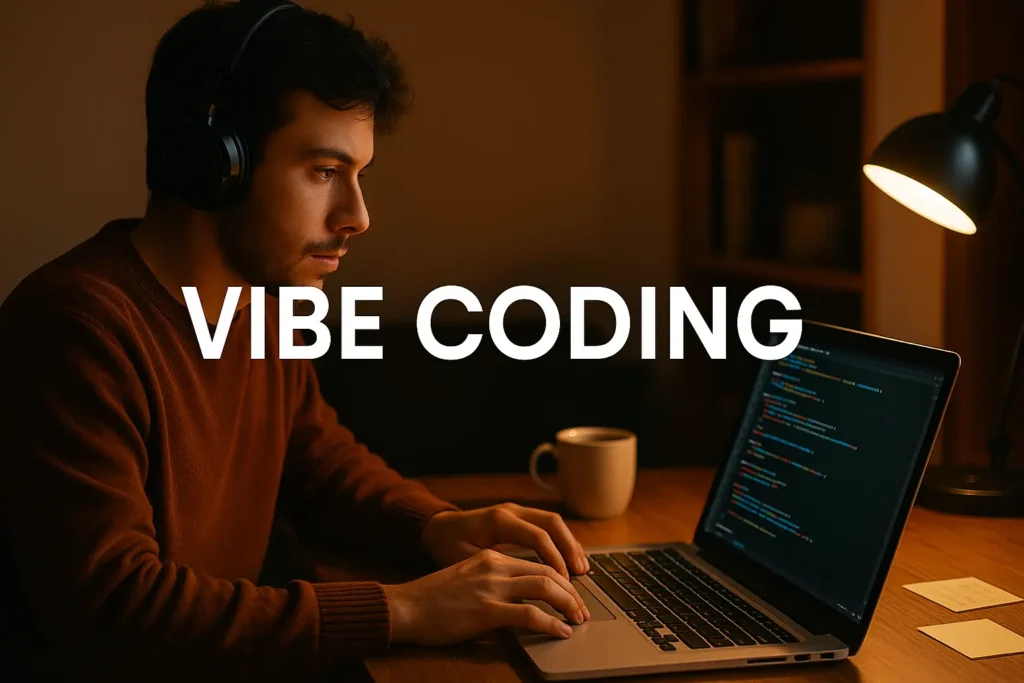
Before A few months, I was watching a friend code — music playing, coffee in hand, typing like they were composing a song instead of writing Python. No debugging tools open. No step-by-step planning. Just… vibes.
At first, I laughed. Is this even real? But the more I watched, the more I understood:
coding doesn’t always have to feel rigid, mechanical, or perfectly structured.
Sometimes, you learn more by feeling your way through it — following intuition, experimenting, and letting curiosity lead.
That’s Vibe Coding.
It’s not about being careless. It’s about coding with flow, confidence, and creativity — trusting your brain to guide you when a strict plan isn’t needed. And surprisingly, it can be a powerful skill.
What Is Vibe Coding? (Plain & Simple)
Vibe Coding is the idea of writing code intuitively. Instead of planning every detail in advance, you:
✔ experiment
✔ tweak until it works
✔ follow what feels right
Think of it like jazz improvisation — there’s structure, yes, but you’re free to move within it.
It’s the opposite of overthinking-to-death. No frozen stare at a blank screen, no endless planning. Just you, your keyboard, and curiosity.
Why Vibe Coding Works (Better Than You Think)
Because not everything needs a rigid blueprint.
Here’s what makes vibe coding surprisingly effective:
| Benefit | Why it matters |
|---|---|
| Faster creative flow | Less planning → more doing. |
| Low pressure learning | Mistakes become exploration, not failure. |
| Builds real intuition | You learn patterns by feeling them. |
| Encourages experimentation | You discover solutions docs won’t show you. |
Sometimes progress > perfection.
How to Start Vibe Coding — Step-by-Step
Even creativity has structure. Here’s a simple way to practice vibe coding intentionally:
1. Start with a tiny goal
Nothing huge — build a to-do list app, a background color changer, a random quote generator.
2. Just begin typing
Don’t over-plan. Write the first line that makes sense. Let that lead to the next.
3. Test constantly
Run your code often. Adjust when things break (they will — that’s normal).
4. Refactor later
Vibe first, tidy later. The magic happens in the mess.
5. Celebrate the small wins
Even if the code is scrappy, working software is still working software.
A Quick Example of Vibe Coding in Action
Let’s say you want a button that changes background color:
document.querySelector("button").onclick = () => {
  document.body.style.background =
    "#" + Math.floor(Math.random()*16777215).toString(16);
}
No planning. No deep architecture discussions. Just vibes → click → color.
Is it production-ready? Not yet.
But you built something — and momentum is everything.
When to Vibe Code vs When to Not
| Vibe Coding is great for… | Not ideal for… |
|---|---|
| Prototypes & ideas | Banking software |
| Learning new languages | Mission-critical systems |
| Personal projects | Large teams needing structure |
Vibes are a spark — structure is the finish line.
Useful Tools and Extras for Vibe Coders
You don’t need special software…
but these make free-flow coding more fun:
- VS Code – smooth, intuitive editor
- StackOverflow + ChatGPT – for quick “why doesn’t this work?” answers
- CodePen / Replit – instant browser-based testing
- Live Server plugin – see your code update instantly
Pair these with lo-fi beats and coffee for maximum effect.
Common Vibe Coding Mistakes to Avoid
Even intuition needs guardrails:
🚫 Never vibe your way into production code
🚫 Don’t skip refactoring — future you will cry
🚫 Document as you go, or you’ll forget what you built
🚫 Don’t confuse “vibing” with “not thinking”
Creative coding = freedom with intention.
Real-World Uses of Vibe Coding
You might be surprised where vibe coding helps:
- Hackathons → speed beats perfection
- UI prototyping → fast, visual experimentation
- Game development → fun loops & rapid iteration
- Learning new frameworks → break → fix → repeat
Some of the best ideas are discovered, not planned.
Final Takeaway
Vibe Coding isn’t a replacement for structured development — it’s a complement.
A way to unlock creativity, reduce pressure, and enjoy building again.
Start small. Follow your curiosity. Code boldly.
And let the vibes guide you.
FAQs
Is vibe coding unprofessional?
Not at all — it’s great for prototyping & early exploration.
Do I need experience to vibe code?
No! Beginners often benefit most because it reduces pressure.
Can I use vibe coding at work?
Yes — for ideas, drafts, and experimentation. Just polish your code later.

Adrian Cole is a technology researcher and AI content specialist with more than seven years of experience studying automation, machine learning models, and digital innovation. He has worked with multiple tech startups as a consultant, helping them adopt smarter tools and build data-driven systems. Adrian writes simple, clear, and practical explanations of complex tech topics so readers can easily understand the future of AI.