In an era where consumers expect faster delivery and better access to local services, REEF Technology has emerged as a transformative force in urban logistics. This comprehensive guide explores how REEF Technology is revolutionizing the way cities work by converting underutilized spaces into vibrant hubs that bring goods, services, and experiences directly to neighborhoods.
Important note: This article focuses on REEF Technology (reeftechnology.com), the Miami-based proximity network company, not to be confused with Reef Technologies, a Poland-based Python development firm.
The REEF Mission: Transforming Spaces, Connecting Communities
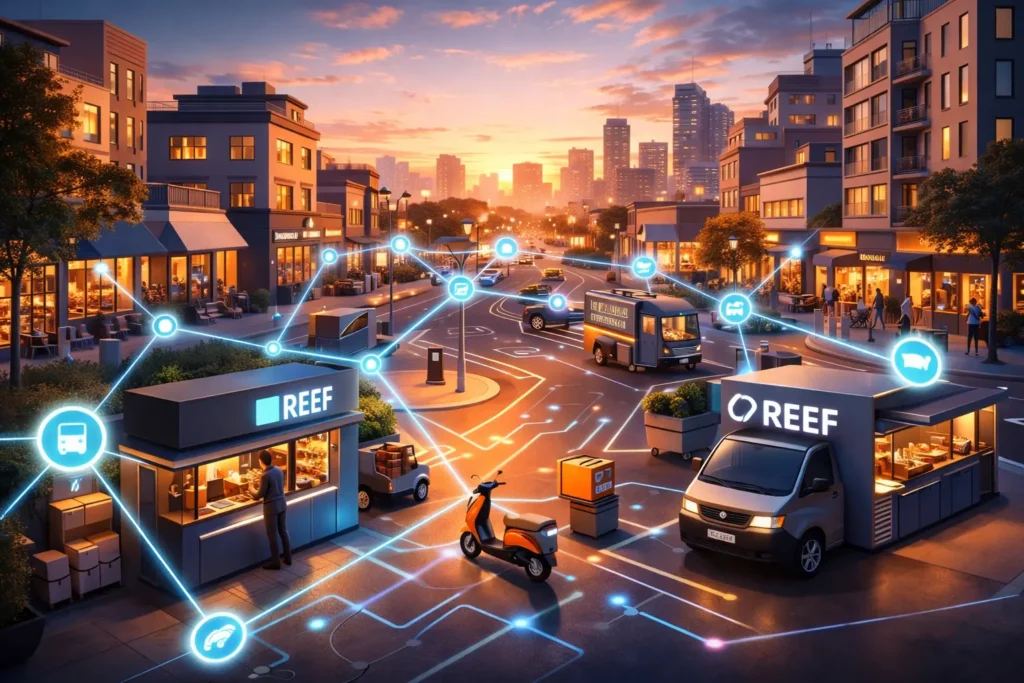
REEF Technology operates at the intersection of real estate and technology, creating what the company calls a “proximity network” — a revolutionary ecosystem designed to transform how urban spaces serve their communities. At its core, REEF’s mission is simple yet profound: make cities work better by bringing essential goods, services, and experiences closer to where people actually live, work, and spend their time.
From Parking Lots to Proximity Hubs: Our History
Founded in 2013 under the name ParkJockey, REEF Technology began with a straightforward goal: modernize parking management through technology. What started as a parking solutions company quickly evolved into something far more ambitious. The company’s leadership recognized that parking lots — those vast, underutilized asphalt expanses scattered throughout urban areas — represented untapped potential for community transformation.
The rebranding to REEF Technology marked a strategic pivot toward a broader vision. Today, the company has raised an impressive $1.79 billion across 13 financing rounds, backed by major institutional investors including Oaktree Capital Management and UBS. With headquarters in Miami, Florida, and a global workforce of approximately 18,000 employees, REEF has scaled from a regional parking operator to an international proximity network platform.
The Core Problem: Bridging the Digital-Physical Gap
Modern consumers live in a digital-first world where they can order almost anything with a few taps on their smartphones. However, the physical infrastructure to fulfill these digital promises hasn’t kept pace. Traditional logistics models rely on centralized warehouses located far from urban centers, creating inefficiencies in the “last mile” — the final, most expensive leg of delivery.
REEF identified several critical urban challenges:
- Underutilized real estate: Millions of square feet of parking lots sit largely empty, especially as urban residents shift away from car ownership
- Last-mile logistics costs: Delivering from distant warehouses to dense neighborhoods remains prohibitively expensive and environmentally wasteful
- Limited local entrepreneurship: High capital requirements and real estate costs prevent entrepreneurs from serving their own communities
- Brand expansion barriers: National and regional brands struggle to establish local presence without significant capital investment
Our Vision: The Power of Proximity
REEF’s answer to these challenges is encapsulated in their mantra: “The Power of Proximity.” Rather than viewing distance as an inevitable obstacle, REEF transforms physical proximity into a competitive advantage. By converting parking lots and other single-use spaces into multi-purpose neighborhood hubs, REEF creates micro-fulfillment centers positioned exactly where demand exists.
This proximity-first approach delivers tangible benefits across the ecosystem. Consumers receive faster delivery and better access to local services. Property owners unlock new revenue streams from previously static assets. Brands expand their market reach without building expensive brick-and-mortar locations. Entrepreneurs gain affordable access to infrastructure and established customer bases. The result is a network effect where each stakeholder’s participation increases value for everyone else.
How the REEF Technology Platform Works
While many articles describe what REEF does, few explain how the system actually operates. Understanding the mechanics of REEF’s platform reveals the sophistication behind their seemingly simple concept.
The Ulysses Network: Connecting Entrepreneurs and Brands
At the heart of REEF’s ecosystem is the Ulysses Network, named after the company’s vision of journeying toward new possibilities. This network connects independent entrepreneurs — called Ulysses Operators — with established brands seeking local presence.
Ulysses Operators are local business owners who operate out of REEF’s prepared spaces. Rather than taking on the risk and expense of opening a traditional location, operators leverage REEF’s infrastructure, technology, and brand partnerships. An operator might run a delivery kitchen preparing food for multiple restaurant brands, manage a local logistics hub, or operate a retail pickup location — all from a single REEF-enabled space.
For brands, this model is transformative. A restaurant chain can expand into a new city without building restaurants. A retailer can offer same-day delivery without opening stores. A healthcare provider can establish neighborhood clinics without long-term real estate commitments. The Ulysses Network makes this possible by providing a ready-made network of motivated local operators.
Our Real Estate Technology (PropTech) Infrastructure
REEF’s platform sits at the cutting edge of property technology (PropTech), combining sophisticated software with physical infrastructure transformation.
Adaptive Reuse of Spaces
REEF specializes in the adaptive reuse of parking real estate and other underutilized properties. The company doesn’t simply repurpose spaces — it reimagines them entirely. A typical REEF transformation might convert a section of a parking lot into:
- Delivery kitchens (also known as ghost kitchens or dark kitchens) equipped with commercial-grade cooking equipment
- Last-mile logistics hubs for package sorting and rapid delivery
- Mobile retail spaces offering pickup for online orders
- Healthcare clinics providing neighborhood-based medical services
- Flexible community spaces that serve multiple purposes throughout the day
This adaptive approach maximizes property value while maintaining flexibility. Spaces can be reconfigured as neighborhood needs evolve, ensuring long-term relevance and revenue generation.
Technology Stack & Management Tools
Behind the physical infrastructure lies robust business and productivity software that powers the entire operation. REEF’s technology platform handles:
- Property management systems that optimize space allocation and utilization
- Marketplace technology connecting consumers, brands, and operators
- Business intelligence tools providing real-time analytics on demand patterns
- Logistics software routing deliveries and managing inventory
- Financial systems handling multi-party transactions and revenue sharing
This integrated technology stack allows REEF to manage thousands of locations while maintaining consistent quality and operational efficiency. For Ulysses Operators, the platform reduces complexity, allowing them to focus on service delivery rather than backend logistics.
The Marketplace: Connecting Brands to Local Demand
REEF operates a two-sided marketplace where supply (brands and services) meets demand (local consumers). This marketplace model creates network effects: more consumers attract more brands, which in turn attract more consumers.
For brands, the compelling value proposition is minimal capital investment. Instead of spending millions to establish physical presence, brands pay REEF based on usage and revenue sharing. This transforms real estate from a fixed cost into a variable expense aligned with actual business performance.
The marketplace also aggregates demand data, providing brands with insights into local preferences before committing resources. A restaurant brand can test menu items in specific neighborhoods, a retailer can gauge interest in product categories, and a service provider can identify underserved communities — all with minimal risk.
REEF Technology Services & Solutions
REEF’s proximity network enables several distinct service categories, each addressing specific market needs.
Neighborhood Logistics & Last-Mile Delivery Hubs
REEF’s logistics hubs serve as micro-fulfillment centers strategically positioned throughout urban areas. These hubs dramatically reduce delivery times and costs by storing inventory closer to end consumers. Rather than shipping from distant warehouses, products travel short distances from neighborhood hubs.
This approach is particularly powerful for groceries, meal kits, and other time-sensitive goods. A REEF logistics hub can serve a 2-3 mile radius with sub-30-minute delivery windows, transforming customer expectations and enabling entirely new business models.
Delivery Kitchen (Ghost Kitchen) Management
REEF’s delivery kitchen network has become one of its most visible services. These facilities — purpose-built commercial kitchens optimized for food delivery — allow restaurant brands to serve new markets without opening dine-in locations.
A single REEF kitchen might host multiple restaurant brands simultaneously. This shared infrastructure model dramatically reduces operating costs while providing the flexibility to adjust brand mix based on demand. For restaurants, it’s a low-risk way to test new markets, expand delivery capacity, or launch virtual brands.
The ghost kitchen model has proven especially resilient, growing significantly during periods when dine-in restaurants faced challenges. REEF’s scale and operational expertise position it as a leader in this rapidly evolving segment.
Multi-Purpose Property Management for Real Estate Owners
For property owners, REEF offers a turnkey solution to transform underperforming assets into revenue-generating hubs. Parking lots, in particular, represent enormous untapped value. As urban car ownership declines and parking demand falls, these properties face decreasing returns.
REEF’s partnership model allows property owners to maintain ownership while REEF handles conversion, operations, and ongoing management. Property owners benefit from increased cash flow, enhanced property valuations, and diversified revenue streams — all without operational burden.
Beyond parking lots, REEF works with retail centers, office complexes, and mixed-use developments to activate unused or underutilized space. This might include unused loading docks, vacant retail storefronts, or seasonal spaces that sit empty during off-peak periods.
Who Partners with REEF?
REEF’s ecosystem brings together diverse stakeholders, each with distinct goals and value propositions.
| Partner Type | Their Goal | How REEF Helps |
|---|---|---|
| Property Owners | Increase asset value and diversify revenue | Transforms single-use spaces into revenue-generating proximity hubs with professional management and minimal owner involvement |
| Brands & Content Owners | Expand market reach with low capital expenditure | Provides turnkey access to local markets via the proximity network, transforming real estate from fixed to variable cost |
| Entrepreneurs (Ulysses Operators) | Start or grow a local business with reduced risk | Offers platform access, prepared infrastructure, technology tools, and established brand partnerships |
| Communities & Consumers | Better access to goods, services, and local jobs | Increases neighborhood access to quality offerings while creating local employment opportunities |
| Investors & Municipalities | Urban revitalization and improved logistics | Demonstrates new models for adaptive reuse and sustainable urban development |
This multi-stakeholder approach creates a resilient business model where value flows in multiple directions simultaneously.
REEF Technology Company Facts & Leadership
Understanding REEF’s scale and backing provides important context for evaluating the company’s long-term viability and ambitions.
Corporate Overview
REEF Technology maintains its headquarters in Miami, Florida, positioning itself in one of America’s fastest-growing urban markets. The company operates as a private, equity-backed corporation with significant institutional support.
With approximately 18,000 employees globally, REEF has built substantial operational capacity. This workforce spans property management, technology development, operations, and support functions necessary to manage thousands of locations across multiple countries.
Growth & Funding
REEF’s financial backing is substantial and signals serious investor confidence in the proximity network model. The company has raised $1.79 billion across 13 financing rounds, with investments from prominent firms including:
- Oaktree Capital Management: A leading global alternative investment management firm
- UBS Asset Management: The wealth management division of one of the world’s largest banks
- SoftBank Vision Fund: Known for backing transformative technology companies
- Mubadala Investment Company: Abu Dhabi’s sovereign wealth fund
This diverse investor base provides not only capital but also strategic guidance, global networks, and credibility in institutional markets.
The funding has enabled REEF to pursue aggressive expansion while investing heavily in technology infrastructure. Unlike many startups that prioritize growth over sustainability, REEF’s substantial capital base allows it to build durable competitive advantages through technology and operational excellence.
Strategic Acquisitions & Global Reach
REEF has pursued strategic acquisitions to accelerate capabilities and market presence:
- iKcon: Acquisition expanded REEF’s technology capabilities and operator network
- 2ndKitchen: Strengthened REEF’s position in the delivery kitchen segment
- Impark: This subsidiary brought extensive parking management expertise and a large property portfolio
These acquisitions demonstrate REEF’s strategy of building both technological sophistication and physical infrastructure. Rather than choosing between being a technology platform or a real estate operator, REEF integrates both capabilities into a unified competitive advantage.
REEF’s global reach now extends across North America and into select international markets. This geographic diversification reduces reliance on any single region while allowing the company to test approaches in different regulatory and competitive environments.
FAQs
What does REEF Technology actually do?
REEF Technology operates a proximity network that transforms underutilized urban spaces — primarily parking lots — into neighborhood hubs for delivery, services, and experiences. The company provides infrastructure, technology, and marketplace connections that allow brands to reach local customers and entrepreneurs to build businesses with reduced capital requirements.
What is the “Ulysses” network?
The Ulysses Network is REEF’s ecosystem of independent operators who run businesses from REEF-enabled spaces. Named after the spirit of exploration and journey, Ulysses Operators partner with REEF to operate delivery kitchens, logistics hubs, and service locations. They receive infrastructure, technology support, and access to established brand partnerships, allowing them to focus on service delivery rather than property management.
How is REEF Technology different from other logistics or real estate companies?
REEF differentiates itself by integrating real estate transformation with logistics technology and marketplace dynamics. Traditional logistics companies operate centralized warehouses and delivery networks. Traditional real estate companies lease space. REEF does both simultaneously while adding a marketplace layer that connects brands with operators and consumers. This integrated model creates unique value that pure-play logistics or real estate companies cannot easily replicate.
Who are REEF Technology’s main competitors?
REEF faces competition from several directions. In delivery kitchens, competitors include CloudKitchens and Kitchen United. In logistics, companies like Uber Freight and traditional warehouse operators compete for brand partnerships. In PropTech, various platforms offer property management solutions. However, few competitors integrate all three elements — real estate transformation, logistics infrastructure, and marketplace technology — into a unified platform at REEF’s scale.
How can I partner with REEF as a brand or property owner?
Brands interested in expanding through REEF’s proximity network can explore partnership opportunities through REEF’s business development team. The process typically involves evaluating market fit, demand analysis, and operational requirements for your specific category.
Property owners can connect with REEF to discuss transformation opportunities for underutilized assets. REEF evaluates properties based on location, size, existing infrastructure, and surrounding demand patterns. Ideal properties are in dense urban or suburban areas with strong consumer demand and available space for conversion.
Is REEF Technology a public company?
No, REEF Technology operates as a private company backed by institutional investors including Oaktree Capital Management, UBS Asset Management, SoftBank Vision Fund, and Mubadala Investment Company. While some venture-backed companies eventually pursue public listings, REEF has not announced any plans for an initial public offering (IPO). The company’s substantial private funding allows it to focus on long-term growth without the quarterly reporting pressures of public markets.
What is the relationship between REEF Technology and ParkJockey?
REEF Technology was originally founded as ParkJockey in 2013. ParkJockey focused on technology-enabled parking management, providing digital solutions for parking operators. As the company’s vision expanded beyond parking to encompass broader neighborhood logistics and proximity services, the leadership rebranded to REEF Technology. This rebrand reflected the evolution from a parking-centric company to a comprehensive proximity network platform. While parking management remains part of REEF’s portfolio, it now represents just one component of a much larger ecosystem.
The Future of Proximity Networks
REEF Technology represents a compelling vision for urban transformation. By recognizing that proximity creates value in an increasingly digital world, REEF has positioned itself at the intersection of multiple powerful trends: the growth of delivery commerce, the adaptive reuse of real estate, the rise of entrepreneurial operating models, and the push for sustainable urban logistics.
The company’s success will ultimately depend on execution across multiple complex dimensions: maintaining operational quality across thousands of locations, developing technology that scales efficiently, balancing the interests of diverse stakeholders, and adapting to rapidly evolving consumer behaviors and regulatory environments.
For property owners, brands, entrepreneurs, and urban planners, REEF offers a concrete example of how cities might evolve. Rather than accepting the inefficiencies of current logistics models or the underutilization of valuable real estate, REEF demonstrates that creative integration of technology, infrastructure, and marketplace dynamics can unlock substantial value.
As urban populations continue growing and consumer expectations continue rising, proximity networks like REEF’s may prove not just advantageous but essential. The power of proximity, it turns out, is the power to make cities work better for everyone.
For more information about REEF Technology’s services, partnership opportunities, or career openings, visit reeftechnology.com or explore their investor relations materials for detailed company information.

Adrian Cole is a technology researcher and AI content specialist with more than seven years of experience studying automation, machine learning models, and digital innovation. He has worked with multiple tech startups as a consultant, helping them adopt smarter tools and build data-driven systems. Adrian writes simple, clear, and practical explanations of complex tech topics so readers can easily understand the future of AI.