

Securing quality healthcare is a cornerstone of financial stability and personal well-being. For residents of the Sunshine State, finding affordable health insurance in Florida can sometimes feel like a complex puzzle. With various plans, eligibility rules, and enrollment periods, it is easy to feel overwhelmed. The good news is that Florida has a robust system in place, primarily through the federal Health Insurance Marketplace, designed to make coverage accessible and budget-friendly for millions.
This guide will serve as your comprehensive roadmap to understanding and obtaining affordable health insurance in Florida. We will break down how the Marketplace works, explain the critical financial assistance available, explore options outside of the Marketplace like Florida KidCare, and provide actionable tips for choosing the right plan for you and your family. Whether you are self-employed, between jobs, or your employer doesn’t offer coverage, quality health insurance is within your reach.
Understanding the Florida Health Insurance Landscape
Unlike some states that run their own health insurance exchanges, Florida uses the federally-run Health Insurance Marketplace, accessible through the website HealthCare.gov. This is the primary portal for individuals and families to shop for, compare, and enroll in Affordable Care Act (ACA) compliant health plans.
The ACA established several key protections and standards that all Marketplace plans must follow:
- Coverage for Essential Health Benefits: All plans must cover a core set of ten benefits, including emergency services, hospitalization, prescription drugs, mental health services, and maternity care.
- No Denial for Pre-Existing Conditions: Insurance companies cannot deny you coverage or charge you more based on your health history.
- Free Preventive Care: Services like annual check-ups, flu shots, and certain health screenings are covered at no cost to you.
Florida has one of the highest enrollment rates in the country, with numerous insurance carriers competing for business. This competition helps keep costs down and provides a wide variety of plan options for consumers.
The Key to Affordability: Subsidies and Financial Assistance
The single most important factor that makes coverage affordable for most people is financial assistance, also known as subsidies. These subsidies are provided by the federal government to lower the cost of your health insurance. There are two main types.
1. Premium Tax Credit (PTC)
The Premium Tax Credit is a subsidy that directly lowers your monthly health insurance premium.
- How it Works: The tax credit is available to individuals and families with household incomes between 100% and 400% of the Federal Poverty Level (FPL). However, thanks to recent legislation, a “subsidy cliff” at 400% FPL has been temporarily eliminated, meaning even those with higher incomes may qualify if their health insurance premium would exceed 8.5% of their household income.
- How You Receive It: You can choose to have the PTC paid directly to your insurance company each month, which reduces your premium payment immediately. This is the most common choice. Alternatively, you can pay the full premium each month and claim the entire tax credit when you file your federal income taxes.
- Example: If your monthly premium is $500 and you qualify for a $400 tax credit, you would only have to pay $100 per month for your health insurance.
2. Cost-Sharing Reductions (CSR)
Cost-Sharing Reductions are an extra subsidy that helps lower your out-of-pocket costs, such as deductibles, copayments, and coinsurance.
- How it Works: CSRs are only available to individuals and families with household incomes between 100% and 250% of the FPL.
- Key Requirement: To receive CSR benefits, you must enroll in a Silver-level plan on the Marketplace. If you qualify for CSRs but choose a Bronze, Gold, or Platinum plan, you will not get these extra savings.
- Benefit: A Silver plan with CSRs can have out-of-pocket costs comparable to a Gold or even Platinum plan, making it an excellent value for those who qualify.
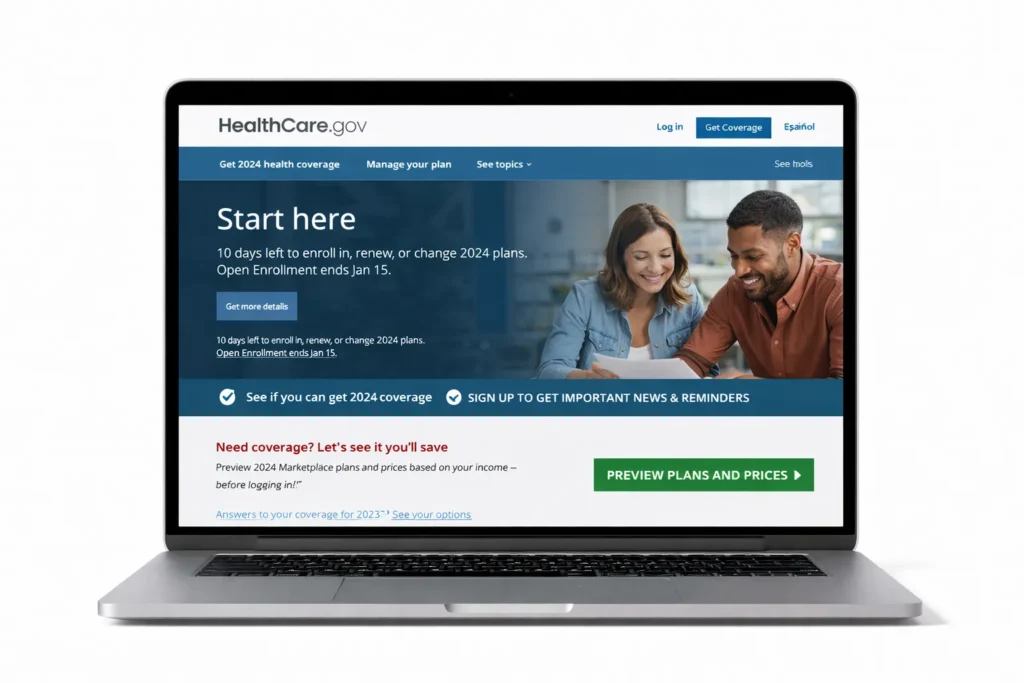
The Marketplace is designed to be a one-stop-shop for all your insurance needs. Here is a step-by-step guide to using it.
Step 1: Create an Account and Apply
You will start by creating an account on HealthCare.gov. Then, you will fill out a single application with information about your household, income, and any employer-sponsored insurance that may be available to you. This one application will determine your eligibility for Marketplace plans, Premium Tax Credits, Cost-Sharing Reductions, and even state programs like Medicaid.
Step 2: Compare Plans
Once your eligibility is determined, you can compare the different plans available in your area. The Marketplace organizes plans into four “metal tiers”:
- Bronze: Lowest monthly premium, but highest out-of-pocket costs (deductibles, copays). Good for healthy individuals who want protection against major medical events.
- Silver: Moderate monthly premium and moderate out-of-pocket costs. This is the only tier where you can get Cost-Sharing Reductions.
- Gold: High monthly premium, but low out-of-pocket costs. Good for individuals who expect to use medical services frequently.
- Platinum: Highest monthly premium and the lowest out-of-pocket costs.
When comparing plans, look beyond just the premium. Pay close attention to the deductible, the copayments for doctor visits, and the provider network to ensure your preferred doctors and hospitals are included.
Step 3: Enroll
After you choose a plan, you can complete your enrollment directly on the website. You will then need to make your first premium payment directly to the insurance company to activate your coverage.
When Can You Enroll? Understanding Enrollment Periods
You can’t sign up for a health insurance plan just any time. There are specific periods when you are allowed to enroll.
Open Enrollment Period
This is the main time of year when anyone can enroll in a new health plan or change their existing one. The Open Enrollment Period typically runs from November 1 to January 15 each year.
Special Enrollment Period (SEP)
If you experience a Qualifying Life Event (QLE), you may be eligible for a Special Enrollment Period, which allows you to enroll in a plan outside of the Open Enrollment window. Common QLEs include:
- Losing other health coverage (like from a job).
- Getting married or divorced.
- Having a baby or adopting a child.
- Moving to a new ZIP code.
- A change in income that affects your eligibility for subsidies.
You usually have 60 days from the date of the event to enroll in a new plan.
Options for Children: Florida KidCare
For families seeking coverage specifically for their children, Florida KidCare is an excellent resource. It is the state’s Children’s Health Insurance Program (CHIP) and offers high-quality, low-cost coverage for children from birth through age 18.
How Florida KidCare Works
Florida KidCare is actually a partnership of four different programs. A single application determines which program a child is eligible for based on age and family income.
- Medicaid: For children from families with the lowest incomes.
- MediKids: For children ages 1-4.
- Florida Healthy Kids: For children ages 5-18.
- Children’s Medical Services (CMS): For children with special healthcare needs.
Coverage is either free or low-cost, with most families paying a small monthly premium (e.g., $15 or $20). The benefits are comprehensive, covering everything from doctor visits and hospital stays to dental and vision care.
What About Medicaid for Adults in Florida?
Medicaid provides health coverage to millions of low-income Americans. While Florida does offer Medicaid, it is one of a handful of states that has not expanded its Medicaid program under the ACA.
This means that the eligibility criteria for adults are more restrictive than in expansion states. Generally, to qualify for Medicaid in Florida as an adult under 65, you must have a very low income and meet a specific non-financial category, such as being pregnant, a parent or caretaker of a minor child, elderly, or having a disability.
Childless adults with incomes below the poverty line often fall into the “coverage gap”—they earn too much for traditional Medicaid but not enough to qualify for subsidies on the HealthCare.gov Marketplace (which start at 100% of the FPL).
Short-Term Health Insurance: A Word of Caution
You may see advertisements for very cheap, short-term health insurance plans. While these plans can seem appealing, it is crucial to understand what they are—and what they are not.
Short-term plans are not ACA-compliant. This means:
- They can deny you coverage or charge you more based on pre-existing conditions.
- They do not have to cover the ten essential health benefits. Many exclude coverage for things like maternity care, mental health, or prescription drugs.
- They have annual and lifetime coverage limits, meaning they could stop paying if you incur very high medical bills.
While a short-term plan might be a temporary solution for a healthy person who is between jobs for a month or two, it is not a substitute for comprehensive, affordable health insurance in Florida.
Tips for Choosing the Right Plan
- Estimate Your Medical Needs: Think about how often you typically visit the doctor or need prescriptions. If you expect frequent medical use, a Gold plan with a higher premium but lower copays might save you money overall.
- Check the Provider Network: Before you enroll, use the plan’s online directory to make sure your preferred doctors, specialists, and hospitals are in-network. Going out-of-network is significantly more expensive.
- Understand the Full Cost: Don’t just look at the premium. Add up the deductible, copayments, and out-of-pocket maximum to understand your total potential financial exposure.
- Don’t Be Afraid to Get Help: Navigating the system can be tricky. Florida has a large network of certified insurance agents and Navigators who can provide free, unbiased assistance with your application and help you choose a plan.
Conclusion
Finding affordable health insurance in Florida is not only possible but also more accessible than ever before, thanks to the Health Insurance Marketplace and the significant financial assistance available. By understanding how Premium Tax Credits and Cost-Sharing Reductions work, you can dramatically lower the cost of comprehensive, high-quality coverage.
Take the time to explore your options on HealthCare.gov during the Open Enrollment Period, or see if you qualify for a Special Enrollment Period. For children’s coverage, Florida KidCare offers a fantastic, low-cost solution. By empowering yourself with knowledge, you can navigate the system with confidence and secure the health coverage that you and your family deserve.
FAQs About Affordable Health Insurance in Florida
What is the best way to get affordable health insurance in Florida?
For most individuals and families, the best way is to apply through the Health Insurance Marketplace at HealthCare.gov. The application will determine if you qualify for subsidies that lower your monthly premiums and out-of-pocket costs.
What if I can’t afford the premiums on the Marketplace?
If your income is very low, you may qualify for Florida Medicaid. If you are applying for children, Florida KidCare offers free or very low-cost coverage. It is always best to complete the application on HealthCare.gov to see all the programs you are eligible for.
Can I get health insurance if I have a pre-existing condition?
Yes. Under the Affordable Care Act (ACA), all Marketplace plans must cover pre-existing conditions. An insurance company cannot refuse to cover you or charge you a higher premium because of your health status.
I am self-employed. What are my options?
If you are self-employed, you can use the Health Insurance Marketplace to buy a plan. You will be eligible for the same Premium Tax Credits and Cost-Sharing Reductions as anyone else, based on your net income from self-employment.
Where can I get free help with my application?
You can find free, in-person or virtual help from certified Navigators and insurance agents. You can search for local assistance directly on the HealthCare.gov website by entering your ZIP code.

Sofia Bennett is a fashion writer and style observer known for her clean sense of aesthetics and trend analysis. She has covered fashion shows, reviewed designer collections, and interviewed independent creators. Sofia specializes in connecting fashion with real-life lifestyle choices, helping readers understand what looks good — and why.