
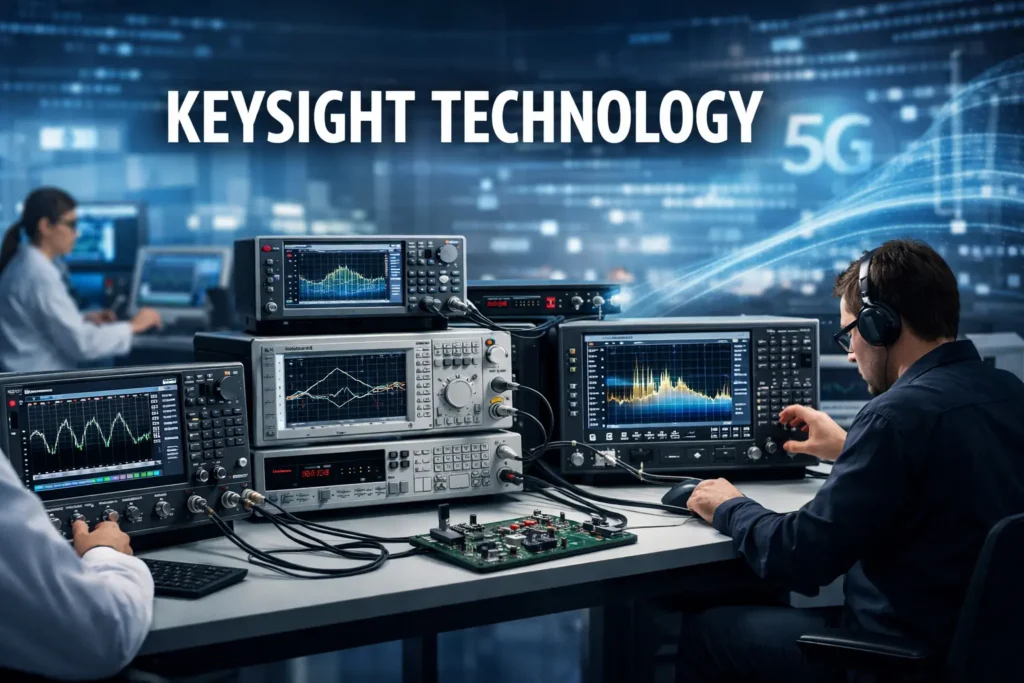
If you’ve ever worked in electronics, telecommunications, aerospace, or advanced manufacturing, you’ve likely encountered keysight technology — even if you didn’t realize it at the time. Behind nearly every reliable wireless connection, validated semiconductor chip, or safety-critical system is a layer of testing that determines whether something works in theory or survives in the real world.
That’s where Keysight enters the picture.
This guide is written for engineers, technical leaders, procurement teams, and decision-makers who want more than surface-level explanations. Whether you’re evaluating test equipment, trying to understand industry standards, or deciding if Keysight is worth the investment, this article breaks it all down — clearly, honestly, and from real-world experience.
By the end, you’ll understand:
- What Keysight technology actually does
- Where it delivers the most value
- Who should (and shouldn’t) use it
- How it compares to alternatives
- How to avoid costly mistakes when adopting it
What Is Keysight Technology? (From Beginner to Expert Understanding)
At its core, keysight technology refers to advanced electronic measurement, testing, simulation, and validation systems used to design, verify, and optimize complex electronic and communication systems.
Keysight Technologies builds both hardware instruments and software platforms that allow engineers to answer one critical question:
Does this system behave exactly as expected — under real-world conditions?
Beginner View: The Simple Explanation
Think of Keysight tools as highly sophisticated diagnostic equipment for electronics. Just like medical imaging reveals what’s happening inside the human body, Keysight instruments reveal what’s happening inside circuits, signals, networks, and systems.
Intermediate View: The Practical Role
At a working level, Keysight helps teams:
- Measure electrical signals with extreme precision
- Simulate real-world environments before deployment
- Validate compliance with global standards
- Identify performance bottlenecks and failure risks early
Expert View: Why It Matters
As systems become faster, smaller, and more interconnected (5G, EVs, AI hardware), traditional testing fails. Keysight technology exists precisely because modern systems behave in non-linear, unpredictable ways that demand advanced modeling and validation.
This isn’t optional testing — it’s risk mitigation at scale.
Why Keysight Technology Matters in Today’s High-Speed, High-Risk World
The reason Keysight has become an industry benchmark is simple: failure is no longer cheap.
A missed signal integrity issue, a flawed RF design, or a compliance failure can mean:
- Delayed product launches
- Regulatory penalties
- Massive recall costs
- Brand damage
Keysight’s value shows up where precision matters most.
Key Benefits That Actually Move the Needle
- Accuracy at extreme frequencies and speeds
- Early detection of design flaws
- Reduced time-to-market
- Confidence in regulatory compliance
- Scalable testing from lab to production
This is why Keysight dominates in environments where “close enough” simply isn’t acceptable.
Real-World Use Cases: Who Uses Keysight Technology (and Why)
1. Telecommunications & 5G/6G Development
Keysight plays a critical role in:
- Network emulation
- RF validation
- Massive MIMO testing
- Latency and throughput analysis
Without this level of testing, modern wireless networks simply wouldn’t function reliably.
2. Semiconductor & Chip Design
As chip architectures grow more complex, Keysight tools help engineers:
- Validate performance before fabrication
- Identify signal integrity issues
- Reduce costly silicon re-spins
3. Automotive & EV Systems
From ADAS to battery management systems, automotive electronics require zero-failure tolerance. Keysight supports:
- Functional safety validation
- High-voltage testing
- Embedded system reliability
4. Aerospace & Defense
Mission-critical systems demand absolute confidence. Keysight enables:
- Secure communications testing
- Radar and electronic warfare validation
- Harsh-environment simulation
Step-by-Step: How Keysight Technology Fits into a Real Engineering Workflow
This is where most content fails — so let’s get practical.
Step 1: Define the Risk, Not the Tool
Before selecting any Keysight solution, experienced teams start by asking:
- What failure would be catastrophic?
- Where uncertainty is highest?
- What standards must be met?
Step 2: Choose the Right Measurement Layer
Keysight offers tools across:
- Component-level testing
- System-level validation
- Network-level emulation
Choosing incorrectly here leads to overspending or blind spots.
Step 3: Combine Hardware + Software
Keysight’s real power comes from integrated ecosystems, such as PathWave software paired with instruments. This enables:
- Automated testing
- Repeatable workflows
- Data-driven optimization
Step 4: Validate, Stress, and Iterate
Best-in-class teams don’t just test once. They:
- Stress systems under edge conditions
- Validate across environments
- Iterate designs before release
Keysight Technology vs Alternatives: Honest Comparison
Keysight is not the right choice for everyone — and that’s important to say.
When Keysight Makes Sense
- Enterprise or R&D environments
- Regulatory-heavy industries
- Cutting-edge technology development
- High financial or safety risk
When It’s Overkill
- Hobbyist projects
- Early-stage prototyping with low risk
- Cost-constrained startups without compliance needs
Common Alternatives (Contextual)
- Lower-cost test equipment vendors
- Open-source simulation tools
- In-house testing setups
Trade-off reality: You save money upfront, but often pay later in failures, delays, or redesigns.
Common Mistakes People Make with Keysight Technology
Mistake 1: Buying Tools Without Workflow Planning
This leads to underused equipment and wasted budgets.
Fix: Design your testing workflow first, then select tools.
Mistake 2: Over-specifying “Just in Case”
More features ≠ better outcomes.
Fix: Match capabilities to actual risk.
Mistake 3: Ignoring Training & Integration
Keysight tools are powerful — but only if teams know how to use them.
Fix: Invest in onboarding and best-practice implementation.
FAQs
What is Keysight technology used for?
It’s used to measure, test, simulate, and validate complex electronic and communication systems before and after deployment.
Is Keysight Technologies considered industry-standard?
Yes. It’s widely regarded as a benchmark in test and measurement across telecom, semiconductor, automotive, and aerospace sectors.
Is Keysight equipment expensive?
Compared to entry-level tools, yes — but the ROI often comes from reduced failures, faster development, and compliance confidence.
Who typically uses Keysight solutions?
Professional engineers, R&D teams, manufacturers, and enterprises working on high-precision or regulated technologies.
Can small companies benefit from Keysight?
Yes — if the risk profile justifies it. Otherwise, lighter alternatives may be more practical initially.
Conclusion: When Precision Matters, Keysight Delivers
Keysight technology isn’t about flashy specs or brand prestige. It exists for one reason: to reduce uncertainty in systems where failure is costly.
If your work touches advanced electronics, high-speed communications, or mission-critical systems, Keysight isn’t just a toolset — it’s an insurance policy against unknowns.
The smartest teams don’t ask “Is it expensive?”
They ask “What happens if we’re wrong?”

Adrian Cole is a technology researcher and AI content specialist with more than seven years of experience studying automation, machine learning models, and digital innovation. He has worked with multiple tech startups as a consultant, helping them adopt smarter tools and build data-driven systems. Adrian writes simple, clear, and practical explanations of complex tech topics so readers can easily understand the future of AI.