From the moment we wake up to check our smartphones, to the smart thermostats regulating our homes, technology has become the invisible force shaping every aspect of modern life. The application of technology—the practical implementation of technological innovations to solve real-world problems—has evolved from a luxury to an absolute necessity. But what exactly are these applications, and how are they transforming our world?
This comprehensive guide explores the diverse applications of technology across homes, travel, business, and education. Whether you’re a student researching for an assignment, a professional looking to leverage technology for competitive advantage, or simply curious about how technology is reshaping our daily lives, this guide provides the insights you need.
Technology applications span an incredibly wide spectrum—from the Internet of Things (IoT) devices in our homes to artificial intelligence systems powering business decisions, from automated airport check-ins to personalized learning platforms revolutionizing education. Each application brings unique benefits like efficiency, convenience, and cost savings, while also presenting challenges around privacy, security, and the digital divide.
Core Technologies Driving Modern Applications
Before diving into specific applications, it’s essential to understand the foundational technologies powering today’s innovations. These core technologies form the building blocks that enable practical applications across all sectors of society.
Artificial Intelligence (AI) and Machine Learning
Artificial intelligence represents perhaps the most transformative technology of our era. AI systems can analyze vast amounts of data, recognize patterns, make predictions, and even learn from experience without explicit programming. Machine learning, a subset of AI, enables systems to improve automatically through experience. Deep learning takes this further by using neural networks to process information in ways that mimic the human brain.
Reinforcement learning, another AI approach, allows systems to learn optimal behaviors through trial and error—the same technique that enabled Google’s DeepMind to create AlphaGo, which defeated world champions at the complex game of Go. Today, AI powers everything from personalized product recommendations on e-commerce sites to fraud detection in banking, from automated customer service chatbots to advanced medical diagnostics.
The Internet of Things (IoT) and Connectivity
The Internet of Things refers to the network of physical devices embedded with sensors, software, and connectivity that enables them to collect and exchange data. From smart refrigerators that track expiration dates to industrial sensors monitoring equipment performance, IoT devices create an interconnected ecosystem of intelligent objects.
The rollout of 5G networks is accelerating IoT adoption by providing faster speeds, lower latency, and the ability to connect far more devices simultaneously. This connectivity revolution enables real-time data collection and analysis, powering applications like smart cities, precision agriculture, and predictive maintenance in manufacturing.
Cloud and Mobile Computing
Cloud computing has democratized access to powerful computing resources. Instead of maintaining expensive on-premises infrastructure, individuals and businesses can access software, storage, and computing power on-demand through the internet. This shift has enabled everything from remote work capabilities to sophisticated data analytics for small businesses.
Mobile technology complements cloud computing by putting these powerful capabilities in our pockets. The ubiquity of smartphones has created a platform for countless applications, from mobile banking and health tracking to navigation and social connection. Together, cloud and mobile computing have transformed how we work, communicate, and access information.
Applications of Technology in the Home and Daily Life
Our homes have become showcases for practical Applications of Technology. Smart home technology transforms ordinary residences into intelligent, responsive environments that enhance comfort, security, and efficiency.
The Rise of the Smart Home
The smart home ecosystem centers around interconnected devices that communicate with each other and respond to user commands or automated triggers. Smart speakers like Amazon Echo and Apple HomePod serve as central hubs, allowing voice control of various connected devices. These systems use natural language processing to understand commands like “dim the lights” or “what’s the weather?”
Smart thermostats learn your preferences and schedule, automatically adjusting temperature to optimize comfort and energy use. They can detect when you’re away and reduce heating or cooling accordingly. Smart lighting systems allow remote control, scheduling, and even color adjustment to match your mood or activity. Smart plugs turn ordinary appliances into connected devices, enabling remote control and energy monitoring.
Home automation extends beyond individual devices to create integrated systems. Geofencing technology can trigger actions when you arrive or leave home—unlocking doors, adjusting climate control, or disabling security systems. Scenes and routines automate multiple actions with a single command, like a “good morning” routine that gradually brightens lights, starts coffee, and reads the news.
Key Benefits of Smart Home Technology
Smart home applications deliver tangible benefits that improve quality of life:
- Convenience and Ease of Use: Control devices remotely through smartphone apps or voice commands. No more searching for light switches or adjusting thermostats manually. The hands-free control is particularly valuable when multitasking or physically occupied.
- Energy and Cost Savings: Smart thermostats can reduce heating and cooling costs by 10-23% according to various studies. Smart lighting ensures lights are only on when needed. Energy monitoring features provide insights into consumption patterns, enabling more informed decisions.
- Enhanced Security and Safety: Video doorbells let you see and speak with visitors remotely. Smart locks provide keyless entry and activity logs. Smart smoke detectors send alerts to your phone during emergencies. Security cameras with motion detection can distinguish between people, animals, and vehicles.
- Remote Access and Monitoring: Check on your home from anywhere. Ensure you turned off appliances, adjust climate control before arriving, or monitor elderly parents’ activity patterns for safety.
- Maintenance Monitoring: Smart leak detectors prevent water damage. HVAC monitors alert you to system issues before they become costly repairs. Smart appliances can self-diagnose problems and schedule service.
Challenges and Considerations for Smart Homes
Despite their benefits, smart home technologies present real challenges that potential adopters should carefully consider:
- High Initial Cost: Quality smart devices are expensive. A comprehensive smart home setup can cost thousands of dollars. While energy savings may offset some costs over time, the upfront investment is substantial.
- Privacy Concerns: Smart devices constantly collect data about your habits, presence, and activities. This data could be accessed by hackers, shared with third parties, or requested by law enforcement. Always-listening smart speakers raise particular privacy concerns.
- Security and Hacking Risks: Connected devices create potential entry points for cyberattacks. Poorly secured IoT devices have been exploited to create botnets for distributed denial-of-service attacks. Hackers could potentially unlock smart locks, disable security cameras, or access personal data.
- Internet Dependence: Most smart home features require a stable internet connection. Outages can leave you unable to control basic home functions. Some devices become entirely non-functional without connectivity.
- Compatibility and Complexity: Different manufacturers use different protocols and ecosystems. Ensuring devices work together can be challenging. Setup often requires technical knowledge, and troubleshooting issues can be frustrating.
Revolutionizing the Travel and Transportation Industry
Technology applications have transformed the travel experience, making journeys faster, more convenient, and more efficient for both travelers and operators. From automated airport processes to real-time journey information, digital technology has become integral to modern transportation.
Seamless Travel with Airport Automation
Airports have embraced automation to reduce congestion and improve passenger flow. Online and mobile check-in allow travelers to check in from home, receiving electronic boarding passes on their smartphones. This eliminates the need to queue at check-in desks for passengers without baggage.
Self-service kiosks enable quick check-in at the airport, with touchscreen interfaces guiding users through the process. Automated bag drop systems use barcode scanning and weight sensors to accept checked luggage without staff intervention. Some airports have introduced biometric boarding, using facial recognition to verify identity at various checkpoints, further streamlining the process.
Benefits:
- Reduced wait times and queues, creating a less stressful travel experience
- Operational cost savings for airlines by reducing staffing requirements
- Greater convenience and control for passengers over their journey
Disadvantages:
- Technical issues can create bottlenecks during the transition period
- Safety concerns with automated baggage systems (conveyor belt injuries)
- Some passengers, particularly elderly travelers, may struggle with new technology
The Future of Rail with Smart Ticketing
Rail systems worldwide are replacing physical tickets with digital alternatives. Smart ticketing encompasses e-tickets stored on smartphones, contactless payment cards, and dedicated travel cards with embedded chips. Passengers can purchase tickets through apps, receive digital barcodes for scanning at gates, and even use account-based systems where charges are automatically calculated based on journeys taken.
Benefits:
- Enhanced customer convenience—no need to queue at ticket machines or carry physical tickets
- Integrated journey planning apps help passengers find optimal routes and best prices
- Operators gain valuable data on passenger flows for better service planning
Disadvantages:
- Fraud risks from barcode copying or unauthorized sharing
- Hacking vulnerabilities in digital ticketing systems
- User discomfort with technology can create barriers for some passengers
Real-Time Information for Smarter Journeys
GPS tracking and connected sensors enable real-time tracking of buses, trains, and other public transport. Travel apps display live arrival times, service disruptions, and alternative routes. Smart signs at stops show updated information. This transparency helps travelers make informed decisions, reducing uncertainty and wait times.
The benefits extend beyond convenience—real-time data enables transport operators to respond quickly to issues, reroute vehicles around problems, and better manage capacity. For travelers, knowing exactly when their bus will arrive means less time standing in the cold and better ability to plan connections.
Transforming Business, Retail, and Banking
Business applications of technology have revolutionized how companies operate, compete, and serve customers. From retail to finance, technology has become the primary driver of innovation and competitive advantage.
Enhancing the Retail Experience
E-commerce platforms have transformed retail, but technology applications extend far beyond online shopping. AI-powered recommendation engines analyze browsing and purchase history to suggest products, significantly increasing sales conversion rates. Inventory management systems use machine learning to predict demand, optimize stock levels, and reduce waste.
Physical retail has embraced technology too. Cashierless stores using computer vision and sensors automatically detect what customers take from shelves and charge them as they leave. Augmented reality apps let customers visualize furniture in their homes before purchase. Smart mirrors in fitting rooms suggest complementary items and allow requesting different sizes without leaving the room.
Supply chain optimization leverages IoT sensors and AI to track shipments, predict delays, and optimize routing. This reduces costs, improves delivery times, and enhances sustainability by minimizing unnecessary transportation.
The Fintech Revolution in Banking
Financial technology—or fintech—has democratized access to banking services while improving security and convenience. Mobile banking apps provide full account management capabilities from smartphones. Users can transfer money, pay bills, deposit checks by photo, and monitor spending in real time.
Contactless payments using near-field communication (NFC) technology have made transactions faster and more convenient. Digital wallets store payment information securely, eliminating the need to carry physical cards. Cryptocurrencies and blockchain technology promise even more fundamental changes to how value is stored and transferred.
AI powers fraud detection systems that analyze transaction patterns to identify suspicious activity in real time. These systems can block fraudulent transactions before they complete, providing security that would be impossible with manual review. Machine learning algorithms also enable automated credit scoring, loan approval, and personalized financial advice.
Personal finance management tools aggregate data from multiple accounts, categorize spending automatically, and provide insights into financial health. These applications help users budget more effectively and work toward financial goals.
Data-Driven Decision Making for Businesses
Perhaps the most transformative business application is the ability to leverage data for strategic advantage. Cloud computing platforms provide powerful analytics tools accessible to businesses of all sizes. Companies can analyze customer behavior, identify trends, optimize operations, and predict future outcomes.
Business intelligence systems aggregate data from multiple sources—sales, operations, customer service, social media—providing comprehensive insights. Dashboard visualizations make complex data accessible to non-technical decision makers. Predictive analytics forecast demand, identify risks, and suggest optimal strategies.
Customer relationship management (CRM) systems track every interaction with customers, enabling personalized service and identifying opportunities for upselling. Marketing automation platforms use AI to deliver the right message to the right person at the right time, dramatically improving campaign effectiveness.
The Impact of Technology on Education and Learning
Educational technology represents one of the most promising yet controversial applications of technology. While digital tools offer tremendous potential to enhance learning, their implementation raises important questions about effectiveness and impact.
Promising Applications for Students
Online learning platforms have democratized education, providing access to courses from top universities worldwide. Students can learn at their own pace, revisit difficult concepts, and access educational content anytime, anywhere. Video lectures, interactive simulations, and virtual labs make abstract concepts tangible.
AI-powered adaptive learning systems personalize education by assessing student understanding and adjusting content difficulty accordingly. If a student struggles with a concept, the system provides additional practice and alternative explanations. Advanced students can progress faster without being held back.
Educational games and interactive simulations make learning engaging. Physics simulations let students experiment with variables impossible in physical labs. Historical recreations bring the past to life. Language learning apps use spaced repetition algorithms to optimize vocabulary retention.
Reinforcement learning concepts are being explored as learning tools themselves. By gamifying the learning process and providing immediate feedback, these systems help students develop problem-solving skills through guided trial and error—the same process that enables AI systems to master complex tasks.
The Teacher’s Toolkit: New Aids and Challenges
Technology provides teachers with powerful new tools. Learning management systems organize course materials, track student progress, and facilitate communication. Automated grading for objective assessments reduces administrative burden, freeing time for one-on-one instruction.
Plagiarism detection software helps maintain academic integrity by comparing student work against vast databases of existing content. These AI-powered systems can identify not just verbatim copying but also paraphrasing and idea theft.
However, these same AI capabilities create new challenges. Sophisticated AI writing tools can generate essays that are difficult to distinguish from student work. Teachers must evolve assessment methods to focus on critical thinking and original analysis rather than rote writing tasks that AI can easily complete.
Data analytics help identify struggling students early, enabling timely intervention. Teachers can see which concepts classes find difficult and adjust instruction accordingly. However, this data collection raises privacy concerns that must be carefully managed.
Balancing Technology Use: Does It Help or Hinder?
The critical question in educational technology is not whether we can use technology, but whether we should—and how much. Research reveals a complex picture where technology can both help and hinder learning depending on implementation.
Cognitive load theory suggests that technology can overwhelm students with stimuli, reducing their ability to process and retain information. Multitasking between learning platforms and social media divides attention, making deep learning difficult. The constant availability of information may reduce motivation to memorize foundational knowledge, potentially hampering the development of thinking skills.
The Finnish education system, often cited as one of the world’s best, takes a measured approach. While embracing technology, Finnish schools emphasize that it should support rather than replace traditional teaching methods. They recognize that foundational skills—reading, writing, mathematical reasoning—must be developed before technology can effectively enhance learning.
The digital divide represents another challenge. Students without reliable internet access or suitable devices at home face significant disadvantages in technology-heavy curricula. This inequality risks widening existing educational gaps rather than closing them.
Effective educational technology implementation requires careful balance: using digital tools where they genuinely add value, maintaining strong foundational instruction, ensuring equitable access, and preserving space for human interaction and guidance that technology cannot replace.
Specialized Applications: Agriculture and Science
Beyond consumer and business applications, technology is transforming specialized fields that impact global welfare.
Precision agriculture uses GPS, drones, and sensors to optimize farming. Farmers can monitor soil conditions, crop health, and weather patterns in real time. Automated irrigation systems water crops based on actual need rather than fixed schedules, conserving water while improving yields. Drones survey large fields quickly, identifying pest infestations or nutrient deficiencies before they spread. GPS-guided tractors plant seeds with centimeter accuracy, maximizing land use.
In biological sciences, advanced technologies enable research that was previously impossible. Genome sequencing, once prohibitively expensive and time-consuming, now costs a fraction of its original price and takes hours instead of years. This acceleration has revolutionized medicine, agriculture, and our understanding of biology.
Scientific instruments enhanced by AI can process experimental data at unprecedented scales, identifying patterns humans might miss. Machine learning helps predict protein structures, design new materials, and model climate scenarios. These applications accelerate scientific discovery while reducing research costs.
The Future of Technology Applications
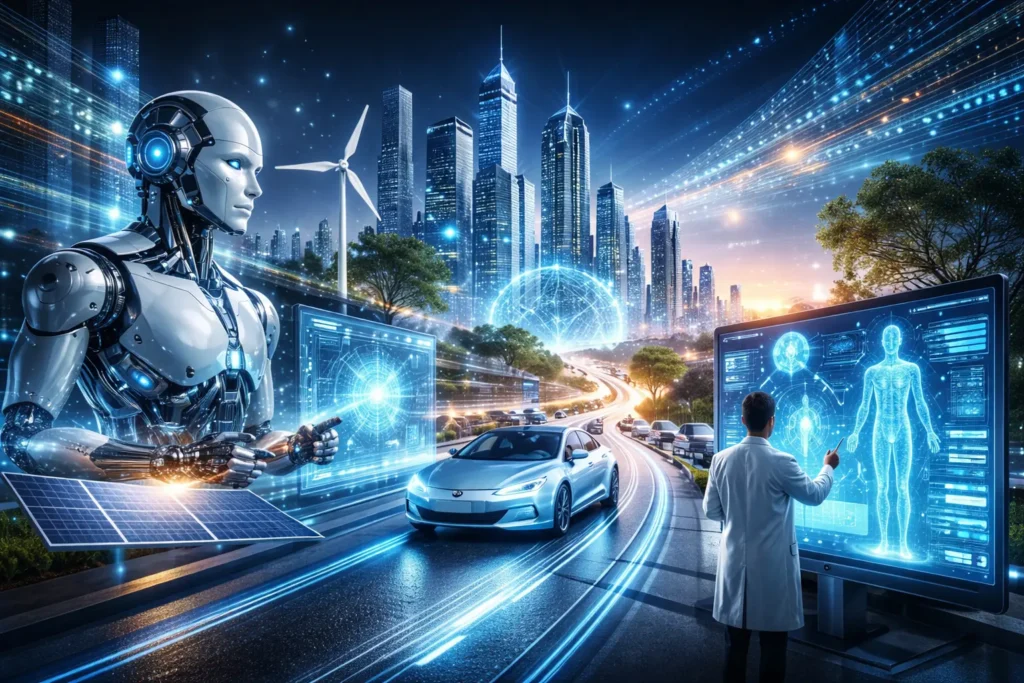
As transformative as current applications are, emerging technologies promise even more profound changes. Artificial general intelligence (AGI)—AI systems with human-like reasoning across domains—could revolutionize virtually every field simultaneously. Advanced robotics will bring physical automation to tasks currently requiring human dexterity and decision-making.
Hyper-connectivity through advanced networks will enable applications we can barely imagine today. Quantum computing may solve problems currently beyond our capabilities, from drug discovery to climate modeling. Biotechnology applications could extend lifespans, eliminate diseases, and enhance human capabilities.
However, these advances raise ethical questions that society must address. How do we ensure AI systems remain aligned with human values? How can we manage job displacement from automation? How do we protect privacy in an increasingly monitored world? How do we ensure equitable access to technology’s benefits?
Sustainable technology development is crucial. As applications multiply, their environmental impact—from energy consumption to electronic waste—must be carefully managed. The goal should be technology that improves human welfare without compromising planetary health.
FAQS
What is the meaning of “application of technology”?
Application of technology refers to the practical implementation of technological innovations to solve real-world problems or achieve specific goals. It encompasses how we use technologies like AI, IoT, cloud computing, and mobile platforms in our daily lives, businesses, education, and other sectors.
What are some practical applications of artificial intelligence (AI) today?
AI is used in personalized product recommendations, fraud detection in banking, virtual assistants, medical diagnostics, autonomous vehicles, facial recognition, content moderation, and predictive maintenance. Machine learning powers spam filters, search engines, and translation services we use daily.
How is technology used in the travel industry?
The travel industry uses online and mobile check-in, automated bag drop systems, electronic boarding passes, smart ticketing for public transport, real-time GPS tracking, and travel apps providing journey information. These applications reduce wait times, improve convenience, and optimize operations.
What are the main benefits of smart home technology?
Smart home technology offers convenience through voice and remote control, energy and cost savings through automated optimization, enhanced security with cameras and smart locks, safety improvements with smoke detectors and leak sensors, and remote monitoring capabilities for peace of mind.
What are the disadvantages or risks of using smart devices?
Key concerns include high initial costs, privacy risks from constant data collection, security vulnerabilities to hacking, dependence on internet connectivity, compatibility issues between different manufacturers, and setup complexity. These devices also raise questions about who controls your data and how it’s used.
How is technology changing the way we learn?
Technology enables online learning platforms, personalized adaptive learning systems, interactive simulations, and instant access to information. However, it also raises concerns about cognitive load, digital distractions, reduced development of foundational skills, and unequal access creating a digital divide.
What is the Internet of Things (IoT) and how is it applied?
IoT refers to networks of physical devices with sensors and connectivity that collect and exchange data. Applications include smart home devices, industrial equipment monitoring, precision agriculture, smart cities, wearable health trackers, and connected vehicles. IoT enables automation, optimization, and data-driven decision making.
How are businesses using technology to improve customer service?
Businesses use AI-powered chatbots for 24/7 support, CRM systems to track customer interactions, personalized recommendations based on behavior analysis, self-service portals for quick issue resolution, and predictive analytics to anticipate customer needs. These applications improve response times while reducing costs.
What is fintech and how is it used in banking?
Fintech (financial technology) encompasses mobile banking apps, contactless payments, digital wallets, cryptocurrency, blockchain, AI-powered fraud detection, automated credit scoring, and personal finance management tools. These applications make banking more convenient, secure, and accessible while reducing operational costs.
What are the ethical concerns surrounding new technology applications?
Major ethical concerns include privacy invasion through data collection, algorithmic bias in AI systems, job displacement from automation, the digital divide creating inequality, environmental impact from energy consumption and e-waste, potential for surveillance and control, and ensuring technology remains aligned with human values as it becomes more powerful.
Can technology replace teachers in the classroom?
While technology can deliver content and assess learning, it cannot fully replace teachers. Human educators provide mentorship, emotional support, motivation, adaptive instruction based on subtle cues, and social modeling that technology cannot replicate. The most effective approach uses technology to augment rather than replace teachers.
How can I protect my privacy when using smart home devices?
Use strong, unique passwords for all devices. Enable two-factor authentication. Regularly update firmware. Review and limit data sharing permissions. Use separate networks for IoT devices. Disable cameras and microphones when not needed. Research manufacturers’ privacy policies before purchase. Consider devices with local processing rather than cloud-dependent features.
Conclusion
The application of technology has become inseparable from modern life. From smart homes that respond to our voices to AI systems making billion-dollar business decisions, from automated travel processes to personalized learning platforms, technology applications touch virtually every aspect of human activity.
The benefits are substantial: unprecedented convenience, dramatic efficiency gains, enhanced safety and security, personalized experiences, and access to information and services once available only to the privileged few. Technology has democratized capabilities while creating entirely new possibilities.
Yet these same applications present real challenges. Privacy erosion, security vulnerabilities, job displacement, the digital divide, and questions about how technology shapes human cognition and society demand serious attention. The goal is not to reject technology but to implement it thoughtfully, with clear understanding of both benefits and risks.
As we look toward the future, the pace of technological change will likely accelerate. Success will require not just technical innovation but wisdom in application—ensuring technology serves human flourishing rather than becoming an end in itself. The most important application of technology may ultimately be applying our judgment about when, where, and how to use it.
Which application of technology do you think will have the biggest impact on your life in the coming years? And more importantly, how will you ensure that impact is positive?

Adrian Cole is a technology researcher and AI content specialist with more than seven years of experience studying automation, machine learning models, and digital innovation. He has worked with multiple tech startups as a consultant, helping them adopt smarter tools and build data-driven systems. Adrian writes simple, clear, and practical explanations of complex tech topics so readers can easily understand the future of AI.