
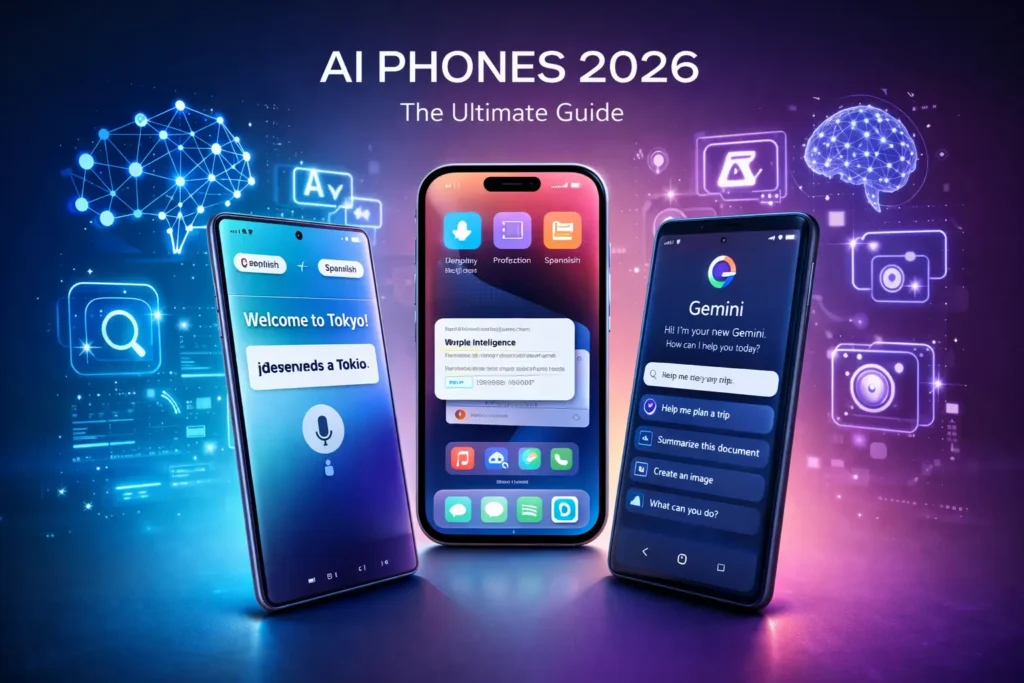
The smartphone revolution has entered a new era. In 2026, AI phones are transforming how we communicate, create, and interact with technology. Unlike traditional smartphones that rely on basic automation, AI smartphones leverage advanced machine learning algorithms, large language models (LLMs), and dedicated neural processing units (NPUs) to deliver a truly personalized experience.
From real-time language translation to computational photography that rivals professional cameras, AI features are redefining what’s possible in your pocket. This comprehensive guide will explain what makes AI phones unique, explore the revolutionary features that set them apart, compare the top models from Samsung, Apple, Google, and other leading brands, and help you choose the perfect AI smartphone for your needs.
What is an AI Phone? How Does It Work?
Beyond a Voice Assistant: The AI Smartphone Explained
An AI phone is more than a smartphone with Siri or Google Assistant. It’s a device built from the ground up to integrate artificial intelligence into every aspect of your daily life. While traditional smartphones process tasks using standard CPU and GPU combinations, AI smartphones feature dedicated AI processors or neural processing units (NPUs) that can perform trillions of operations per second specifically optimized for AI workloads.
The key distinction lies in how these phones process information. Many AI features run on-device rather than in the cloud, meaning your data stays on your phone for faster processing and enhanced privacy. This on-device AI capability enables real-time language translation during calls, instant photo editing with generative AI, and personalized recommendations that learn from your usage patterns—all without sending your sensitive information to remote servers.
Core AI Technologies Powering Your Phone
Think of an AI phone’s neural processing unit as a specialized brain designed exclusively for artificial intelligence tasks. Unlike general-purpose processors that handle everything from gaming to web browsing, the NPU focuses solely on AI computations like image recognition, natural language processing, and predictive analytics.
Modern AI phones leverage three core technologies:
Machine Learning: Your phone learns from your behavior, adapting features like battery optimization, app suggestions, and notification priorities based on your usage patterns. Over time, your device becomes more intuitive and personalized.
Large Language Models (LLMs): Advanced AI models like Google Gemini, Apple Intelligence, and Samsung’s integration with various LLMs enable your phone to understand context, generate human-like text, and assist with complex writing tasks. These models power features like email composition, document summarization, and intelligent search.
Computational Photography: AI doesn’t just capture photos—it understands them. Scene detection automatically adjusts camera settings for portraits, landscapes, or food. Night mode uses AI to combine multiple exposures for stunning low-light photos. Generative AI can even remove unwanted objects or enhance image quality beyond what the camera sensor physically captures.
Top AI Phone Features That Change How You Use Your Phone
Revolutionary AI Camera & Photography
The camera is where AI truly shines. Modern AI phones have transformed mobile photography from point-and-shoot simplicity to professional-grade creativity.
Scene Detection & Optimization: Your phone instantly recognizes what you’re photographing—whether it’s a sunset, a plate of food, or a portrait—and automatically adjusts settings for optimal results. This eliminates the guesswork from photography.
Generative Edit & Object Removal: Remove photobombers, power lines, or unwanted objects from your photos with a simple tap. AI analyzes the scene and intelligently fills in the background, creating seamless edits that look completely natural. Samsung’s Generative Edit and Google’s Magic Editor make professional photo editing accessible to everyone.
Enhanced Portrait & Night Mode: AI-powered portrait mode creates beautiful depth effects with precise edge detection, while night mode captures stunning low-light photos by intelligently combining multiple exposures and reducing noise.
Real-World Example: You’re at a family gathering and capture a perfect moment, but a stranger walked into the frame. With Generative Edit, you simply circle the unwanted person, tap remove, and your phone seamlessly fills in the background as if they were never there.
Effortless Communication & Translation
Language barriers are dissolving thanks to AI-powered communication features that work in real-time.
Live Translate: Make phone calls in different languages with real-time, two-way translation. Samsung’s Live Translate feature allows you to speak in your language while the other person hears it in theirs—and vice versa. This works entirely on-device for maximum privacy.
Interpreter Mode: Have face-to-face conversations with people who speak different languages. Your phone displays translated text in split-screen mode, making in-person communication seamless.
Writing Assist & Smart Compose: Compose emails, messages, and documents with AI assistance. The phone suggests complete sentences, adjusts tone (formal, casual, friendly), checks grammar, and even generates entire drafts based on brief prompts.
Call Transcripts: AI automatically transcribes phone calls, making it easy to review important conversations, capture details, or share information without taking notes.
Real-World Example: You’re traveling abroad and need to book a restaurant. With Live Translate, you call the restaurant directly, speak English, and they hear your request in their native language—all in real-time without any awkward pauses.
Smarter Productivity & Search
AI phones revolutionize how you find information and stay organized.
Circle to Search: See something interesting on your screen? Simply circle it with your finger to instantly search for it without switching apps. This Google-powered feature works across photos, videos, and social media posts.
Note Assist & Smart Summaries: AI automatically formats your notes, creates summaries of long documents, generates to-do lists from meeting transcripts, and even translates notes into different languages.
Personalized Briefing: Your phone learns your interests and routines, delivering personalized news summaries, weather updates, and calendar reminders exactly when you need them.
Magic Portal (HONOR): Drag content between apps intelligently. Drag a restaurant name from a message directly into your maps app, or move a photo into an email with contextual understanding.
Real-World Example: You’re scrolling through Instagram and see a dress you love but don’t know the brand. Simply circle the dress with your finger, and Circle to Search identifies it, shows you where to buy it, and even finds similar styles at different price points.
Creative Tools at Your Fingertips
AI empowers creativity by handling the technical complexity, letting you focus on your artistic vision.
Audio Eraser: Remove unwanted background noise from videos—traffic sounds, wind, crowd noise—while preserving voices and important audio. Google’s Pixel phones excel at this feature.
Generative Fill & Expansion: Extend photos beyond their original frame, change backgrounds entirely, or generate new content to fill empty spaces in your compositions.
Automatic Highlight Reels: AI analyzes your photos and videos, identifying the best moments and automatically creating engaging highlight reels with music, transitions, and effects.
Real-World Example: You recorded your child’s school play, but the audio is full of coughing and rustling from the audience. Audio Eraser removes these distractions, leaving only your child’s voice and the performance music.
Top AI Phones of 2026: Detailed Comparison
Choosing the right AI phone depends on your priorities—camera quality, ecosystem preference, battery life, or specific AI features. Here’s a comprehensive breakdown of the leading models.
| Model | Key AI Features | Processor | Highlight Spec | Starting Price |
| Samsung Galaxy S25 Ultra | Galaxy AI, Live Translate, Generative Edit, Audio Eraser, Circle to Search | Snapdragon 8 Gen 3 | 200MP camera, S-Pen AI features, 5000mAh battery | $1,299 / PKR 360,000 |
| Apple iPhone 16 Pro Max | Apple Intelligence, Writing Tools, Clean Up, Visual Intelligence | A18 Pro | 48MP Fusion camera, Action button, Titanium design | $1,199 / PKR 480,000 |
| Google Pixel 9 Pro XL | Gemini AI, Magic Editor, Best Take, Audio Magic Eraser | Google Tensor G4 | 50MP camera, 7 years of updates, Pure Android experience | $999 / PKR 350,000 |
| HONOR Magic6 Pro | MagicOS AI, Magic Portal, AI Motion Sensing, Smart Translation | Snapdragon 8 Gen 3 | 180MP camera, 5600mAh battery, 80W fast charging | $1,099 / PKR 320,000 |
Samsung Galaxy S25 Ultra – The AI Powerhouse
The Samsung Galaxy S25 Ultra represents the pinnacle of AI smartphone technology, combining Samsung’s comprehensive Galaxy AI suite with flagship hardware. The S25 Ultra’s Snapdragon 8 Gen 3 processor includes an advanced NPU capable of 45 trillion operations per second, enabling sophisticated on-device AI processing.
Standout AI Features:
S-Pen AI Integration: The included S-Pen becomes an AI powerhouse with features like sketch-to-image generation, handwriting-to-text conversion with formatting, and smart selection that understands context.
Live Translate: Real-time phone call translation in 13 languages, working entirely on-device for privacy. The feature even translates text messages and captions in real-time.
Generative Edit: Advanced photo editing that can remove objects, fill backgrounds intelligently, and even adjust subject positioning within photos.
Note Assist: Automatically formats notes, creates summaries, and generates translations. Perfect for students and professionals.
Best For: Power users who want the most comprehensive AI feature set, photographers who demand the best camera system (200MP primary sensor), and Samsung ecosystem users. The S-Pen makes it ideal for creatives and note-takers.
Apple iPhone 16 Pro Max – Privacy-First Intelligence
Apple’s approach to AI prioritizes privacy and seamless integration across its ecosystem. Apple Intelligence, powered by the A18 Pro chip, processes most AI tasks directly on your device, with optional Private Cloud Compute for more intensive operations that still maintains end-to-end encryption.
Standout AI Features:
Writing Tools: System-wide writing assistance that can rewrite text in different tones, proofread with explanations, and summarize content. Works across all apps, from Messages to Notes to third-party applications.
Clean Up (Photo Tool): Intelligently remove unwanted objects from photos with a single tap, similar to Samsung’s Generative Edit but with Apple’s signature simplicity.
Visual Intelligence: Point your camera at objects, text, or landmarks to get instant information, translations, or contextual actions. It’s like having a visual search engine built into your camera.
Siri Enhancements: Siri now understands context better, maintains conversation flow, and can perform complex multi-step tasks across apps.
Best For: Privacy-conscious users, Apple ecosystem loyalists who value seamless integration across iPhone, iPad, and Mac, and users who prefer a curated, refined AI experience over exhaustive features. The iPhone 16 Pro Max excels in video recording with advanced stabilization and AI-enhanced audio.
Google Pixel 9 Pro XL – The Pure Android AI Experience
Google’s Pixel lineup has always showcased the best of Android, and the Pixel 9 Pro XL takes this to new heights with deep Google Gemini integration. The custom Tensor G4 chip is specifically designed for AI and machine learning workloads, making the Pixel 9 Pro XL incredibly intelligent despite not having the highest benchmarks scores.
Standout AI Features:
Gemini Integration: Google’s advanced AI assistant is deeply integrated into the Pixel experience. It can help with complex research, generate content, analyze images, and even control smart home devices with natural language.
Magic Editor: Google’s most advanced photo editing tool can change lighting conditions, move subjects, expand backgrounds, and apply complex edits that would require professional software on other devices.
Best Take: Combines multiple photos from a burst to ensure everyone in a group photo looks their best. No more choosing between photos where one person is blinking.
Audio Magic Eraser: Industry-leading noise reduction for videos. Remove wind, traffic, or crowd noise while preserving dialogue and important sounds.
Call Screen: AI answers calls for you, screens spam, and provides a transcript of what the caller wants before you decide to answer.
Best For: Android purists who want the latest Google features first, photography enthusiasts who value computational photography over hardware specs, and users who appreciate AI assistants that genuinely understand context. The Pixel 9 Pro XL also offers an unmatched 7 years of software updates.
Best of the Rest: HONOR, Xiaomi & More
While Samsung, Apple, and Google dominate headlines, several other manufacturers are delivering exceptional AI experiences:
HONOR Magic6 Pro: HONOR’s flagship features MagicOS AI with unique features like Magic Portal, which uses AI to understand content and intelligently drag it between apps. The 180MP camera rivals anything on the market, and the 5600mAh battery with 80W fast charging addresses a common pain point. HONOR’s AI Motion Sensing can detect gestures and adjust the interface accordingly, making it excellent for accessibility.
Xiaomi 14 Ultra: Developed in partnership with Leica, the Xiaomi 14 Ultra delivers professional-grade photography with AI enhancement. Its HyperOS AI features smart suggestions, device optimization, and impressive translation capabilities. The price-to-performance ratio makes it an attractive flagship alternative.
OnePlus 12: OnePlus combines fast performance with practical AI features like Smart Image Matting (precise subject extraction), AI Eraser for photos, and AI-powered battery optimization. It’s priced more aggressively than flagship competitors while still offering a premium experience.
Oppo Find X7 Ultra: Oppo’s flagship excels in photography with a quad-camera system featuring two periscope telephoto lenses. AI features include AI Portrait Retouching, AI Best Face (similar to Pixel’s Best Take), and AI Linking for cross-device integration.
AI Phone Buying Guide: What to Consider
Choosing the right AI phone requires understanding your priorities and how different AI implementations align with your needs.
On-Device AI vs. Cloud AI: Why Privacy Matters
Not all AI is created equal when it comes to privacy and performance. Understanding the difference between on-device AI and cloud-based AI is crucial.
On-Device AI processes everything locally on your phone’s NPU without sending data to remote servers. This approach offers:
Enhanced Privacy: Your photos, messages, and personal data never leave your device. Features like Samsung’s Live Translate and Apple Intelligence operate entirely on-device.
Faster Response: No network latency means instant results, which is crucial for real-time features like translation or photo editing.
Offline Functionality: Many AI features work without an internet connection, perfect for travel or areas with poor connectivity.
Cloud-Based AI sends data to powerful remote servers for processing. This approach enables:
More Powerful Processing: Cloud servers can handle more complex AI tasks that might be too intensive for mobile hardware.
Constant Improvement: Models can be updated and improved without phone updates.
Lower Battery Drain: Offloading processing saves battery life.
Security Best Practices:
Look for phones with Personal Data Engines that learn your preferences locally without cloud uploads. Samsung’s Knox Security and Apple’s on-device processing set the gold standard. Verify that sensitive AI features like financial data analysis, health monitoring, and personal communications use data encryption and offer clear privacy controls.
Matching AI Features to Your Needs
Different users benefit from different AI capabilities. Here’s how to match features to your lifestyle:
For Content Creators & Photographers:
Prioritize: Advanced AI camera features (Generative Edit, Magic Editor, scene optimization), Audio Eraser for video content, automated highlight reel creation, and powerful photo processing. Best Choices: Samsung Galaxy S25 Ultra (versatility), Google Pixel 9 Pro XL (computational photography), Xiaomi 14 Ultra (Leica partnership).
For International Travelers & Multilingual Users:
Prioritize: Live Translate for phone calls, Interpreter mode for face-to-face conversations, offline language support, and text translation across apps. Best Choices: Samsung Galaxy S25 Ultra (13 languages for Live Translate), HONOR Magic6 Pro (Smart Translation), Google Pixel 9 Pro XL (Gemini translation).
For Productivity & Professionals:
Prioritize: Writing Assist and smart compose, Note Assist with summaries, Circle to Search for research, call transcription, and cross-device integration. Best Choices: Apple iPhone 16 Pro Max (ecosystem integration), Samsung Galaxy S25 Ultra (S-Pen + Note Assist), Google Pixel 9 Pro XL (Gemini assistant).
For Privacy-Conscious Users:
Prioritize: On-device AI processing, transparent privacy controls, minimal cloud dependencies, and encrypted data handling. Best Choices: Apple iPhone 16 Pro Max (Apple Intelligence privacy-first design), Samsung Galaxy S25 Ultra (Knox Security + on-device features).
For Budget-Conscious Buyers:
Prioritize: Core AI features without flagship pricing, good software update commitments, and battery optimization. Best Choices: Google Pixel 8a (mid-range with flagship AI), OnePlus 12 (aggressive pricing), Samsung Galaxy A series (trickle-down AI features).
Understanding Pricing and Value
AI phone pricing varies significantly based on brand positioning, hardware specifications, and AI capabilities. Here’s what to expect in different segments:
Flagship Segment ($1,000-$1,500 / PKR 280,000-420,000):
These devices offer the complete AI experience with cutting-edge processors, maximum RAM, and all available AI features. Samsung Galaxy S25 Ultra, Apple iPhone 16 Pro Max, and Google Pixel 9 Pro XL fall into this category. You’re paying for premium materials, best-in-class cameras, and the newest AI innovations.
Upper Mid-Range ($600-$999 / PKR 170,000-280,000):
Excellent value proposition with 70-80% of flagship AI features at significantly lower prices. HONOR Magic6 Pro, OnePlus 12, and Xiaomi 14 deliver impressive AI capabilities without the premium brand tax. This segment is ideal for most users who want capable AI features without overspending.
Mid-Range ($400-$599 / PKR 110,000-170,000):
Selective AI features with focus on practical applications. Google Pixel 8a and Samsung Galaxy A55 bring essential AI capabilities like photo enhancement, basic scene detection, and smart battery optimization to affordable devices. Some advanced features may be limited or cloud-dependent.
Regional Pricing Considerations:
Pricing varies significantly by region. Pakistani buyers often face higher prices due to import duties and taxes, while UAE and UK markets may have more competitive pricing. Consider:
Warranty and official support availability in your region
Currency exchange fluctuations for imported devices
Local carrier compatibility and 5G band support
Software update commitment (affects long-term value)
FAQs
What is the difference between a regular smartphone and an AI phone?
Regular smartphones include basic AI features like voice assistants and auto-correct, but AI phones have dedicated neural processing units (NPUs) that enable advanced on-device machine learning. This powers features like real-time language translation, computational photography, predictive text that understands context, and adaptive battery optimization. AI phones learn from your behavior and proactively assist rather than just responding to commands.
Are AI features safe, and is my data private?
Privacy depends on implementation. Leading AI phones like the iPhone 16 Pro Max and Samsung Galaxy S25 Ultra prioritize on-device AI processing, meaning your data stays on your phone. Features are protected by data encryption and personal data engines that learn locally. Apple uses Private Cloud Compute for intensive tasks that still maintains end-to-end encryption. Samsung’s Knox Security provides military-grade protection. Always check AI feature privacy settings and verify which functions require cloud processing.
Which AI phone has the best camera for photography?
It depends on your priorities. The Samsung Galaxy S25 Ultra offers the highest resolution (200MP) with extensive AI editing tools including Generative Edit and Audio Eraser. The Google Pixel 9 Pro XL excels in computational photography with Magic Editor and the best low-light performance. The iPhone 16 Pro Max delivers exceptional video with advanced stabilization and the most natural color science. For versatility and editing power, choose Samsung. For point-and-shoot excellence and computational wizardry, choose Pixel. For video and ecosystem integration, choose iPhone.
Do I need an internet connection for all AI features to work?
Many core AI features work offline, especially on phones with powerful NPUs. Samsung’s Live Translate, most photo editing features, voice assistants with on-device processing, and battery optimization all function without internet. However, features requiring large language models like ChatGPT integration, web-based search within AI assistants, and some advanced image generation may need connectivity. Cloud-based features like Google’s Gemini advanced queries and syncing across devices require internet but offer more powerful processing.
What are the best budget or mid-range AI phones?
The Google Pixel 8a ($499/PKR 140,000) offers the best mid-range AI experience with features trickling down from flagship Pixels, including Magic Editor, Call Screen, and 7 years of updates. The Samsung Galaxy A55 ($450/PKR 125,000) brings Galaxy AI features like Circle to Search and photo enhancement to affordable pricing. The OnePlus Nord 3 ($400/PKR 110,000) delivers solid AI-powered battery optimization and decent computational photography. For the absolute best value in AI capabilities without flagship pricing, the Pixel 8a is unbeatable.
Conclusion: The AI Phone Revolution is Here
AI phones represent more than an incremental upgrade—they’re a fundamental reimagining of what smartphones can do. Whether you’re a photographer seeking the perfect shot, a traveler breaking down language barriers, a professional maximizing productivity, or simply someone who wants a phone that truly understands and anticipates your needs, there’s an AI phone designed for you.
The Samsung Galaxy S25 Ultra delivers the most comprehensive AI suite with exceptional versatility. The Apple iPhone 16 Pro Max prioritizes privacy and seamless ecosystem integration. The Google Pixel 9 Pro XL showcases the purest Android AI experience with industry-leading computational photography. Meanwhile, brands like HONOR, Xiaomi, and OnePlus prove that flagship AI capabilities are increasingly accessible at mid-range prices.
As AI technology continues evolving, these devices will only become more capable through software updates. The investment you make today in an AI phone isn’t just about current features—it’s about future-proofing your mobile experience for the AI-driven era ahead.
Ready to experience the future of mobile technology? Choose the AI phone that matches your priorities and discover a smarter, more intuitive way to stay connected.
Last Updated: January 2026

Adrian Cole is a technology researcher and AI content specialist with more than seven years of experience studying automation, machine learning models, and digital innovation. He has worked with multiple tech startups as a consultant, helping them adopt smarter tools and build data-driven systems. Adrian writes simple, clear, and practical explanations of complex tech topics so readers can easily understand the future of AI.