
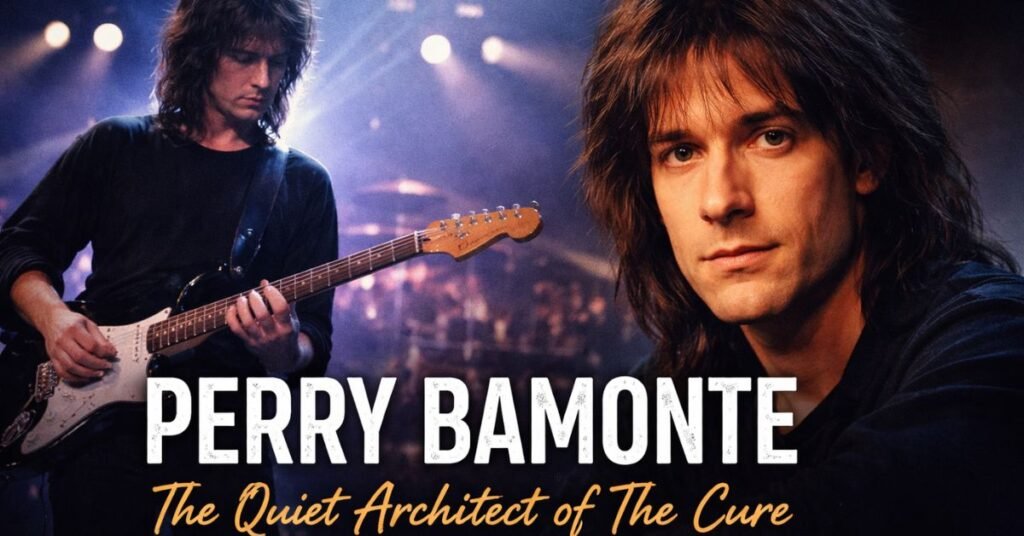
If you’ve ever listened to a The Cure song and felt that layered, almost cinematic atmosphere wrap around you—like sound filling every empty corner of a room—there’s a strong chance perry bamonte had something to do with it. Within the first few minutes of revisiting The Cure’s late-80s and 90s live performances, his fingerprints are unmistakable. Subtle. Precise. Emotionally intelligent.
Perry Bamonte may never have chased the spotlight the way some rock musicians do, but his contribution to one of the most influential bands in alternative music history is deep, meaningful, and long-lasting. His recent passing has pushed many longtime fans to pause, reflect, and finally ask a question that should’ve been asked years ago: Who exactly was Perry Bamonte, and why did his work matter so much?
In this in-depth guide, I’ll walk you through his story—not as a headline, but as a craftsman. You’ll understand who he was, how he shaped The Cure’s sound, what musicians can learn from his approach, and why his legacy deserves careful attention, not just a footnote.
Introduction: Why Perry Bamonte’s Story Still Matters
Some musicians shout their presence. Others whisper—and somehow, the whisper lasts longer.
That was Perry Bamonte.
When news broke of his death, many fans realized they’d spent decades hearing his work without fully knowing his name. That’s not a failure of recognition—it’s a testament to how seamlessly he served the music rather than himself.
Today, in an era of viral solos and algorithm-driven stardom, Perry Bamonte represents something increasingly rare:
a musician who understood restraint, texture, and emotional timing better than flash.
By the end of this article, you’ll understand:
- Who Perry Bamonte was beyond the headlines
- How his musicianship shaped The Cure’s live and studio sound
- The real-world lessons his career offers to musicians, producers, and creatives
- Why his legacy deserves renewed respect
Who Was Perry Bamonte? A Clear, Human Explanation
Perry Bamonte was a British musician best known as a guitarist and keyboardist for The Cure during some of their most sonically ambitious years.
But labeling him as “just another band member” misses the point.
Perry wasn’t there to dominate the sound—he was there to complete it.
His Role in Simple Terms
Think of The Cure’s music like a painting:
- Robert Smith provided the main subject and emotional core
- Simon Gallup laid down the frame with bass
- Perry Bamonte added depth, shading, and atmosphere
He often handled:
- Additional guitar layers
- Keyboard textures
- Sound reinforcement during live performances
- Musical continuity during complex arrangements
He was especially vital in live shows, where The Cure’s densely layered studio tracks needed to be translated into something powerful and faithful on stage.
How Perry Bamonte Fit Into The Cure’s Evolution
To understand Perry Bamonte’s importance, you need to understand when he joined The Cure.
By the late 1980s:
- The Cure had already achieved massive success
- Their songs had grown more layered and atmospheric
- Live performances demanded technical precision
Perry joined at a time when the band needed musical glue—someone who could:
- Fill sonic gaps
- Reinforce melodies without overpowering them
- Shift between guitar and keyboards effortlessly
And he did exactly that.
Why His Timing Mattered
This era included songs that relied heavily on:
- Overlapping guitar lines
- Ambient keyboard pads
- Emotional pacing rather than raw aggression
Without musicians like Perry Bamonte, much of that material would have sounded thin or incomplete live.
Benefits & Real-World Use Cases of Perry Bamonte’s Approach
Let’s move beyond biography and talk practical value—especially if you’re a musician, producer, or creative professional.
What Perry Bamonte Did Exceptionally Well
His approach offers several real-world lessons:
- Musical restraint:
He played only what the song needed, nothing more. - Layer awareness:
He understood how multiple parts interact in a mix. - Live adaptability:
Switching instruments smoothly under pressure. - Ego-free collaboration:
Supporting the band’s vision instead of chasing attention.
Who Can Learn Most from His Style
Perry Bamonte’s career is especially valuable for:
- Session musicians
- Live performers in large bands
- Guitarists learning atmospheric playing
- Keyboardists working in rock contexts
- Producers focused on texture and mood
Who Might Struggle With This Approach
This style isn’t ideal if you:
- Prefer solo-driven, spotlight-heavy music
- Thrive on improvisational chaos
- Need constant audience attention
Perry’s brilliance came from precision, not flash.
Step-by-Step: How Perry Bamonte Built Atmospheric Soundscapes
If you’ve ever wondered how musicians like Perry Bamonte achieved such depth without clutter, here’s a simplified breakdown.
Step 1: Understand the Song’s Emotional Center
Before touching an instrument, Perry focused on:
- The emotional tone
- The lyrical mood
- The dynamic arc of the song
Tip: Ask, “What emotion is missing?” instead of “What can I play?”
Step 2: Choose Complementary Tones, Not Competing Ones
He avoided stepping on:
- Lead vocals
- Primary guitar riffs
Instead, he used:
- Chorus and delay effects
- Clean or lightly driven tones
- Keyboard pads that breathed
Step 3: Play Fewer Notes, More Sustain
Sustain and space were his allies.
Best practices:
- Let chords ring
- Avoid unnecessary fills
- Trust silence
Step 4: Adapt Live Without Overthinking
Live performance is unforgiving. Perry mastered:
- Smooth transitions between guitar and keys
- Locking into tempo-driven cues
- Staying invisible while essential
Tools, Gear & Musical Choices Perry Bamonte Favored
While Perry Bamonte never marketed himself as a gear guru, his choices reflected practicality over hype.
Instruments & Sound Philosophy
Rather than chasing rare gear, he focused on:
- Reliable guitars
- Consistent keyboard tones
- Effects that enhanced mood, not volume
Free vs Paid Tools (For Modern Musicians)
If you’re inspired by his sound today:
- Free options:
- DAW stock reverbs
- Basic delay plugins
- Paid options:
- Ambient reverb suites
- Chorus and modulation pedals
Expert recommendation:
Invest in control, not complexity. Perry’s sound was intentional, not excessive.
Common Mistakes Musicians Make (And How Perry Avoided Them)
Mistake 1: Overplaying
Why it happens:
Insecurity or excitement.
Fix:
Listen twice, play once.
Mistake 2: Competing for Sonic Space
Why it happens:
Lack of arrangement awareness.
Fix:
Assign each instrument a role.
Mistake 3: Ignoring Live Practicality
Why it happens:
Studio-first thinking.
Fix:
Rehearse transitions relentlessly.
Perry Bamonte avoided all three—not by accident, but by discipline.
Perry Bamonte’s Legacy: Quiet, But Immense
Perry Bamonte’s death marks the loss of a musician who understood something many never learn:
Music isn’t about being heard—it’s about being felt.
He didn’t chase fame.
He didn’t dominate interviews.
He didn’t overplay.
And because of that, his work still resonates.
In a band as emotionally rich as The Cure, Perry Bamonte was the unseen architect—holding up the structure so the emotions could soar.
Conclusion: Why Perry Bamonte Will Always Matter
To truly appreciate perry bamonte, you have to listen differently.
Listen for:
- The space between notes
- The emotional undercurrent
- The layers that don’t announce themselves
His career reminds us that not all legends stand in the spotlight. Some stand just off to the side, making sure the music never collapses.
If you’re a musician, learn from his restraint.
If you’re a fan, revisit the songs with fresh ears.
If you’re discovering him for the first time—welcome. You’ve just uncovered one of alternative music’s quiet pillars.
FAQs About Perry Bamonte
1. Who was Perry Bamonte?
Perry Bamonte was a guitarist and keyboardist best known for his work with The Cure during their late 1980s and 1990s era.
2. Why is Perry Bamonte important to The Cure?
He played a crucial role in translating the band’s layered studio sound into powerful live performances.
3. What instruments did Perry Bamonte play?
He primarily played guitar and keyboards, often switching seamlessly during live shows.
4. Was Perry Bamonte a founding member of The Cure?
No, he joined later but became essential during a highly creative period.
5. What made his playing style unique?
Restraint, atmosphere, and emotional awareness defined his approach.
6. Did Perry Bamonte write songs?
He contributed musically rather than as a primary songwriter, focusing on arrangement and texture.
7. What can musicians learn from Perry Bamonte?
That subtlety, discipline, and listening often matter more than technical flash.
8. How should new fans explore his work?
Start with live performances from The Cure’s late 80s and 90s and listen closely to the layers.

Hannah Price is a digital journalist who covers breaking news, global events, and trending stories with accuracy and speed. She has previously contributed to several online magazines and has built a reputation for verifying facts before publishing. Hannah believes in responsible reporting and aims to present stories in a way that readers can trust.