If you’ve ever Googled a plumber, searched for a café near you, or checked reviews before hiring a contractor, you’ve already used a business directory — even if you didn’t realize it.
So what is a business directory, really?
At its core, a business directory is an online or offline listing platform that organizes businesses by category, location, industry, or service so customers can easily find and contact them. Think of it as the digital evolution of the old Yellow Pages — but smarter, searchable, and often review-driven.
In today’s digital-first world, business directories are more than simple listings. They influence local SEO rankings, build trust, drive targeted traffic, and help small businesses compete with larger brands. Whether you’re a startup founder, local service provider, marketing agency, or someone exploring online visibility strategies, understanding how business directories work can unlock serious growth opportunities.
In this in-depth guide, you’ll learn:
- Exactly what a business directory is (in plain English)
- The different types of directories
- Why they matter for SEO and visibility
- How to use them strategically
- The tools that help manage listings
- Common mistakes to avoid
- And practical, real-world examples that actually make sense
Let’s break it down properly.
What Is a Business Directory? A Beginner-Friendly Explanation
A business directory is a structured platform that lists businesses along with essential information such as:
- Business name
- Address
- Phone number
- Website
- Operating hours
- Services offered
- Reviews and ratings
If you imagine the internet as a giant city, business directories are the organized maps and street guides that help people find specific shops, services, or professionals.
In simple terms:
A business directory connects customers searching for services with businesses that provide them.
Before the internet, physical directories like printed Yellow Pages were the main source of business discovery. Today, online business directories have replaced them — and they’re far more powerful because they integrate search engines, customer reviews, maps, and sometimes booking systems.
Here’s an analogy:
If your website is your house, a business directory is the road sign pointing people toward it.
Without that sign, fewer people know you exist.
With multiple well-placed signs? You get consistent traffic.
Modern business directories aren’t just databases. They act as:
- Discovery engines
- Reputation platforms
- SEO signals for Google
- Lead generation channels
And that’s where things get interesting.
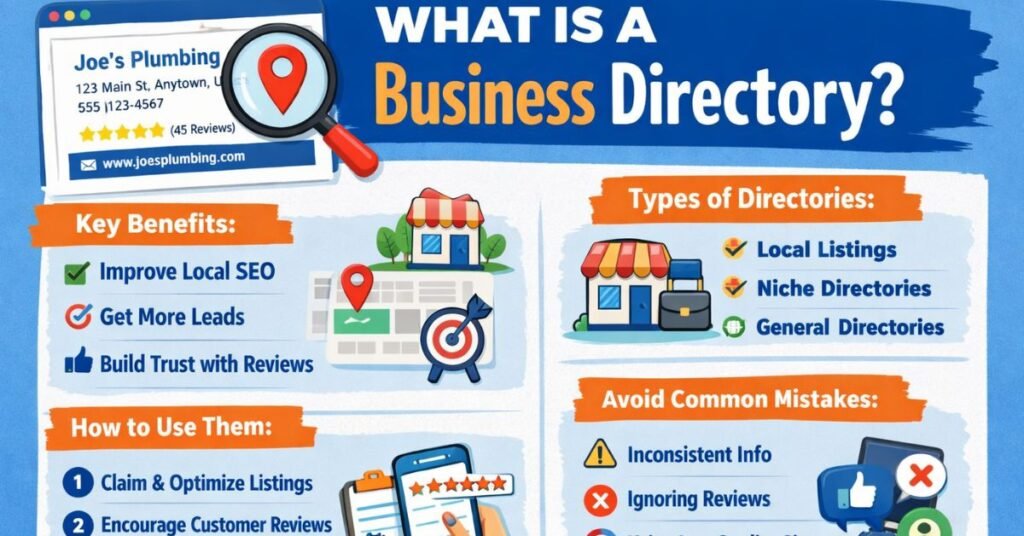
Types of Business Directories (Not All Are the Same)
When people ask what is a business directory, they often assume there’s only one type. In reality, there are several categories, each serving a different purpose.
Understanding these differences helps you choose the right platforms for your business.
General Business Directories
These list businesses across multiple industries and locations. They’re broad and accessible to almost any company.
Examples include platforms like Yelp or Yellow Pages. These directories:
- Organize listings by category and location
- Allow customer reviews
- Often rank well in Google search results
Best for: Local businesses, service providers, restaurants, retail stores.
Local Business Directories
These focus specifically on businesses within a geographic area. They are especially powerful for local SEO.
For example, city-specific directories or chamber of commerce listings.
Best for:
- Small local businesses
- Service-area businesses (plumbing, cleaning, landscaping)
- Brick-and-mortar stores
Niche or Industry-Specific Directories
These target specific professions or industries.
Examples:
- Legal directories for lawyers
- Healthcare directories for doctors
- Real estate listing directories
- B2B supplier directories
These are powerful because they attract highly targeted audiences.
Best for:
- Specialized professionals
- B2B companies
- Consultants
Online vs. Offline Directories
Offline directories still exist (printed booklets, trade association lists), but online directories dominate because they:
- Update instantly
- Integrate maps
- Show real-time reviews
- Support SEO
Today, when someone asks what is a business directory, they’re almost always referring to online directories.
Why Business Directories Matter in 2026
Let’s address the big question:
Do business directories still matter?
Absolutely — and arguably more than ever.
Here’s why.
1. They Strengthen Local SEO
Search engines use business directories to verify your NAP details:
- Name
- Address
- Phone number
When your information is consistent across multiple directories, search engines trust your business more.
That trust can translate into:
- Higher local rankings
- Better visibility in map results
- Increased credibility signals
2. They Drive Targeted Traffic
People searching on directories often have buying intent.
For example:
“Best emergency plumber near me.”
That’s not casual browsing. That’s someone ready to hire.
Being listed puts you in front of high-intent customers.
3. They Build Trust Through Reviews
Modern business directories double as review platforms.
When potential customers see:
- Real reviews
- High ratings
- Detailed service descriptions
They feel safer choosing your business.
Trust reduces friction. Reduced friction increases conversions.
4. They Create Backlinks
Many directories provide backlinks to your website.
While not all are high authority, quality directories can:
- Support domain authority
- Improve indexing
- Diversify your backlink profile
5. They Help You Compete Locally
A small business can outrank a large brand in local directory results.
That levels the playing field.
For startups and local service providers, that’s powerful.
Real-World Use Cases: Who Benefits Most?
Understanding what is a business directory is one thing. Seeing how it works in real life is another.
Here are practical scenarios.
Local Service Providers
Plumbers, electricians, cleaners, landscapers.
When someone searches “emergency electrician near me,” directories often appear at the top of search results.
If you’re listed properly:
- You appear in multiple places
- You increase call opportunities
- You capture urgent leads
Restaurants and Cafés
Food businesses thrive on:
- Reviews
- Photos
- Ratings
- Location visibility
Directories help customers discover:
- Opening hours
- Menu
- Contact details
- Popular dishes
Freelancers and Consultants
Niche directories can position freelancers as credible professionals.
For example:
- Marketing consultants in B2B directories
- Lawyers in legal directories
- Designers in creative directories
B2B Companies
Supplier directories and industry databases help:
- Generate partnership leads
- Build authority
- Get discovered by procurement teams
The key takeaway?
If people search for your service online, business directories can help you get found.
Step-by-Step Guide: How to Use Business Directories Strategically
Now let’s move from theory to action.
Here’s how to use business directories the right way.
Step 1: Audit Your Current Listings
Search your business name in Google.
Check:
- Are you already listed?
- Is your information accurate?
- Are there duplicate listings?
- Are there incorrect phone numbers?
Inconsistent data hurts credibility and SEO.
Step 2: Standardize Your NAP Information
Before creating or updating listings, define your official:
- Business name (exact format)
- Address (consistent abbreviation)
- Phone number (same format everywhere)
Consistency is critical.
Step 3: Claim and Optimize Listings
Don’t just create listings — optimize them.
Add:
- Detailed descriptions (with keywords naturally included)
- High-quality photos
- Service lists
- Business hours
- FAQs (if supported)
- Website link
Think of each directory profile as a mini-landing page.
Step 4: Encourage Reviews
Politely ask satisfied customers to leave reviews.
You can:
- Send follow-up emails
- Add review links to invoices
- Include QR codes in physical locations
Respond to every review — positive or negative.
That signals professionalism.
Step 5: Monitor and Update Regularly
Business details change.
Hours shift.
Phone numbers update.
Services expand.
Keep listings current to avoid confusion and lost leads.
Tools to Manage Business Directory Listings
Manually managing listings across dozens of platforms can be exhausting.
That’s where tools come in.
Free Options
Manual submissions:
- Direct sign-ups on directories
- Spreadsheet tracking
- DIY updates
Pros:
- No cost
- Full control
Cons:
- Time-consuming
- Easy to miss updates
Paid Tools
Listing management platforms allow you to:
- Update multiple directories at once
- Track review performance
- Monitor listing accuracy
- Identify duplicates
Pros:
- Time-saving
- Centralized control
- Scalable for agencies
Cons:
- Monthly subscription fees
Best for:
- Agencies managing multiple clients
- Multi-location businesses
- Growing brands
If you’re just starting, manual might work.
If you’re scaling? Automation pays off.
Free vs. Paid Business Directories: What’s Worth It?
Not all directories are equal.
Here’s a balanced view.
Free Directories
Benefits:
- Cost-effective
- Good for local SEO
- Accessible
Downsides:
- Limited features
- Competitive categories
- Fewer customization options
Paid Directories
Benefits:
- Premium placement
- Enhanced profiles
- Lead tracking
- Sometimes direct inquiries
Downsides:
- Ongoing cost
- ROI varies by industry
Pro tip:
Start with high-quality free listings. Measure traffic. Upgrade only where ROI is clear.
Common Mistakes and How to Avoid Them
Let’s talk about errors I see repeatedly.
Mistake 1: Inconsistent Business Information
Different phone numbers.
Old addresses.
Misspelled names.
Fix:
Create a master document and stick to it.
Mistake 2: Ignoring Reviews
Silence looks careless.
Fix:
Respond professionally and quickly.
Mistake 3: Listing in Low-Quality Directories
Spammy directories can hurt credibility.
Fix:
Prioritize trusted, relevant platforms.
Mistake 4: Keyword Stuffing Descriptions
Overloading descriptions with keywords looks unnatural.
Fix:
Write human-first descriptions.
Mistake 5: Forgetting to Track Performance
If you don’t track results, you can’t measure ROI.
Fix:
Use UTM links or analytics to monitor traffic from directories.
How Business Directories Impact SEO (Deep Dive)
Search engines rely on trust signals.
Business directories contribute to:
- Citation consistency
- Brand mentions
- Backlinks
- Local authority signals
When multiple trusted platforms confirm your business details, search engines gain confidence in your legitimacy.
In local search, trust equals visibility.
Business directories don’t replace your website.
They amplify it.
Conclusion: Are Business Directories Still Worth It?
So, what is a business directory?
It’s more than a list of businesses.
It’s a visibility engine.
A trust builder.
An SEO amplifier.
A lead generator.
For small businesses, they provide exposure.
For professionals, they build credibility.
For marketers, they create scalable traffic channels.
Used strategically, business directories can become one of the most underrated growth tools in your marketing stack.
If you haven’t audited your listings yet, that’s your next step.
Visibility isn’t accidental.
It’s structured.
And business directories are part of that structure.
FAQs
What is a business directory in simple terms?
A business directory is a platform that lists businesses along with their contact information, services, and location to help customers find them easily.
Are business directories good for SEO?
Yes. They improve local SEO through citation consistency, backlinks, and trust signals.
Are free business directories worth it?
High-quality free directories are absolutely worth using, especially for small businesses.
How many directories should a business be listed on?
Quality matters more than quantity. Focus on relevant, trusted directories rather than hundreds of low-quality ones.
Do business directories generate real leads?
Yes, especially local and niche directories where users search with buying intent.

Michael Grant is a business writer with professional experience in small-business consulting and online entrepreneurship. Over the past decade, he has helped brands improve their digital strategy, customer engagement, and revenue planning. Michael simplifies business concepts and gives readers practical insights they can use immediately.