Introduction
Why do businesses suddenly change strategy, why do entire industries reinvent themselves, and why do governments introduce new policies almost overnight? At the heart of these actions lies a powerful question: what forces businesses industries and governments to make decisions in the first place?
Decisions at large scales rarely happen randomly. Whether it’s a multinational corporation launching a new product, an industry shifting toward sustainability, or a government introducing economic reforms, there are always underlying forces pushing those choices forward.
Think of it like sailing a ship. The captain might steer, but the wind, currents, weather, and destination ultimately shape the journey. In the same way, decision-makers operate within a complex environment influenced by economics, technology, social expectations, competition, and political pressures.
Understanding these forces is more than just academic curiosity. It helps:
- Entrepreneurs anticipate market changes
- Professionals understand corporate strategy
- Investors predict industry trends
- Citizens interpret government policy decisions
In this guide, we’ll break down what forces businesses industries and governments to make decisions, using real-world examples, practical insights, and easy-to-understand explanations.
By the end of this article, you’ll understand:
- The core forces shaping large-scale decisions
- How these forces interact with each other
- Real-world examples from businesses and governments
- Tools and frameworks used by decision-makers
- Common mistakes organizations make when responding to pressure
Let’s start with the foundation.
Understanding What Forces Businesses Industries and Governments to Make Decisions
Before diving into the individual factors, it’s important to understand the broader concept behind decision-making at large scales.
Businesses, industries, and governments operate inside complex systems. These systems include markets, societies, regulations, technologies, and global trends.
Decisions happen when pressures or opportunities within these systems demand a response.
In simple terms:
Decisions are reactions to change, pressure, risk, or opportunity.
To visualize this, imagine a company selling DVDs in 2005. At the time, physical media dominated the entertainment industry. But then several forces emerged:
- Faster internet speeds
- Changing consumer behavior
- Advancements in streaming technology
- New competitors
Companies that recognized these forces early shifted to streaming platforms. Those that ignored them struggled or disappeared.
The same dynamic applies to governments and industries.
For example:
A government may raise interest rates because of inflation pressures.
An industry might adopt greener practices due to environmental regulations.
A company could pivot its strategy because of emerging technology.
These decisions rarely come from a single factor. Instead, they usually result from multiple forces interacting simultaneously.
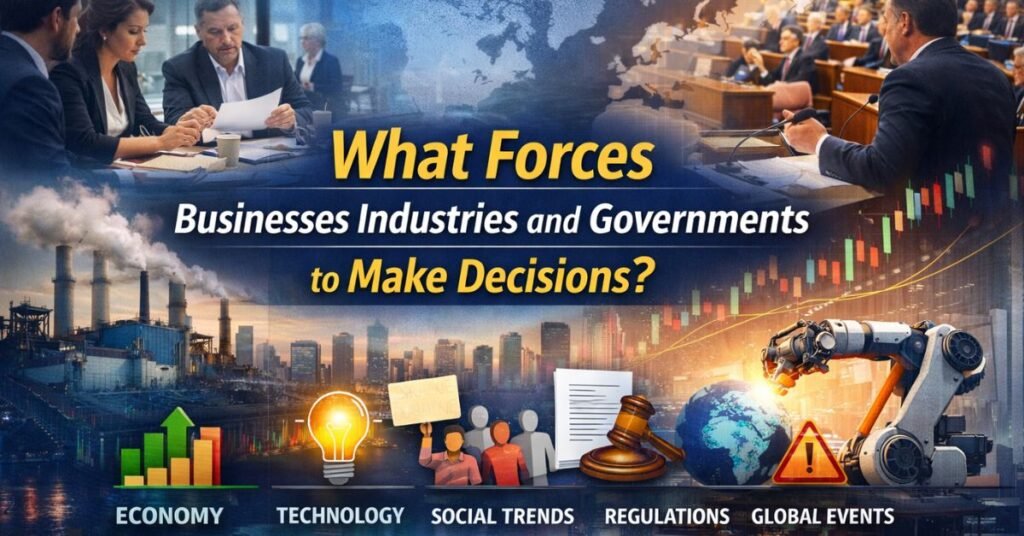
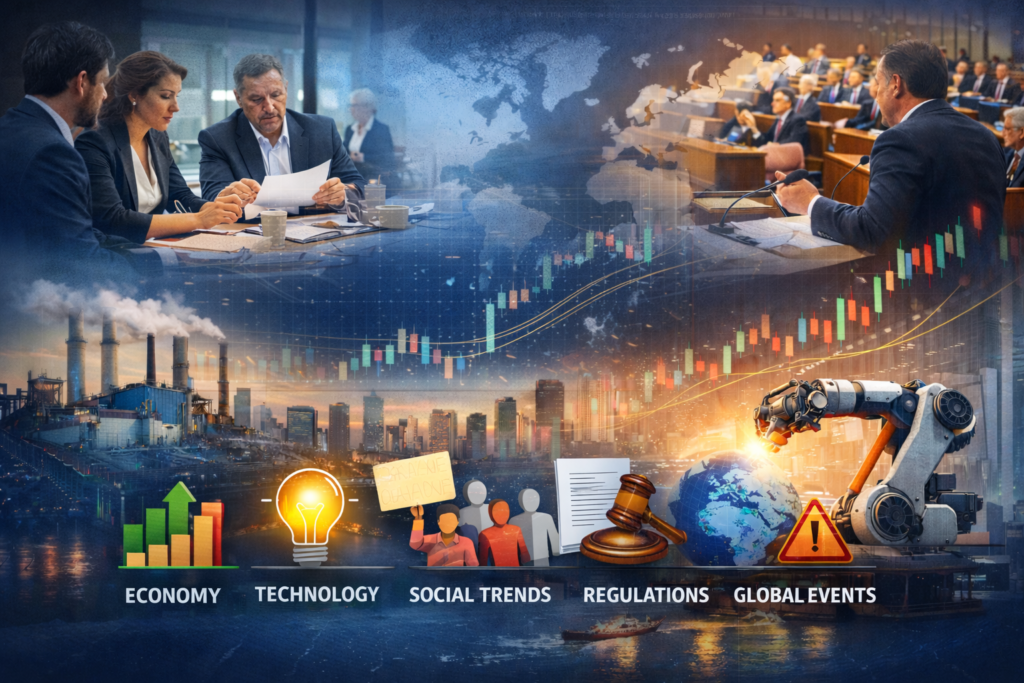
The most common forces include:
- Economic conditions
- Technological change
- Consumer demand
- Competition
- Government regulation
- Social and cultural shifts
- Environmental concerns
- Global events
Each of these forces acts like a push or pull that influences decision-makers.
Understanding them helps explain not just what decisions are made, but why they are made.
Economic Forces That Drive Decision Making
One of the most powerful forces influencing decision-making is economics.
Businesses, industries, and governments must constantly respond to economic conditions such as inflation, unemployment, interest rates, and market demand.
These economic forces shape decisions in ways that affect millions of people.
For businesses, the primary economic driver is profitability.
Companies constantly evaluate questions like:
- Are sales increasing or declining?
- Are production costs rising?
- Are customers willing to pay more?
- Is the market growing or shrinking?
If costs increase due to supply chain disruptions, businesses might raise prices or find cheaper suppliers.
During economic downturns, companies often:
- Reduce spending
- Freeze hiring
- Delay expansion plans
Industries react to economic forces as well.
For example, during the global financial crisis of 2008, many industries dramatically shifted strategy. Banks tightened lending rules, construction slowed, and consumer spending dropped.
Governments, on the other hand, must manage entire economies.
They make decisions based on indicators like:
- GDP growth
- inflation rates
- unemployment levels
- trade balances
When inflation rises rapidly, governments or central banks may increase interest rates to stabilize prices.
Economic forces are powerful because they affect every stakeholder simultaneously.
When the economy shifts, everyone—from small startups to national governments—must respond.
Technological Innovation as a Major Decision Driver
Technology has always been one of the most disruptive forces shaping decisions.
Throughout history, technological breakthroughs have forced businesses, industries, and governments to rethink how they operate.
Consider the impact of:
- The internet
- Artificial intelligence
- Automation
- Mobile technology
- Cloud computing
Each of these innovations changed entire industries.
When smartphones became widespread, companies had to adapt quickly. Businesses developed mobile apps, retailers invested in e-commerce platforms, and governments updated digital infrastructure.
Technology creates two types of pressure:
- Opportunity pressure
- Competitive pressure
Opportunity pressure occurs when a new technology opens new possibilities.
Companies that adopt the technology early can gain a significant advantage.
Competitive pressure happens when rivals adopt technology first.
Organizations then face a difficult decision: adapt quickly or risk falling behind.
Governments must also respond to technological changes.
For example, they may introduce regulations around:
- data privacy
- artificial intelligence
- cybersecurity
- digital payments
Technology also forces governments to modernize public services.
Online tax filing systems, digital identity platforms, and electronic healthcare records are all examples of governments responding to technological forces.
In today’s digital economy, technology evolves so quickly that decision-makers must constantly monitor innovation to remain competitive and relevant.
Consumer Demand and Social Expectations
Another major force shaping decisions is consumer behavior.
Businesses ultimately exist to serve customers. If consumer preferences change, companies must adapt or risk losing market share.
Consumer demand influences decisions such as:
- product design
- pricing strategies
- marketing campaigns
- distribution channels
For example, growing interest in healthier lifestyles pushed many food companies to introduce organic, low-sugar, or plant-based products.
Social expectations also play a role.
Modern consumers care about more than just price and convenience. They increasingly expect companies to demonstrate values like:
- environmental responsibility
- ethical labor practices
- transparency
- inclusivity
These expectations force businesses to reconsider how they operate.
Industries often shift together when consumer values evolve.
For instance, the rise of sustainability has influenced industries like:
- fashion
- automotive
- energy
- packaging
Governments also respond to public demand.
Public opinion can influence policies on issues such as:
- climate change
- healthcare
- education
- taxation
In democratic systems especially, public sentiment is one of the most powerful forces influencing policy decisions.
Ignoring consumer demand or public expectations can lead to loss of trust, declining sales, or political backlash.
Competition and Market Pressure
Competition is another critical force that shapes decision-making.
In competitive markets, organizations must constantly monitor rivals and respond to their strategies.
If a competitor launches a groundbreaking product, other companies often feel immediate pressure to innovate as well.
Competition forces businesses to make decisions about:
- pricing
- product features
- marketing strategy
- expansion into new markets
For example, when one ride-sharing company lowers fares, competitors may need to adjust pricing to remain attractive to customers.
Industries also experience competitive shifts.
When new entrants disrupt traditional markets, entire sectors can transform.
Streaming services disrupted the entertainment industry. Online marketplaces changed retail. Fintech companies are reshaping banking.
Governments are not immune to competitive pressure either.
Countries compete globally for:
- investment
- talent
- trade partnerships
- technological leadership
This competition often influences government policies.
For example, governments may introduce tax incentives to attract foreign investment or invest heavily in education and research to strengthen national competitiveness.
Competition acts as a constant motivator that pushes organizations and governments to evolve.
Political and Regulatory Forces
Government regulations play a major role in shaping decisions across industries.
Businesses must operate within legal frameworks that govern:
- labor laws
- environmental standards
- taxation
- safety regulations
- data protection
When regulations change, companies often need to adjust strategies quickly.
For example, stricter environmental regulations may require companies to invest in cleaner technologies.
Regulatory forces can also reshape entire industries.
Consider industries such as:
- healthcare
- banking
- telecommunications
- energy
These sectors are heavily regulated because they have significant social or economic impact.
Governments themselves face political pressures when making decisions.
Political forces include:
- elections
- public opinion
- lobbying groups
- international diplomacy
Political leaders must balance competing interests while making policies that affect national economies and societies.
These forces can sometimes create difficult trade-offs between economic growth, environmental protection, and social welfare.
Global Events and External Shocks
Sometimes decisions are driven by unexpected events.
Global crises can force rapid decision-making across governments, industries, and businesses.
Examples include:
- financial crises
- pandemics
- geopolitical conflicts
- natural disasters
During the COVID-19 pandemic, businesses rapidly shifted to remote work models. Industries accelerated digital transformation, and governments implemented emergency policies to support economies.
External shocks often reveal vulnerabilities in systems.
Organizations that respond quickly to these events can adapt successfully, while those that fail to respond may struggle.
Global events also highlight the interconnected nature of modern economies.
A supply chain disruption in one country can affect production worldwide.
As a result, decision-makers increasingly consider global risks when planning strategies.
Step-by-Step Process Organizations Use to Make Major Decisions
When facing strong external forces, organizations typically follow a structured decision-making process.
Although approaches vary, the core steps usually include:
1. Identifying the Problem or Opportunity
Decision-making begins with recognizing a change in the environment.
This could be:
- declining sales
- emerging technology
- new regulations
- changing consumer behavior
Leaders must first understand what is happening and why.
2. Gathering Information
Organizations collect data to analyze the situation.
This may involve:
- market research
- financial analysis
- customer feedback
- competitor analysis
Reliable information helps decision-makers understand risks and opportunities.
3. Evaluating Possible Options
Next, leaders consider different strategies.
For example:
- launching a new product
- entering a new market
- adjusting pricing
- investing in technology
Each option is evaluated based on potential outcomes.
4. Choosing a Strategy
After analyzing options, decision-makers select the strategy that best aligns with organizational goals.
This stage often involves collaboration between executives, analysts, and stakeholders.
5. Implementation
Once a decision is made, organizations execute the strategy through operational changes.
This could include hiring teams, launching campaigns, or investing in infrastructure.
6. Monitoring Results
Finally, organizations track outcomes and adjust strategies if necessary.
Decision-making is rarely a one-time event. It’s an ongoing process of learning and adaptation.
Tools and Frameworks Used in Strategic Decision-Making
Decision-makers often rely on analytical tools to evaluate forces affecting businesses, industries, and governments.
Some of the most widely used frameworks include:
SWOT Analysis
SWOT stands for:
- Strengths
- Weaknesses
- Opportunities
- Threats
This framework helps organizations evaluate internal capabilities and external risks.
PESTLE Analysis
PESTLE examines macro-environmental forces:
- Political
- Economic
- Social
- Technological
- Legal
- Environmental
It’s particularly useful for understanding large-scale influences on industries.
Porter’s Five Forces
This framework analyzes industry competition by examining:
- competitive rivalry
- supplier power
- buyer power
- threat of substitutes
- threat of new entrants
Data Analytics Tools
Modern organizations also rely on advanced analytics platforms to analyze trends and forecast outcomes.
These tools help leaders make data-driven decisions instead of relying solely on intuition.
Common Mistakes Businesses and Governments Make When Responding to Pressure
Even experienced leaders sometimes make poor decisions when reacting to external forces.
Some common mistakes include:
Ignoring Early Warning Signs
Organizations sometimes dismiss early signals of change.
By the time the threat becomes obvious, competitors may already have adapted.
Overreacting to Short-Term Trends
Short-term fluctuations do not always represent long-term changes.
Overreacting can lead to unnecessary strategic shifts.
Lack of Reliable Data
Decisions made without accurate information often lead to poor outcomes.
Resistance to Change
Internal culture can prevent organizations from adapting quickly.
Employees and leaders may resist change because it disrupts established routines.
Poor Communication
Even good decisions can fail if they are not clearly communicated across the organization.
Avoiding these mistakes requires strong leadership, clear analysis, and adaptability.
Conclusion
Understanding what forces businesses industries and governments to make decisions provides valuable insight into how the modern world operates.
Economic conditions, technological innovation, consumer expectations, competition, regulations, and global events all combine to shape the choices made by leaders.
These forces rarely act alone. Instead, they interact in complex ways that require careful analysis and strategic thinking.
For businesses, recognizing these forces early can create competitive advantage. For industries, it helps explain major shifts and trends. For governments, it highlights the balancing act required to manage economic growth, social welfare, and global challenges.
In a rapidly changing world, the ability to understand and respond to these forces is more important than ever.
The organizations and governments that succeed are those that remain flexible, informed, and willing to adapt.
FAQs
What forces businesses industries and governments to make decisions?
Major forces include economic conditions, technological innovation, consumer demand, competition, regulations, and global events.
Why do businesses change strategies frequently?
Businesses adapt strategies in response to market conditions, new technologies, competitive pressures, and evolving customer preferences.
How do governments make policy decisions?
Governments analyze economic data, public opinion, political priorities, and international factors before implementing policies.
What role does technology play in decision-making?
Technology creates both opportunities and pressures. Organizations must adopt new technologies to remain competitive and efficient.
Why is consumer demand important in business decisions?
Consumer preferences determine which products succeed in the market. Businesses must align strategies with customer expectations.

Michael Grant is a business writer with professional experience in small-business consulting and online entrepreneurship. Over the past decade, he has helped brands improve their digital strategy, customer engagement, and revenue planning. Michael simplifies business concepts and gives readers practical insights they can use immediately.