
If you’ve been circling the world of data, analytics, or digital transformation lately, you’ve probably asked yourself: what does ELT stand for in business?
It’s one of those acronyms that gets thrown around in strategy meetings, tech roadmaps, and investor decks — but rarely explained in plain English.
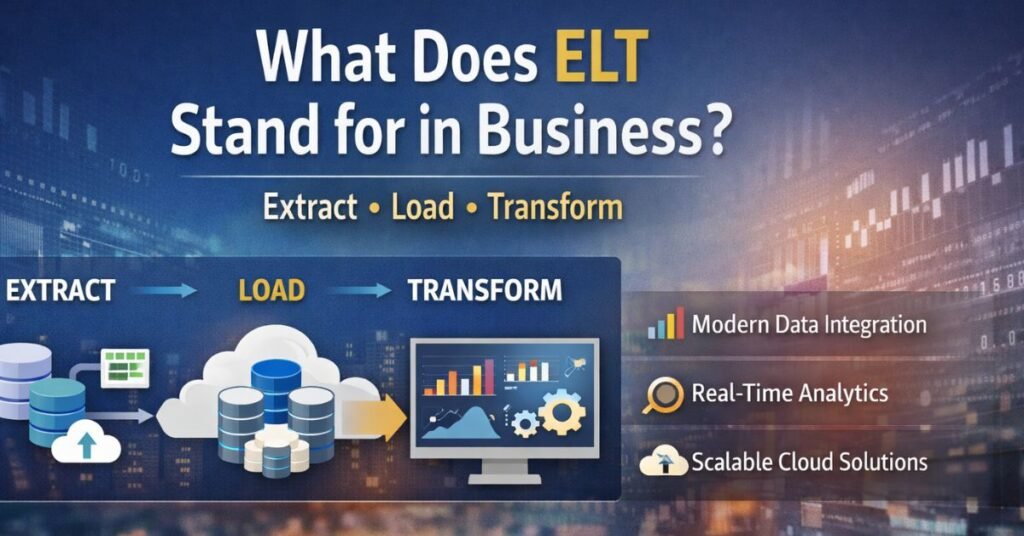
ELT stands for Extract, Load, Transform.
On the surface, that sounds technical. But in reality, ELT is simply a smarter, modern way businesses move and prepare data so leaders can make better decisions.
And in today’s economy — where decisions are powered by dashboards, forecasts, and real-time analytics — understanding ELT isn’t optional. It’s foundational.
In this guide, I’ll walk you through:
- What ELT really means (without jargon)
- How it differs from ETL
- Why it matters for startups and enterprises alike
- Practical use cases across industries
- A step-by-step implementation roadmap
- Tools, comparisons, and expert recommendations
- Common mistakes and how to avoid them
- FAQs optimized for search and clarity
Whether you’re a founder, data analyst, operations manager, or simply exploring modern data architecture, this article will give you clarity — and confidence.
Let’s break it down.
What Does ELT Stand for in Business? A Beginner-Friendly Breakdown
At its core, ELT stands for:
- Extract
- Load
- Transform
These three steps describe how businesses collect data from different sources and turn it into something useful.
Here’s the simplest way to think about it.
Imagine you’re running a restaurant chain.
You collect:
- Sales data from POS systems
- Customer reviews from social media
- Inventory data from suppliers
- Marketing performance from ad platforms
That raw data is messy. It lives in different systems. It uses different formats. It updates at different times.
ELT is the structured process that:
- Extracts data from all those sources
- Loads it into a central system (like a data warehouse)
- Transforms it into clean, usable insights
Instead of cleaning the data before storing it (which is how older systems worked), ELT stores everything first — then processes it inside a powerful data warehouse.
That shift might sound small. It’s not.
It’s what allows modern companies to scale analytics without bottlenecks.
ELT vs ETL: What’s the Difference?
Before ELT became dominant, businesses used something called ETL — Extract, Transform, Load.
The order is different.
And the order changes everything.
How ETL Works
With ETL:
- Extract data
- Transform it in a staging area
- Load only cleaned data into storage
This made sense when storage was expensive and computing power was limited.
How ELT Works
With ELT:
- Extract data
- Load it directly into a modern data warehouse
- Transform it using the warehouse’s computing power
This approach became popular with cloud platforms like:
- Snowflake
- Google BigQuery
- Amazon Redshift
These systems are built to handle massive raw datasets efficiently.
Why ELT Wins in Modern Business
ELT is generally better for:
- High-volume data
- Real-time analytics
- Flexible reporting needs
- Machine learning workflows
- Scalable cloud infrastructure
ETL still has its place in regulated or legacy environments. But in 2026, ELT is the standard for cloud-first companies.
Why ELT Matters in Today’s Data-Driven Economy
Let’s step out of the technical weeds for a moment.
Why should a business leader care about ELT?
Because data is now the engine of competitive advantage.
Companies no longer compete only on product or pricing. They compete on:
- Speed of decision-making
- Accuracy of insights
- Ability to predict trends
- Customer personalization
- Operational efficiency
ELT makes all of that possible.
1. Faster Decision-Making
Because raw data is loaded immediately, teams don’t wait for complex transformation pipelines before accessing information.
Finance teams can analyze daily revenue.
Marketing teams can optimize campaigns in near real-time.
Operations teams can identify bottlenecks instantly.
Speed matters. ELT enables it.
2. Scalability Without Rebuilding Systems
When a company grows from 10,000 customers to 1 million, data volume explodes.
ELT leverages cloud infrastructure that scales automatically. You don’t rebuild pipelines — you expand compute resources.
That flexibility is priceless.
3. Flexibility for Evolving Business Questions
In ETL systems, data transformations are predefined before loading.
In ELT, you can reshape data anytime.
That means:
- New KPIs? No problem.
- New dashboard metrics? Easy.
- New AI models? Fully supported.
ELT future-proofs your analytics strategy.
Real-World Use Cases of ELT in Business
Understanding what ELT stands for in business is one thing. Seeing it in action is another.
Let’s explore how different industries use ELT in real-world scenarios.
E-Commerce Companies
An online retailer collects:
- Website behavior data
- Cart abandonment metrics
- Payment transaction logs
- Customer service interactions
With ELT:
- Data is extracted from platforms like Shopify
- Loaded into a warehouse
- Transformed into customer lifetime value dashboards
This enables:
- Personalized marketing
- Demand forecasting
- Churn prediction
- Real-time sales analysis
SaaS Businesses
Software companies track:
- User onboarding data
- Feature usage
- Subscription revenue
- Support tickets
ELT allows product teams to:
- Identify drop-off points
- Improve feature adoption
- Reduce churn
- Optimize pricing strategies
Financial Institutions
Banks and fintech firms use ELT to:
- Detect fraud
- Monitor transactions
- Run risk analysis
- Generate compliance reports
Because ELT stores raw data, regulators can audit historical records when needed.
Healthcare Organizations
Hospitals and clinics integrate:
- Patient records
- Lab results
- Insurance claims
- Appointment data
ELT supports:
- Predictive patient care
- Operational efficiency
- Billing accuracy
- Research analytics
The common thread? Centralized, scalable data power.
Step-by-Step Guide: How to Implement ELT in Your Business
If you’re considering ELT for your organization, here’s a practical roadmap.
Step 1: Identify Data Sources
Start by mapping all systems generating data:
- CRM systems
- Accounting software
- Marketing platforms
- Operational databases
- APIs
List them clearly.
Without a data inventory, implementation becomes chaotic.
Step 2: Choose a Data Warehouse
Modern ELT relies on powerful cloud warehouses.
Popular choices include:
- Snowflake
- Google BigQuery
- Amazon Redshift
Selection depends on:
- Budget
- Existing cloud ecosystem
- Data volume
- Performance needs
Step 3: Select an ELT Tool
ELT tools automate extraction and loading.
Common options:
- Fivetran
- Airbyte
- Stitch
These tools connect to hundreds of data sources and push data directly into your warehouse.
Step 4: Define Transformation Logic
Transformations happen inside the warehouse.
You can use:
- SQL-based workflows
- Modeling tools like dbt Labs
Best practices:
- Keep raw data untouched
- Create cleaned layers
- Document all transformations
- Version control everything
Step 5: Build Reporting & Analytics
Once transformed, data feeds into:
- BI tools
- Dashboards
- Machine learning models
At this stage, ELT becomes visible to stakeholders.
Step 6: Monitor & Optimize
Track:
- Pipeline failures
- Query performance
- Cost efficiency
- Data accuracy
ELT is not “set it and forget it.” It’s an evolving system.
Tools, Comparisons & Expert Recommendations
Choosing the right ELT ecosystem can make or break your data strategy.
Let’s compare categories.
ELT Platforms
Fivetran
Pros:
- Fully managed
- Reliable connectors
- Minimal maintenance
Cons:
- Higher cost
- Less customization
Airbyte
Pros:
- Open source
- Highly customizable
- Cost-effective
Cons:
- Requires engineering expertise
Stitch
Pros:
- Simple setup
- Good for small teams
Cons:
- Limited advanced features
Data Warehouses
Snowflake
Pros:
- Excellent scalability
- Separation of storage and compute
- Strong performance
Cons:
- Can become expensive at scale
Google BigQuery
Pros:
- Serverless
- Fast queries
- Pay-per-query pricing
Cons:
- Costs unpredictable with heavy querying
Amazon Redshift
Pros:
- Tight AWS integration
- Mature ecosystem
Cons:
- Requires tuning
Free vs Paid Options
Free options are ideal for:
- Early-stage startups
- Prototyping
- Learning environments
Paid tools are better when:
- Data volume is large
- Reliability is critical
- Teams need support
Expert tip: Start small. Prove ROI. Scale deliberately.
Common ELT Mistakes — and How to Fix Them
Even experienced teams make mistakes with ELT implementation.
Let’s address the big ones.
1. Transforming Everything at Once
Fix:
Adopt a layered approach:
- Raw layer
- Staging layer
- Business logic layer
2. Ignoring Data Governance
Fix:
Implement:
- Role-based access control
- Documentation
- Audit logs
3. Underestimating Costs
Cloud warehouses charge for compute and storage.
Fix:
- Monitor usage
- Optimize queries
- Archive unused data
4. Poor Documentation
When key engineers leave, undocumented pipelines collapse.
Fix:
- Use structured documentation
- Maintain transformation logs
- Version control everything
5. Treating ELT as a Purely Technical Project
ELT is a business strategy tool.
Fix:
Align with:
- Revenue goals
- Marketing KPIs
- Operational metrics
Conclusion: Why ELT Is a Strategic Business Asset
So, what does ELT stand for in business?
It stands for Extract, Load, Transform.
But strategically, it stands for something bigger:
- Speed
- Scalability
- Flexibility
- Insight
- Competitive advantage
In the modern business landscape, data is not just a support function. It’s a growth engine.
ELT allows organizations to:
- Centralize intelligence
- Move faster than competitors
- Empower decision-makers
- Future-proof analytics infrastructure
If your organization is scaling — or planning to — ELT isn’t just an IT choice.
It’s a strategic one.
Explore your data ecosystem. Audit your current workflows. Start small. Build intentionally.
And remember: businesses that master data don’t guess. They know.
FAQs
What does ELT stand for in business?
ELT stands for Extract, Load, Transform. It’s a modern data integration process where raw data is loaded into a data warehouse before being transformed.
How is ELT different from ETL?
ETL transforms data before loading it into storage. ELT loads raw data first and performs transformations inside the data warehouse.
Why is ELT popular in cloud computing?
Cloud platforms provide scalable computing power, making it efficient to transform large datasets after loading them.
Is ELT better than ETL?
For most cloud-based, high-volume businesses, ELT offers better scalability and flexibility. However, ETL may still be suitable in certain regulated environments.
What tools are used for ELT?
Popular tools include Snowflake, Google BigQuery, Amazon Redshift, Fivetran, Airbyte, and dbt.

Michael Grant is a business writer with professional experience in small-business consulting and online entrepreneurship. Over the past decade, he has helped brands improve their digital strategy, customer engagement, and revenue planning. Michael simplifies business concepts and gives readers practical insights they can use immediately.