
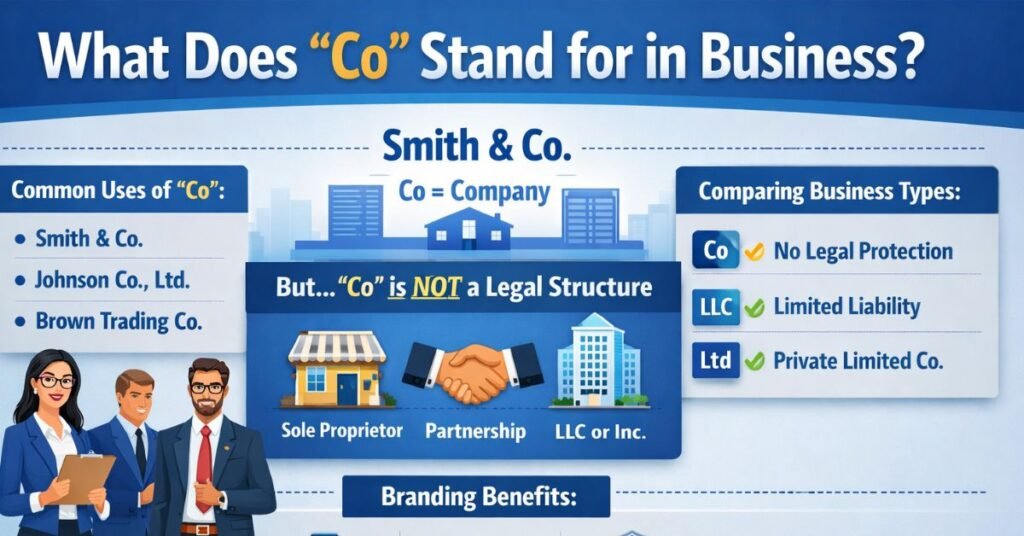
If you’ve ever glanced at a company name and wondered, what does Co stand for in business? — you’re not alone.
You see it everywhere: Smith & Co, Johnson Co., Anderson Trading Co, and sometimes even XYZ Co., Ltd. It looks simple. Almost decorative. But behind those two letters sits a long history of commerce, partnerships, legal structure, branding strategy, and even credibility signaling.
And here’s the truth: understanding what “Co” means isn’t just trivia. If you’re starting a business, choosing a company name, filing paperwork, building a brand, or trying to look more professional online — knowing when and how to use “Co” actually matters.
In this comprehensive guide, you’ll learn:
- The exact meaning of “Co” in business
- The historical origin of the term
- Legal vs. branding usage differences
- When you can (and cannot) use “Co”
- Whether it protects you legally (spoiler: not always)
- How it compares to LLC, Ltd., Inc., Corp, and others
- Common mistakes entrepreneurs make
- How to choose the right suffix for your business
Let’s break it down properly.
What Does “Co” Stand for in Business? (Quick Answer)
“Co” stands for Company.
In business names, it’s typically an abbreviation of the word Company and indicates that a business entity exists beyond just an individual.
For example:
- Smith & Co = Smith and Company
- Brown Trading Co. = Brown Trading Company
- Adams Co. = Adams Company
But here’s the nuance most people miss:
“Co” does not automatically define a legal structure.
It doesn’t tell you whether the business is:
- A sole proprietorship
- A partnership
- An LLC
- A corporation
It simply suggests that the business operates as an organized commercial entity — often with multiple stakeholders or employees.
Now let’s dig deeper.
The Origin and History of “Co” in Business Names
To truly understand what “Co” stands for in business, you have to go back to early trade and commerce.
In the 17th and 18th centuries, merchants commonly formed trading partnerships. A business might be founded by two individuals, like “Smith & Johnson.” But often, there were additional silent investors or junior partners.
Instead of listing everyone, merchants would write:
Smith & Company
Over time, that was shortened to:
Smith & Co.
This convention became widespread in Europe and later in the United States. It signaled:
- There is more than one person involved
- The business has structure
- The founder isn’t operating alone
In many cases, “& Co.” implied credibility. It suggested scale.
Even today, luxury brands use this tradition to evoke heritage and prestige.
What “Company” Actually Means in a Business Context
Before we move further, let’s clarify something important.
A company is a broad term that describes any commercial business organization.
It does not inherently specify legal structure.
Think of “company” as an umbrella word.
Under that umbrella, you can have:
- Sole proprietorships
- Partnerships
- Limited Liability Companies (LLCs)
- Corporations
- Private Limited Companies
- Public Limited Companies
So when someone asks, “What does Co stand for in business?” — the literal answer is simple.
But the legal meaning depends on context.
Is “Co” a Legal Business Structure?
This is where many new entrepreneurs get confused.
The short answer:
No, “Co” by itself is not a legal structure.
Unlike “LLC,” “Inc.,” or “Ltd.,” the abbreviation “Co” does not automatically indicate limited liability protection.
For example:
- “Smith Co.” could be a sole proprietorship.
- “Smith Co., LLC” clearly indicates a limited liability company.
- “Smith Co., Ltd.” typically refers to a private limited company (common in UK, Asia, and other regions).
In many jurisdictions, simply using “Co” does not legally protect you.
You must register your business according to local laws to gain liability protection.
That’s a critical distinction.
Common Variations of “Co” in Business Names
You’ll often see “Co” appear in different formats. Each variation can slightly change meaning.
1. & Co.
Example: Johnson & Co.
Traditionally implies:
- A partnership
- Multiple founders or investors
2. Co.
Example: Baker Co.
More modern usage. Could be:
- Sole proprietor
- LLC
- Corporation
- Brand styling choice
3. Co., Ltd.
Common in:
- United Kingdom
- India
- Pakistan
- Hong Kong
- Singapore
This typically indicates a Private Limited Company.
4. Company
Spelled out fully, often used in formal registration documents.
Why Businesses Use “Co” in Their Name
Now let’s shift from definition to strategy.
Why do businesses still use “Co” today?
Here are the main reasons:
1. It Sounds Established
“Smith Co.” feels more structured than “John Smith.”
It communicates scale — even if the team is small.
2. It Feels Professional
Many freelancers rebrand from:
- “Jane Doe Photography”
to: - “Doe & Co Photography”
It instantly feels more premium.
3. It Suggests Teamwork
Even solo founders use “Co” to imply growth and future expansion.
4. It Has Heritage Appeal
Luxury and consulting brands often prefer “& Co” because it signals tradition and trust.
5. It’s Flexible Across Industries
You’ll find “Co” in:
- Consulting firms
- Trading companies
- Fashion brands
- Investment firms
- Law offices
- Creative agencies
It’s versatile.
Benefits and Use Cases of Using “Co” in Business
Let’s get practical.
Who should consider using “Co” in their business name?
Best Fit For:
- Consultants
- Freelancers building a premium brand
- Boutique agencies
- Family businesses
- Trading companies
- Import/export businesses
- Creative studios
- E-commerce brands
Real-World Scenario
Imagine you’re a freelance marketing consultant.
Option 1:
Ali Marketing Services
Option 2:
Ali & Co Marketing
The second option:
- Sounds bigger
- Feels more established
- Commands higher perceived value
Brand psychology matters.
Step-by-Step Guide: Should You Use “Co” in Your Business Name?
If you’re launching or rebranding, here’s how to decide.
Step 1: Check Legal Requirements
Every country has different naming rules.
Some jurisdictions:
- Require legal suffixes like LLC, Ltd., Inc.
- Restrict misleading terms
Check your local business registry website.
Step 2: Decide Your Legal Structure First
Before naming, choose your structure:
- Sole proprietorship
- Partnership
- LLC
- Corporation
Then confirm whether “Co” can be used alongside it.
Step 3: Check Name Availability
Search:
- Business registry database
- Domain name availability
- Social media handles
- Trademark database
Don’t skip this.
Step 4: Think About Branding
Ask:
- Does “Co” match your brand voice?
- Are you positioning as boutique or corporate?
- Does it align with your industry?
Step 5: Register Properly
Using “Co” in branding is different from registering legally.
Always:
- Register your business officially
- Obtain required licenses
- Secure tax ID
“Co” alone does not protect you.
“Co” vs. LLC vs. Ltd vs. Inc — What’s the Difference?
This is one of the most searched follow-up questions.
Let’s clarify in simple terms.
Co
- Means Company
- Not a legal structure by itself
- Branding-focused
- No automatic liability protection
LLC (Limited Liability Company)
- Legal entity
- Protects personal assets
- Flexible tax structure
- Common in the US
Ltd (Limited)
- Used in UK, South Asia, and other countries
- Shareholders have limited liability
- Separate legal entity
Inc (Incorporated)
- Corporation structure
- Shareholder-based
- Strong legal separation
- Often used in US
Quick Comparison Table
| Term | Legal Protection | Defines Structure? | Used Globally? |
|---|---|---|---|
| Co | No | No | Yes |
| LLC | Yes | Yes | Mostly US |
| Ltd | Yes | Yes | UK & Commonwealth |
| Inc | Yes | Yes | US |
If you’re serious about asset protection, “Co” alone is not enough.
Tools & Resources to Check Business Name Availability
Before you commit to a name with “Co,” use these tools:
Government Business Registry Website
Your country’s official company registration site.
Domain Checkers
- Namecheap
- GoDaddy
Trademark Search
- USPTO (US)
- IPO (UK)
- WIPO global database
Business Name Generators
Helpful for brainstorming, but always verify legally.
Free tools are fine for idea generation. But always validate through official government databases.
Common Mistakes When Using “Co” in Business Names
Let’s talk about what not to do.
Mistake 1: Assuming It Provides Legal Protection
It doesn’t.
You need proper registration.
Mistake 2: Using It to Mislead
Some regions prohibit implying multiple partners when none exist.
Mistake 3: Forgetting Legal Suffix Requirements
Some states require LLC, Ltd, Inc, etc.
Mistake 4: Not Checking Trademark Conflicts
Just because a domain is available doesn’t mean the name is legally safe.
Mistake 5: Overcomplicating the Name
“Smith & Johnson & Co Trading International Global Enterprises”
Keep it clean.
Does “Co” Increase Brand Credibility?
Psychologically? Yes.
Legally? No.
Consumers often perceive:
- “& Co” = established
- “Co.” = structured
- No suffix = small or informal
In consulting, finance, law, and trading — perception matters.
But credibility ultimately comes from:
- Customer experience
- Reputation
- Quality
- Transparency
“Co” can open the door. Your work keeps it open.
When You Should NOT Use “Co”
Avoid it if:
- Your jurisdiction restricts it
- You’re a personal brand built around individuality
- Your brand voice is ultra-modern and minimal
- You want clear legal clarity (LLC/Ltd may be better)
For example:
A tech startup might prefer:
“Nova Labs LLC”
instead of:
“Nova & Co”
Context matters.
Conclusion: What Does Co Stand for in Business?
Let’s recap clearly.
“What does Co stand for in business?”
It stands for Company — a broad term indicating a commercial entity.
But it does not define legal structure or provide liability protection.
It’s:
- A branding tool
- A tradition rooted in partnership commerce
- A flexible naming option
- A perception enhancer
If you’re launching a business, use it strategically — not blindly.
And remember: structure first, branding second.
If you’re considering using “Co” in your business name, take time to verify legal requirements and ensure it aligns with your long-term brand vision.
Now I’d love to know — are you planning to use “Co” in your business name?
FAQs
What does Co stand for in business?
Co stands for Company, which refers broadly to a commercial business entity.
Is Co the same as LLC?
No. LLC is a legal structure offering liability protection. Co is simply an abbreviation for Company.
Does using Co mean I have partners?
Not necessarily. Traditionally it implied multiple people, but today it can be used by solo entrepreneurs.
Can a sole proprietor use Co in their name?
In many places yes, but always check local regulations.
Does Co provide legal protection?
No. You must formally register your business structure to gain protection.

Michael Grant is a business writer with professional experience in small-business consulting and online entrepreneurship. Over the past decade, he has helped brands improve their digital strategy, customer engagement, and revenue planning. Michael simplifies business concepts and gives readers practical insights they can use immediately.