
Introduction
If you’ve ever stared at an invoice that says “payment due in 5 business days,” waited for a package promised to arrive “within 3 business days,” or tried to calculate a deadline that somehow keeps moving, you’re not alone. The phrase what are business days sounds simple, yet it causes confusion every single day in offices, banks, courts, shipping centers, and customer support teams around the world.
Here’s the problem: business days don’t always mean the same thing to everyone. A bank’s idea of a business day might not match a courier’s. A government office may close for holidays you didn’t know existed. And when money, contracts, or deadlines are involved, misunderstanding business days can cost real time and real cash.
In this guide, we’re going to break everything down in plain English. You’ll learn exactly what business days are, how they work across industries and countries, how to calculate them step by step, and how to avoid the most common (and expensive) mistakes people make. Whether you’re a business owner, freelancer, student, shopper, or someone who just wants fewer calendar headaches, this article will give you clarity you can actually use.
By the end, you’ll never second-guess a “business days” deadline again.
Topic Explanation: What Are Business Days, Really?
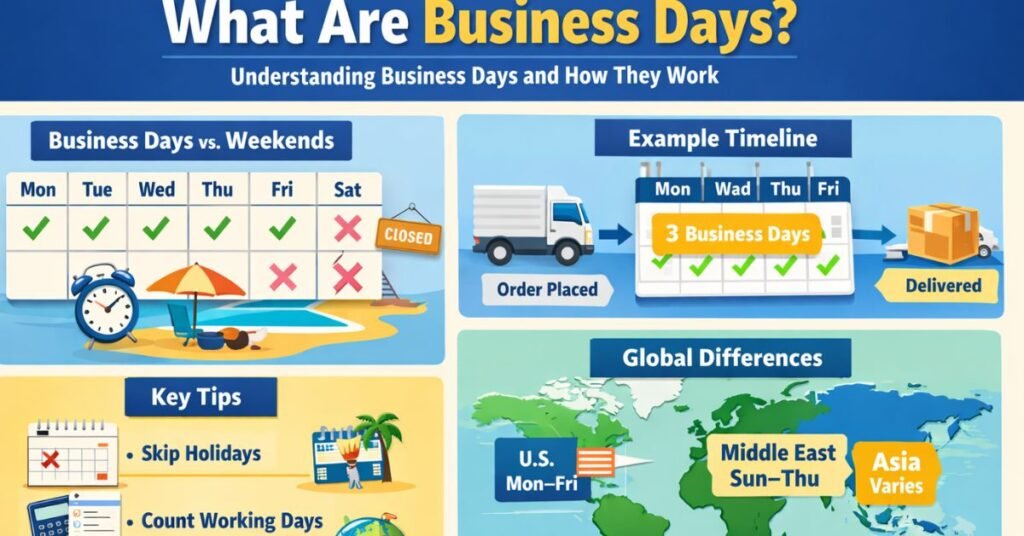
At its core, business days refer to the days when businesses are officially open and operating. In most parts of the world, that means Monday through Friday, excluding weekends and public holidays. Sounds straightforward, right? The complication starts when you realize that not all businesses follow the same schedule.
Think of business days like a restaurant’s opening hours. Just because a restaurant is open doesn’t mean every restaurant is. In the same way, business days depend on the organization, industry, and location involved.
Traditionally, business days exist because commerce needs predictable operating windows. Banks need set days to process transactions. Courts need defined working days to calculate legal deadlines. Companies need consistent schedules for payroll, invoicing, and logistics. Over time, Monday through Friday became the global default, largely shaped by labor laws and economic systems.
However, business days almost never include:
- Saturdays and Sundays (in most countries)
- National public holidays
- Company-specific closure days
This is why “5 business days” can feel longer than a week. If a holiday falls in the middle, those days don’t count. If a process starts late on a Friday, the clock usually doesn’t begin ticking until Monday.
Understanding what business days are isn’t about memorizing a rule. It’s about recognizing context. Who is defining the business day? A bank, a shipping company, a government agency, or an employer? Once you know that, everything else becomes much easier.
Why Business Days Matter More Than You Think
Business days quietly control how modern life functions. They shape timelines, expectations, and legal obligations, often without us noticing until something goes wrong.
Imagine you’re a freelancer waiting on a client payment due in “10 business days.” You might mentally count two weeks, only to realize a holiday extended the wait by several more days. Or maybe you’re running an e-commerce store and promise delivery in “2 business days,” but your warehouse doesn’t ship on Fridays after noon. That gap between expectation and reality is where frustration lives.
Business days matter because they:
- Define when financial transactions are processed
- Determine legal and contractual deadlines
- Set expectations for shipping, support, and services
- Protect organizations from unrealistic turnaround demands
They also create fairness. Without business days, a company could be expected to process requests 24/7, which simply isn’t sustainable for most operations. Business days set boundaries while keeping systems predictable.
Once you understand how business days work, you gain control. You plan better, communicate clearly, and avoid unnecessary stress. It’s not just a calendar concept; it’s a life skill in disguise.
Business Days vs Calendar Days: The Difference That Trips People Up
One of the most common sources of confusion is the difference between business days and calendar days. They sound similar, but they behave very differently.
Calendar days include every day on the calendar: weekdays, weekends, and holidays. If today is Monday and someone says “in 7 calendar days,” you land on the following Monday, no matter what.
Business days, on the other hand, skip non-working days. If today is Monday and someone says “in 7 business days,” you’ll usually land on the following Wednesday or Thursday, depending on holidays.
Here’s a simple way to think about it: calendar days count time; business days count work.
This distinction matters most when dealing with:
- Contracts and legal notices
- Bank transfers and refunds
- Shipping and logistics timelines
- HR policies and payroll processing
Many disputes happen because one party assumes calendar days while the other means business days. The safest approach is always to clarify, especially in writing. If you’re drafting terms or policies, explicitly state whether deadlines use business days or calendar days. That one sentence can save hours of back-and-forth later.
How Business Days Work in Different Industries



While the general idea of business days is consistent, the way they’re applied varies widely by industry. Understanding these differences helps you set realistic expectations.
In banking, business days usually align with when banks are open to process transactions. Even if online banking runs 24/7, many backend systems only settle transactions on business days. That’s why a transfer initiated on Friday evening may not complete until Tuesday if a holiday falls on Monday.
In shipping and logistics, business days often refer to warehouse and courier operating days. A “3 business day delivery” usually means three working days after the item ships, not after you place the order. This distinction is critical for e-commerce sellers managing customer expectations.
In legal and government contexts, business days are tightly defined. Courts often exclude weekends and official holidays when calculating deadlines. Missing a filing deadline because you miscounted business days can have serious consequences.
In customer support, business days usually indicate when teams respond to inquiries. A promise to reply “within 1 business day” often means you’ll hear back the next weekday, not necessarily within 24 hours.
The takeaway is simple: always consider the industry context. The same phrase can mean slightly different things depending on who’s using it.
How to Calculate Business Days Step by Step
Calculating business days doesn’t require fancy tools, but it does require attention to detail. Here’s a practical, foolproof method you can use anytime.
First, identify your starting point. Does the countdown begin today or the next business day? Many organizations start counting from the next business day, especially if the action happens after business hours.
Second, list the business days. Count only weekdays that are not holidays. Skip Saturdays and Sundays automatically unless the organization explicitly works those days.
Third, account for holidays. This is where most people slip up. National holidays, bank holidays, or company-specific closure days all pause the count.
Fourth, stop when you reach the required number of business days. That date is your deadline or expected completion.
For example, if something is due in 5 business days starting on Thursday, and there’s a holiday on Monday, the count would look like this: Friday (1), Tuesday (2), Wednesday (3), Thursday (4), Friday (5). Your deadline lands the following Friday, not Wednesday.
Once you’ve done this a few times, it becomes second nature. The key is slowing down and counting deliberately instead of guessing.
Business Days Across Countries and Cultures
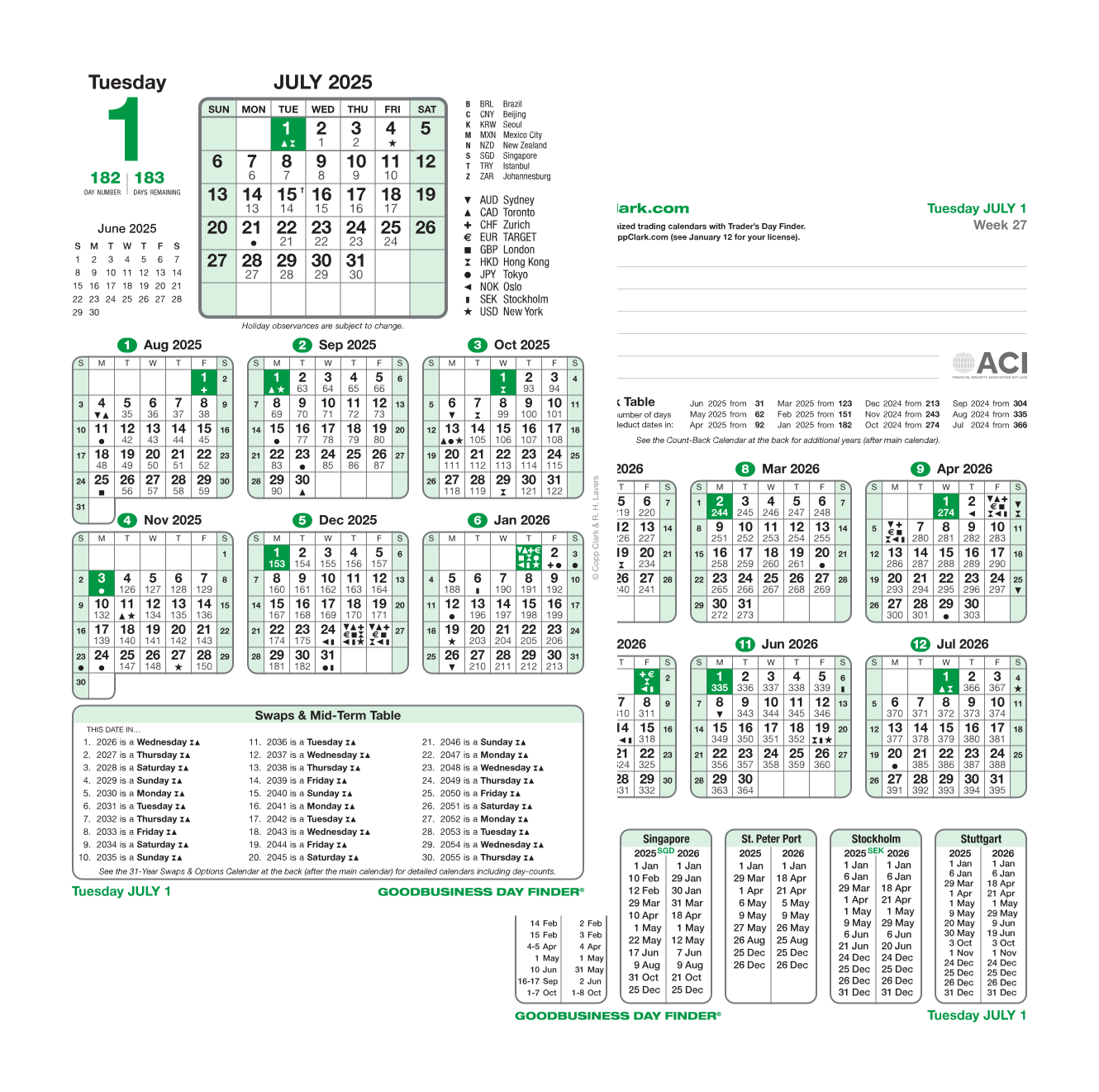

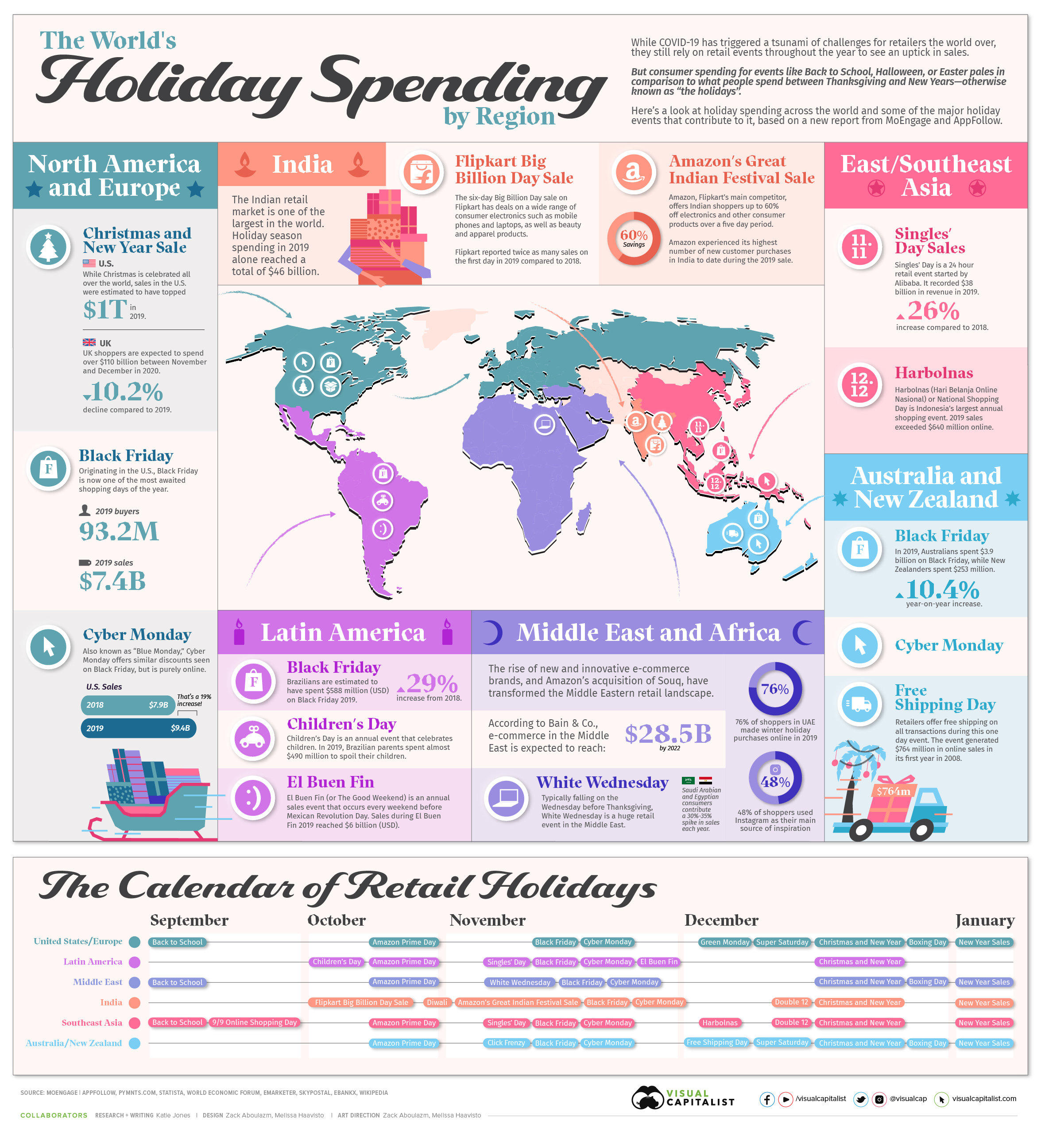
Not all business days are created equal around the world. While Monday through Friday is common in many countries, others follow different workweeks.
In several Middle Eastern countries, the business week traditionally runs from Sunday to Thursday, with Friday and Saturday as the weekend. Some countries have shifted toward a Monday-Friday model, but variations still exist.
Public holidays also vary dramatically. A day that’s a regular business day in one country might be a national holiday in another. This matters enormously for international transactions, remote teams, and global shipping.
If you work across borders, never assume. Always check local business calendars or ask directly. Many international delays happen not because someone dropped the ball, but because two sides were counting different business days.
Global awareness isn’t just polite; it’s practical.
Benefits and Use Cases of Understanding Business Days
Knowing what business days are and how they work gives you an edge in everyday life and professional settings. It’s one of those small pieces of knowledge that quietly improves everything.
For business owners, it helps with accurate timelines, better customer communication, and smoother operations. You can promise what you can actually deliver and avoid overcommitting.
For freelancers and employees, understanding business days protects your income and time. You know when to expect payments, responses, and approvals without unnecessary anxiety.
For consumers, it sets realistic expectations. You stop refreshing tracking pages every hour and understand when a delay is normal versus a problem.
For legal and administrative tasks, it’s essential. Deadlines based on business days are unforgiving, and clarity here can prevent costly mistakes.
In short, understanding business days turns uncertainty into predictability. And predictability is powerful.
Step-by-Step Guide: Using Business Days Correctly in Real Life
Applying business days correctly is mostly about communication and consistency.
Start by always clarifying definitions. If you’re writing a contract, invoice, or policy, define what you mean by business days. State which days are included and which holidays apply.
Next, set buffers. If something must happen by a certain date, don’t aim for the last possible business day. Build in a cushion for unexpected closures or delays.
Use shared calendars. For teams, especially remote or international ones, shared calendars that mark holidays and non-working days are invaluable.
Finally, communicate proactively. If a deadline shifts because of business days, explain why. Most people are understanding when the reasoning is clear.
These small habits prevent misunderstandings and build trust over time.
Tools, Comparisons, and Recommendations for Tracking Business Days
While manual counting works, tools make life easier, especially for recurring tasks.
Free tools like online business day calculators are perfect for quick checks. You enter a start date, number of business days, and location, and they handle weekends and holidays automatically.
Calendar apps can be customized to hide weekends or highlight holidays, which is useful for planning.
Paid project management tools often include business day logic baked into timelines. These are ideal for teams juggling multiple deadlines.
The best tool depends on your needs. For occasional use, free calculators are enough. For businesses, integrated systems save time and reduce errors.
Common Mistakes People Make With Business Days (and How to Fix Them)
The most common mistake is assuming business days equal weekdays without checking holidays. Always verify holiday calendars.
Another frequent error is starting the count on the same day an action occurs, even if it happens after business hours. When in doubt, start counting from the next business day.
People also forget industry differences. A courier’s business day isn’t the same as a bank’s. Match the definition to the context.
Fixing these mistakes is mostly about slowing down and confirming assumptions. A minute of checking beats days of confusion.
Business Days in Contracts, Payments, and Legal Documents
Business days carry legal weight. In contracts, they define when obligations must be met. In payments, they dictate when funds are considered late. In legal documents, they control filing and response deadlines.
This is why precise language matters. Phrases like “within five business days of receipt” should always be paired with definitions. Ambiguity invites disputes.
If you’re not sure how business days apply in a legal or financial document, ask. Clarification upfront is far cheaper than resolution later.
Conclusion: Mastering Business Days Once and for All
Understanding what are business days isn’t about memorizing rules. It’s about thinking clearly, communicating better, and respecting how systems actually work.
Once you grasp the concept, you stop feeling rushed or confused by vague timelines. You plan with confidence, set realistic expectations, and avoid unnecessary stress.
Whether you’re running a business, managing personal finances, or just waiting on a delivery, business days are part of your daily rhythm. Now you know how to work with them instead of against them.
If you found this guide helpful, bookmark it or share it with someone who’s still counting weekends by mistake.
FAQs
What are business days in simple terms?
Business days are the days when businesses are officially open, usually Monday through Friday, excluding weekends and holidays.
Do business days include Saturdays?
In most cases, no. Saturdays are typically excluded unless a business explicitly operates on Saturdays.
How many business days are in a week?
Usually five, assuming no holidays.
Are business days the same worldwide?
No. Business days vary by country, culture, and industry.
Do business days count holidays?
No. Public and official holidays are excluded.

Michael Grant is a business writer with professional experience in small-business consulting and online entrepreneurship. Over the past decade, he has helped brands improve their digital strategy, customer engagement, and revenue planning. Michael simplifies business concepts and gives readers practical insights they can use immediately.