
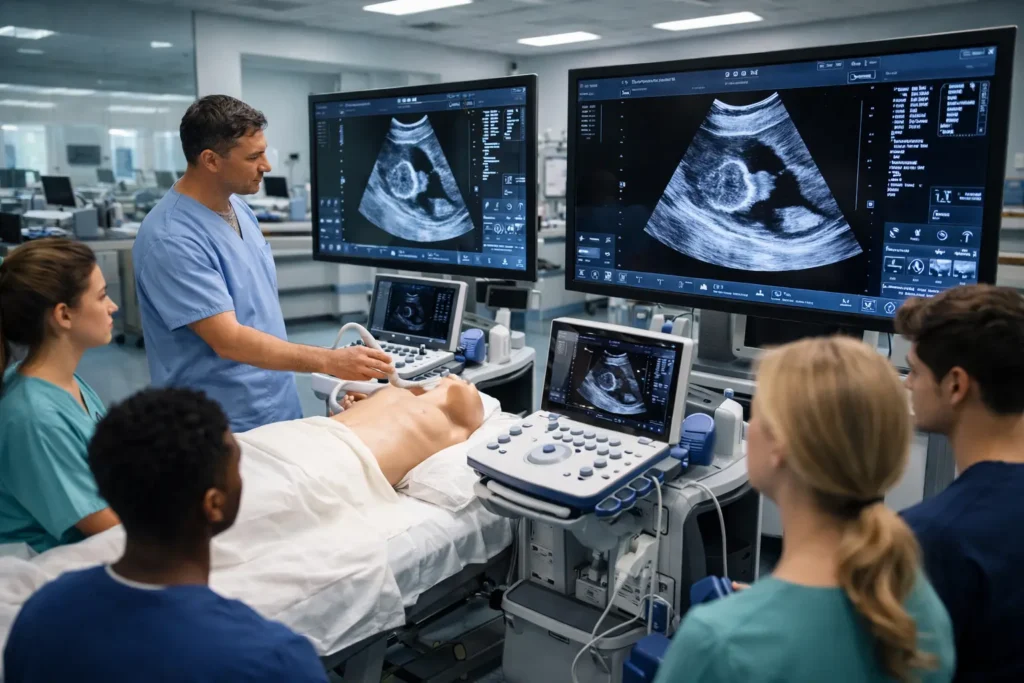
Becoming a diagnostic medical sonographer is one of the most rewarding paths in healthcare. The demand for skilled ultrasound technicians continues to grow, the pay is competitive, and every shift offers the satisfaction of helping patients and supporting medical teams with critical imaging data. But before any of that begins, you face one of the most important decisions of your career: choosing the right ultrasound technology school.
This guide is designed to be the only resource you need at this stage. We’ll walk you through what you’ll actually study, how to evaluate and compare programs, what it takes to get accepted, and exactly what happens after you graduate — from certification exams to your first job. Use it as your roadmap from curious prospective student to confident, credentialed sonographer.
Is an Ultrasound Technology School Right for You?
Before diving into program comparisons, it’s worth taking a moment to reflect on whether sonography is a good personal fit. This is a clinical, patient-facing profession that blends technical precision with genuine compassion. It’s not a desk job — and it’s not for everyone.
Key Qualities of a Successful Sonography Student
The most successful sonography students and graduates tend to share a core set of traits:
- Detail-oriented: Capturing a diagnostic-quality image requires precision. Missing subtle findings can have real consequences for patient care.
- Compassionate and calm: You’ll work with patients who are anxious, in pain, or receiving difficult news. Emotional steadiness matters.
- Technical aptitude: Sonography involves complex equipment, physics principles, and software. Comfort with technology is essential.
- Strong communicator: You’ll collaborate daily with radiologists, physicians, and nursing staff, and interact directly with patients throughout procedures.
- Physical stamina: The job involves standing for extended periods, maneuvering transducers with precision, and assisting patients with limited mobility. It’s more physically demanding than it looks.
If these qualities describe you, an ultrasound technology school is very likely the right next step.
What Will You Learn? The Core Curriculum of an Ultrasound Program
One of the first questions prospective students ask is: what exactly will I study? Ultrasound programs combine classroom instruction with intensive hands-on training. Here’s a breakdown of what to expect.
Foundational Knowledge: Prerequisite Courses
Before you can enroll in core sonography coursework, most programs require you to complete a set of prerequisite courses. These are typically taken at a community college or university before applying, and your grades in them matter — a lot. Common prerequisites include:
- Anatomy and Physiology I and II: The foundation of everything. You need to understand body systems, structures, and their relationships before you can image them.
- Medical Terminology: The shared language of healthcare. This course gives you the vocabulary to read physician orders, chart notes, and imaging requisitions.
- General Physics: Ultrasound is a sound-based technology. Understanding wave physics, reflection, frequency, and energy is directly applicable to how you’ll use the equipment every day.
- College Algebra or Math: Required for understanding measurements, calculations, and physics concepts within the program.
- English Composition: Strong written communication is required for patient documentation and professional settings.
Some programs also recommend or require Biology, Psychology, or Sociology. Always verify the specific prerequisite list for each program you’re considering, as requirements vary.
The Heart of the Program: Core Sonography Courses
Once admitted, you’ll move into the primary curriculum. Most accredited programs cover the following subject areas:
| Course Area | What You’ll Study |
|---|---|
| Ultrasound Physics & Instrumentation | Sound wave behavior, transducer types, image formation, Doppler principles, knobology, and equipment operation |
| Cross-Sectional Anatomy | Detailed study of organs and structures as they appear in axial, sagittal, and coronal imaging planes |
| Abdominal Sonography | Imaging of the liver, gallbladder, pancreas, spleen, kidneys, and aorta |
| OB/GYN Sonography | Obstetric scanning through all trimesters, fetal biometry, gynecologic imaging |
| Vascular Sonography | Doppler evaluation of arteries and veins, hemodynamics, spectral analysis, and vascular pathology |
| Small Parts Scanning | Thyroid, testes, and superficial structures |
| Pathology | Recognizing disease processes and abnormalities on ultrasound images |
| Patient Care | Safety protocols, infection control, patient positioning, and professional ethics |
Depending on the program’s specializations, you may also encounter coursework in cardiac sonography (echocardiography), musculoskeletal sonography, breast sonography, pediatric sonography, or neurosonology.
Hands-On Training: The Role of Labs and Clinical Externships
No aspect of your education is more important — or more distinctive — than the hands-on training component. Ultrasound programs include two types of practical experience:
Scanning Labs: These are on-campus sessions where you practice using ultrasound equipment under faculty supervision. You’ll scan classmates, use imaging phantoms, and develop your technique in a low-stakes environment. Lab time is where you build muscle memory and gain confidence before entering a clinical setting.
Clinical Externships/Rotations: These are real-world placements at hospitals, outpatient imaging centers, and specialty clinics. You’ll work alongside registered sonographers and perform scans on actual patients. Clinical sites vary in setting and complexity, giving you exposure to different patient populations and ultrasound applications.
It’s important to understand the difference between contact hours and credit hours. Contact hours refer to the actual time you spend in a lab or clinical setting — many programs require 1,000 or more clinical contact hours over the course of the program. This is a significant commitment, and it’s one reason why sonography training is so intensive. The volume of hands-on practice is also what makes graduates genuinely job-ready at the time of graduation.
How to Choose the Best Ultrasound Technology School: A 5-Step Checklist
This is the section most guides skip entirely. Knowing what you’ll study is one thing — knowing how to evaluate and compare the schools offering those programs is another. Here is a structured decision-making framework to guide your search.
Step 1: Verify Accreditation (Non-Negotiable)
This is the single most important factor when choosing a sonography program, and it must come before everything else.
The primary accrediting body for diagnostic medical sonography programs in the United States is CAAHEP — the Commission on Accreditation of Allied Health Education Programs. Graduating from a CAAHEP-accredited program is the standard pathway to becoming eligible to sit for the ARDMS (American Registry for Diagnostic Medical Sonography) certification exams, which are the most widely recognized credentials in the field.
If a program is not CAAHEP-accredited, you may not be eligible to take the national certification exam — which means you may not be hireable by most healthcare employers, regardless of your skills. Always verify accreditation status directly on the CAAHEP website (caahep.org) before applying to any program.
Quick Check: Go to caahep.org → “Find a Program” → search by state or school name. If the program isn’t listed, look elsewhere.
Step 2: Compare Program Types — Certificate, Associate, and Bachelor’s
Ultrasound technology schools offer programs at different levels. Each serves a different type of student and leads to different outcomes. Here’s a side-by-side comparison:
| Program Type | Typical Length | Best For | Career Outlook |
|---|---|---|---|
| Certificate | 12–18 months | Students who already hold a healthcare degree (e.g., RN, RT) | Fast entry into the field; limited upward mobility without further education |
| Associate Degree | ~2 years | High school graduates seeking direct entry into sonography | Industry standard; qualifies for all major certification exams and most entry-level roles |
| Bachelor’s Degree | ~4 years | Students who want leadership, education, or advanced career options | Higher earning potential; preferred for supervisory or academic roles |
Online and Hybrid Programs: It’s worth noting that some programs offer hybrid formats, where the didactic (classroom) portion is completed online and the lab/clinical portion is completed in person at a local site. Fully online sonography programs do not exist in a meaningful sense — you cannot learn to scan remotely. If a program advertises itself as “100% online,” verify what they mean before enrolling.
If you already have an associate degree and want to advance, look for articulation agreements — formal partnerships between community colleges and universities that allow you to transfer credits toward a bachelor’s degree.
Step 3: Evaluate the Clinical Component
After accreditation, the quality of a program’s clinical component is the most predictive factor of your readiness to work. When speaking with admissions representatives, ask these specific questions:
- How many clinical affiliate sites does the program work with?
- Are those sites in diverse settings — major hospitals, outpatient clinics, mobile imaging units, specialty centers?
- Does the program have a dedicated clinical coordinator who manages placements and resolves issues?
- Will I be guaranteed a clinical placement, or is that my responsibility to arrange?
- How many clinical contact hours does the program require?
Programs with strong, well-managed clinical networks produce graduates who are comfortable in real-world settings from day one. Programs that leave students to find their own clinical sites — or that rely on only one or two facilities — should be a red flag.
Step 4: Investigate Program Costs and Financial Aid
Tuition transparency is one of the biggest gaps in how ultrasound programs market themselves. Costs vary enormously depending on program type, institution type, and location:
- Community college associate degree programs: Typically $10,000–$25,000 in total tuition for in-state students, making them the most affordable pathway.
- Private college or university programs: Can range from $30,000–$60,000 or more for the full program.
- Certificate programs at private institutions: Often $15,000–$40,000, depending on length and location.
These figures typically cover tuition only. Factor in additional costs such as:
- Textbooks and online learning platforms
- Uniforms and clinical supplies
- Professional liability insurance (often required for clinicals)
- Application fees, background check fees, and drug screening
- Transportation to clinical sites
Financial Aid Options:
- Complete the FAFSA (Free Application for Federal Student Aid) to determine eligibility for federal grants and subsidized loans
- Ask programs about institutional scholarships specific to sonography or allied health students
- Check state-level grants and workforce development funds
- Explore military/veteran benefits (GI Bill) if applicable
- Ask about payment plans or employer tuition reimbursement if you’re already working in healthcare
Don’t let cost alone drive your decision — but don’t ignore it either. A less expensive program with strong accreditation and clinical outcomes is almost always a better value than a costly program with weaker outcomes.
Step 5: Assess Job Placement Rates and Graduate Success
Before committing to a program, ask for documented outcome data. Specifically:
- What percentage of graduates pass the ARDMS certification exam on their first attempt? (Programs often track this; national averages hover around 70–80%.)
- What is the job placement rate within 6 months of graduation?
- What types of employers hire the program’s graduates? (Community hospitals, academic medical centers, outpatient clinics, etc.)
- Do graduates report feeling prepared for the clinical demands of the job?
Reputable programs will share this data willingly. If a program can’t or won’t answer these questions, consider that a significant warning sign.
Admission Requirements: Getting Accepted
Sonography programs are selectively admitting — they do not accept everyone who applies. Understanding the requirements in advance gives you time to strengthen your application.
Common Prerequisite Courses (From an Admissions Perspective)
As discussed in the curriculum section, prerequisite courses are typically required before applying. Most programs require proof of completion with a minimum grade — often a C or better, though competitive programs may require a B or higher in science courses. Your GPA across prerequisites is frequently used as a primary screening criterion. If you earned a C in Anatomy and Physiology, it may be worth repeating the course for a better grade before applying.
Beyond Grades: Observation Hours, Essays, and Interviews
Academic performance is only part of the application picture. Most competitive programs also require:
Observation/Job Shadowing Hours: Many programs require documented hours observing a registered sonographer in a clinical setting — typically 8 to 40 hours. This requirement serves two purposes: it demonstrates your commitment and confirms that you’ve seen the job firsthand before pursuing it. Contact local hospitals or imaging centers to arrange shadowing; some may require a formal request through a volunteer or education coordinator.
Personal Statement or Essay: Your personal statement is your opportunity to explain why you want to be a sonographer, what experiences have prepared you, and what you bring to the profession beyond grades. Be specific and personal — generic statements about “wanting to help people” rarely stand out. Reference your observation experience, relevant work history, or any personal connection to medical imaging.
Letters of Recommendation: These typically come from professors (especially science faculty), healthcare professionals you’ve worked or shadowed with, or supervisors. Choose recommenders who can speak to your academic ability, work ethic, and character.
Interview: Some programs conduct in-person or virtual interviews. Prepare to discuss your motivation for choosing sonography, how you’ve handled challenging situations, and what you know about the program specifically. Showing that you’ve researched the school demonstrates genuine interest.
Other Requirements: Many programs also require a current CPR certification, background check, drug screening, and proof of certain immunizations (hepatitis B, MMR, varicella, TB test) before beginning clinical rotations.
From Student to Sonographer: Certification and Launching Your Career
Graduating from an accredited sonography program is a major milestone — but it’s not the finish line. Here’s what comes next.
Understanding Sonography Certification (ARDMS, ARRT, and CCI)
There are three primary credentialing organizations for sonographers in the United States:
- ARDMS (American Registry for Diagnostic Medical Sonography): The most widely recognized. Offers the RDMS (Registered Diagnostic Medical Sonographer), RVT (Registered Vascular Technologist), and RDCS (Registered Diagnostic Cardiac Sonographer) credentials.
- ARRT (American Registry of Radiologic Technologists): Offers a sonography credential for those already credentialed in radiologic technology.
- CCI (Cardiovascular Credentialing International): Focuses on cardiac credentials, including the RCS (Registered Cardiac Sonographer).
Graduating from a CAAHEP-accredited program satisfies the primary pathway prerequisite for ARDMS exams. After graduation, you’ll apply to sit for the exam, which includes a physics prerequisite exam (SPI — Sonography Principles & Instrumentation) and a specialty exam in your area of focus (abdomen, OB/GYN, vascular, etc.).
Important: You will not be automatically certified upon graduation. You will be eligible to apply for the certification exam. Certification requires passing the exam — plan to begin studying well before graduation.
Ongoing certification requires continuing medical education (CME) credits to maintain credentials over time.
State Licensure Requirements
Most states do not currently require a separate state license to practice as a sonographer — national certification through ARDMS or equivalent is typically sufficient. However, a small number of states do require formal licensure, including New Hampshire, New Mexico, North Dakota, and Oregon. Requirements and regulations can change, so always verify current rules with your state’s health licensing board before beginning your job search.
Exploring Sonography Specializations
One of the most exciting aspects of a sonography career is the variety of clinical paths available. After gaining your general credential, you can pursue additional certifications in specialized areas:
| Specialization | What You’ll Do |
|---|---|
| General/Abdominal Sonography | Image abdominal organs; the most common entry-level focus |
| OB/GYN Sonography | Monitor fetal development; perform gynecologic imaging |
| Cardiac Sonography (Echo) | Image the heart and great vessels; used in cardiology settings |
| Vascular Technology | Evaluate blood flow in arteries and veins; often found in vascular surgery practices |
| Pediatric Sonography | Specialize in imaging neonates, infants, and children |
| Breast Sonography | Complement mammography in breast health centers and oncology practices |
| Musculoskeletal (MSK) Sonography | Image tendons, ligaments, and soft tissue structures; increasingly used in orthopedics |
Beyond clinical roles, experienced sonographers also pursue careers in ultrasound equipment sales, clinical applications training, sonography education, and program administration — paths that leverage your expertise without requiring daily scanning.
faqs
How long is ultrasound technology school?
It depends on the program type. Certificate programs typically take 12 to 18 months. Associate degree programs are generally 2 years. Bachelor’s degree programs take approximately 4 years. If you’re completing prerequisites before applying, add that time to your timeline.
Is ultrasound school hard?
Yes, it is challenging — and that’s by design. The curriculum combines demanding sciences (physics, anatomy, pathology) with intensive clinical training. Students frequently describe the clinical phase as both the most difficult and the most rewarding part of the program. With strong study habits, good time management, and support from faculty, it is very manageable. Thousands of students complete it successfully each year.
Can I take ultrasound classes online?
Yes, partially. Many programs offer the didactic (lecture-based) portion of their curriculum online or in a hybrid format. However, the lab and clinical components are always in-person — you cannot develop scanning skills remotely. Be skeptical of any program advertising “fully online” ultrasound training.
Do I need a degree to become an ultrasound tech?
An associate degree is the most common and broadly accepted entry-level credential. Certificate programs exist but are generally designed for students who already hold a healthcare degree (such as an RN or radiologic technologist). A high school diploma alone is not sufficient for most accredited programs.
How much does ultrasound tech school cost?
Costs range widely — from roughly $10,000 for an in-state community college program to $60,000 or more at some private institutions. Always request a full cost-of-attendance breakdown, including tuition, fees, books, equipment, and clinical-related expenses.
What is the difference between a certificate and an associate degree in sonography?
Both can lead to certification eligibility from an accredited program, but an associate degree provides broader general education, greater transferability of credits, and more flexibility for career advancement. Most employers consider the associate degree the standard entry-level credential.
What GPA is required to get into ultrasound tech school?
Most programs list a minimum cumulative GPA of 2.5 to 3.0, but competitive programs may effectively require higher averages given the volume of applicants. Strong grades in science prerequisites (Anatomy & Physiology, Physics) carry particular weight in selective admissions processes.
Will I be certified when I graduate?
No. Graduation makes you eligible to apply for certification exams — it does not confer certification itself. You must apply to the appropriate credentialing body (typically ARDMS), meet all exam prerequisites, and pass both the physics exam (SPI) and your specialty exam to earn your credential.
Conclusion: Your Next Step Starts With the Right School
The job outlook for diagnostic medical sonographers is strong by any measure, with demand driven by an aging population, advances in imaging technology, and the continued expansion of outpatient healthcare. But career success in this field begins long before your first day on the job — it begins with the school you choose.
Use the 5-step checklist in this guide to evaluate every program you consider:
- Confirm CAAHEP accreditation
- Choose the right degree type for your background and goals
- Assess the depth and diversity of the clinical experience
- Understand the full cost and your financial aid options
- Ask for documented outcomes — job placement rates, certification pass rates, and employer feedback
There are excellent ultrasound technology programs at community colleges, universities, and technical schools across the country. The right one for you is accredited, transparent about outcomes, and equipped to give you the hands-on clinical training that transforms a student into a confident, competent registered sonographer.
Start your research today, reach out to program directors, schedule campus visits, and arrange those observation hours. Every step you take now brings you closer to a career that makes a real difference in patients’ lives every single day.

Adrian Cole is a technology researcher and AI content specialist with more than seven years of experience studying automation, machine learning models, and digital innovation. He has worked with multiple tech startups as a consultant, helping them adopt smarter tools and build data-driven systems. Adrian writes simple, clear, and practical explanations of complex tech topics so readers can easily understand the future of AI.