
Introduction
At some point in every career, success stops being just about talent and hard work and starts being about one critical relationship: their boss. You can be excellent at what you do and still feel stuck, frustrated, or misunderstood if the dynamic with your boss isn’t working. On the flip side, when you understand how to work effectively with their boss—even when personalities clash—your job becomes clearer, your stress drops, and opportunities start opening up.
Most people don’t quit jobs; they quit bosses. That old saying exists for a reason. A boss controls priorities, performance reviews, promotions, workload, and often your day-to-day emotional climate. Yet very few of us are ever taught how to manage this relationship intentionally. We’re told to “just do good work,” as if that alone guarantees recognition and growth.
This guide changes that. You’ll learn what “their boss” really represents in the workplace, how to decode different boss styles, and how to adapt without losing your integrity. We’ll walk through real-world benefits, step-by-step strategies, tools, common mistakes, and practical fixes—so you can move from reacting to their boss to confidently working with them. Whether you’re early in your career or managing seasoned leadership, this article will give you clarity, control, and momentum.
Topic Explanation: What “Their Boss” Really Means in the Workplace
When people talk about “their boss,” they usually mean the person with authority over their role. But in reality, a boss is much more than a job title. Their boss is a decision-maker, a gatekeeper, a coach, and sometimes a source of pressure or motivation—all rolled into one.
Think of their boss as the lens through which your work is seen. Two employees can produce the same output, but if their boss values speed over precision (or vice versa), the outcomes will be judged very differently. Understanding this lens is the foundation of professional success.
There are also layers to what “their boss” represents:
- Strategic direction: What matters most right now
- Expectations: How success is measured
- Communication style: How information flows
- Power dynamics: Who influences decisions
A helpful analogy is driving with a GPS. You may know how to drive well, but if your GPS (their boss) is directing you toward a different destination than you expect, frustration is guaranteed. Alignment—not blind obedience—is the goal.
Importantly, understanding their boss doesn’t mean flattering, manipulating, or sacrificing your values. It means recognizing human patterns, constraints, and priorities so you can collaborate effectively. Once you see their boss as a partner in outcomes rather than an obstacle, your entire approach to work shifts.
Benefits & Use Cases: Why Understanding Their Boss Changes Everything
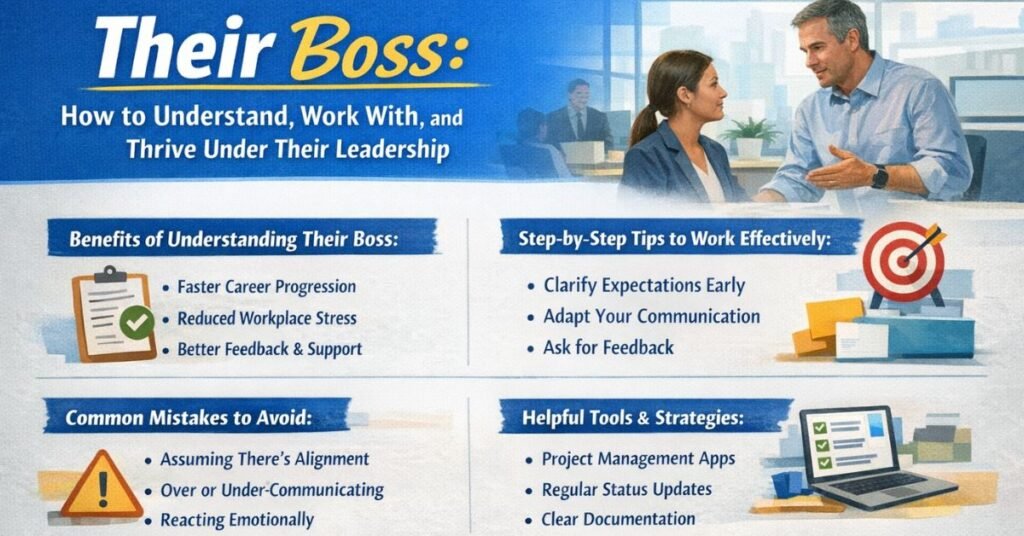
Learning how to work effectively with their boss pays off in ways that go far beyond performance reviews. The most immediate benefit is clarity. When you understand what their boss actually cares about, you stop guessing and start delivering with precision.
Professionals who manage this relationship well often experience:
- Faster career progression due to visibility and trust
- Reduced workplace stress from fewer misunderstandings
- Better feedback that leads to real improvement
- Stronger advocacy during promotions or raises
Consider a common scenario: two team members work equally hard. One constantly feels overlooked, while the other gets praised and promoted. The difference is rarely effort. It’s alignment. The second employee understands how their boss thinks, communicates in a way their boss prefers, and anticipates needs before they’re verbalized.
This skill is especially valuable in:
- Remote or hybrid environments where miscommunication is easy
- Fast-growing companies with shifting priorities
- Cross-functional teams reporting to multiple leaders
- High-pressure roles where expectations change quickly
Understanding their boss also protects you. When priorities shift or leadership changes, those who’ve built strong, adaptable relationships are more resilient. They’re seen as reliable professionals rather than replaceable resources. In short, mastering how to work with their boss isn’t office politics—it’s career insurance.
Step-by-Step Guide: How to Work Effectively With Their Boss
Building a strong working relationship with their boss is a skill, not luck. Here’s a practical, repeatable process you can apply in almost any workplace.
First, observe before you act. Pay attention to how their boss communicates. Do they prefer concise updates or detailed explanations? Are they data-driven or intuition-led? Observation gives you insight without risk.
Second, clarify expectations early. Don’t assume your boss’s version of “urgent” or “done” matches yours. Ask clear questions:
- What does success look like for this task?
- How will this be evaluated?
- When do you want updates?
Third, adapt your communication style. This is not about changing who you are—it’s about translation. If their boss values brevity, lead with conclusions. If they value context, provide background before recommendations.
Fourth, manage up proactively. Share progress before being asked. Flag risks early with solutions, not just problems. This builds trust and positions you as dependable.
Finally, ask for feedback regularly. Not just during reviews, but in real time. Short questions like “Is this the level of detail you’re looking for?” can save weeks of misalignment.
Best practices to remember:
- Respect their time
- Be consistent and reliable
- Document agreements and priorities
- Stay solution-oriented, especially under pressure
Over time, these habits turn their boss into an ally rather than a source of anxiety.
Tools, Comparisons & Recommendations for Managing the Boss Relationship
While relationships are human, the right tools can make working with their boss smoother and more transparent. Tools don’t replace communication—but they support it.
Free tools like shared documents, email summaries, and calendar notes help maintain alignment. A simple weekly update email can dramatically reduce confusion. Free project boards allow visibility without constant check-ins.
Paid tools offer deeper advantages:
- Task management platforms provide real-time status updates
- Performance tracking tools document achievements over time
- Communication platforms centralize decisions and feedback
Free options are best if:
- Your team is small
- Work is straightforward
- Communication is frequent and informal
Paid tools are worth it when:
- Multiple stakeholders are involved
- Projects are complex or long-term
- Accountability and documentation matter
No matter the tool, the key is consistency. Choose one system and use it reliably. Also, align with your boss’s preferences. If their boss lives in email, don’t hide updates in a tool they rarely open.
Expert recommendation: treat tools as a shared workspace, not a surveillance system. Transparency builds trust only when it’s mutual and respectful.
Common Mistakes & Fixes When Dealing With Their Boss
Even experienced professionals make avoidable mistakes with their boss. The good news? Most issues are fixable once you recognize the pattern.
One common mistake is assuming your boss thinks like you. This leads to misaligned priorities and disappointment. The fix is simple: ask clarifying questions and reflect back what you heard.
Another mistake is over-communicating or under-communicating. Some employees flood their boss with details; others go silent. Both create frustration. The solution is calibration—ask how often and in what format updates are preferred.
Emotional reactions are another pitfall. Taking feedback personally or reacting defensively damages trust. Instead, pause, ask follow-up questions, and treat feedback as data, not judgment.
Other frequent errors include:
- Waiting too long to raise concerns
- Complaining without offering solutions
- Trying to impress instead of deliver value
- Avoiding difficult conversations
Fixing these issues starts with self-awareness. If something isn’t working, don’t label their boss as “difficult” immediately. Look for adjustment points on both sides. Small changes in approach often produce outsized improvements.
Conclusion
Your relationship with their boss is one of the most influential factors in your professional life. It shapes how your work is perceived, how opportunities find you, and how satisfied you feel day to day. The good news is that this relationship is not fixed or mysterious—it’s a skill you can learn, refine, and master.
By understanding what their boss truly values, communicating with intention, and managing up proactively, you move from reacting to leading your own career experience. You don’t need to be perfect, political, or fake. You need to be observant, adaptable, and clear.
Take one insight from this guide and apply it this week. Start a clearer conversation. Ask a better question. Send a smarter update. Over time, these small actions compound into trust, influence, and growth. If this article helped, share your experience or explore related workplace guides to keep leveling up.
FAQs
What does “their boss” usually refer to at work?
It refers to the direct manager or supervisor responsible for evaluating performance, assigning priorities, and guiding work.
How can I improve communication with their boss?
Observe their preferred style, ask clarifying questions, and adapt how you share updates and feedback.
Is managing up the same as office politics?
No. Managing up is about alignment and clarity, not manipulation or favoritism.
What if their boss has a difficult personality?
Focus on what you can control: communication, documentation, and professionalism. Adjust without compromising values.
How often should I update their boss?
It depends on their preference and project complexity. Ask directly to avoid guessing.

Michael Grant is a business writer with professional experience in small-business consulting and online entrepreneurship. Over the past decade, he has helped brands improve their digital strategy, customer engagement, and revenue planning. Michael simplifies business concepts and gives readers practical insights they can use immediately.