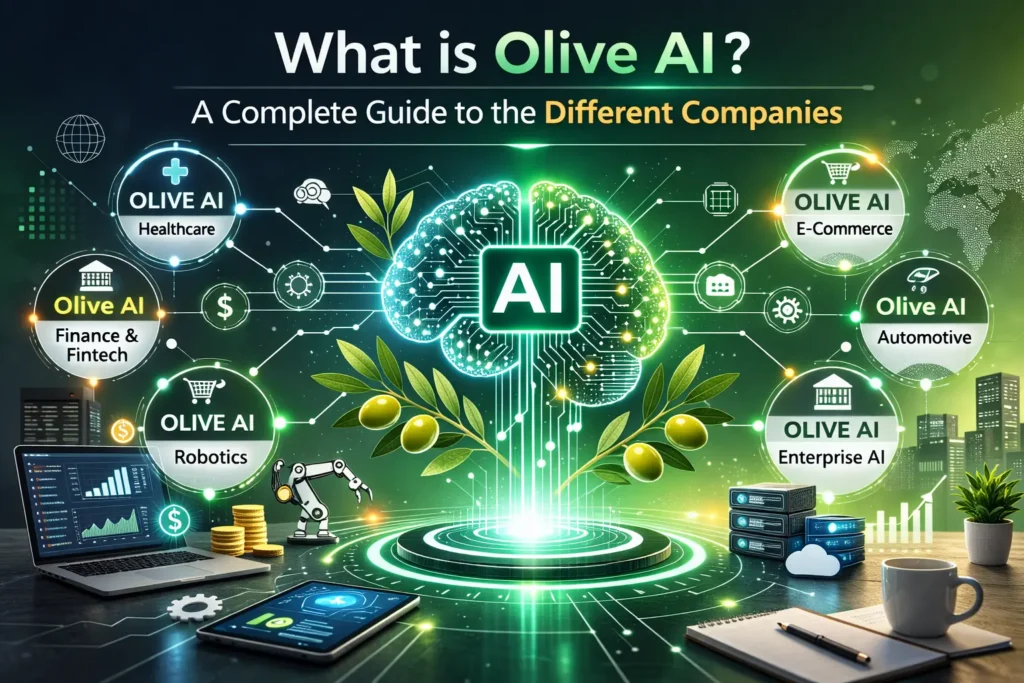
If you’ve searched for ‘Olive AI’ recently, you’ve probably noticed something strange: the results pull in entirely different companies, industries, and use cases. You might land on a defunct healthcare automation firm, a SaaS vendor-sourcing platform, a sales AI tool, or a research organization fighting racial bias in speech recognition — all within the same search results page.
This fragmentation is not an accident. The name ‘Olive AI’ (and its close variants: Oliv.ai, Olive.app, Olive.is, and Olivelab.ai) has been independently claimed by at least five separate entities, none of which are affiliated with one another. Each operates in a different industry, targets a different audience, and solves a different problem.
This guide cuts through the confusion. It provides a clear, structured overview of every major entity operating under the Olive AI umbrella, explains what each one does, who it serves, and what sets it apart. By the end, you’ll know exactly which ‘Olive AI’ is relevant to you — and why all the others aren’t.
1. Olive: The Defunct Healthcare AI Giant
For anyone working in US healthcare technology between 2019 and 2023, ‘Olive AI’ meant one thing: the Columbus, Ohio-based startup that raised over $900 million and promised to automate the administrative backbone of American hospitals.
Founded in 2012 and rebranded around AI-driven healthcare automation, Olive built its product around robotic process automation (RPA) — software robots that could mimic human interactions with computer systems to carry out repetitive, rules-based tasks at scale. The primary use cases included prior authorization processing, utilization management, claims adjudication, and revenue cycle management.
At its height, Olive was valued at $4 billion and positioned itself as an ‘AI workforce for healthcare.’ Its pitch was compelling: hospitals and health systems were drowning in administrative overhead, and Olive’s automation platform could perform those tasks faster, more accurately, and at a fraction of the cost of human labor.
What Happened to the Original Olive AI?
Olive’s story is a cautionary tale in the annals of health-tech investment. Despite its enormous fundraising and high-profile partnerships, the company struggled to deliver consistent, scalable results. Clients reported implementation difficulties, and the company faced the classic challenge of deploying AI in an industry defined by legacy systems, regulatory complexity, and deeply siloed data.
In 2023, Olive began a significant restructuring, selling off product lines and laying off staff. Its core assets were ultimately acquired by Waystar, a healthcare payments and revenue cycle management company. If you navigate to Olive’s old LinkedIn page or website today, you will likely be redirected to Waystar’s properties.
For researchers, investors, or former customers searching for information about the original Olive AI, the key takeaway is this: the company no longer exists as an independent entity. Its technology and some of its team live on within Waystar, but the ‘Olive AI’ brand is effectively retired in the healthcare space.
Key Facts: Original Olive AI
- Founded: 2012 (Columbus, Ohio)
- Core Technology: Robotic Process Automation (RPA) and machine learning
- Primary Market: US hospitals, health systems, payers
- Key Use Cases: Prior authorization, utilization management, revenue cycle automation
- Peak Valuation: ~$4 billion
- Current Status: Defunct; core assets acquired by Waystar
2. Olive.app: The AI Vendor Sourcing & Comparison Platform
Pivot entirely from healthcare to procurement technology, and you’ll find Olive.app — a SaaS platform purpose-built to help enterprises and technology consultants evaluate, compare, and select AI vendors. Where the original Olive AI was about deploying AI inside organizations, Olive.app is about helping organizations find and buy the right AI.
The core insight behind Olive.app is that buying enterprise AI is genuinely hard. The market is enormous, vendor claims are often opaque, and requirements vary dramatically between organizations. Traditional software procurement processes — spreadsheets, informal demos, gut instinct — simply do not scale to a category as complex and fast-moving as artificial intelligence.
Olive.app addresses this by providing a structured, data-driven sourcing environment. Users define their requirements, and the platform surfaces and scores potential vendors against those needs, supports the creation of Request for Proposal (RFP) documents, and provides a collaborative workspace for evaluation teams.
Key Features of Olive.app’s Platform
- RFP Creation Wizard: A guided workflow that helps procurement teams build comprehensive AI vendor RFPs without needing deep technical knowledge. The wizard translates business requirements into evaluable criteria.
- Vendor Scoring & Comparison: Vendors are scored against user-defined requirements, enabling side-by-side comparisons based on capabilities, pricing models, security posture, and integration support.
- Requirements Ranking: Teams can assign weights to different criteria, ensuring that vendor scores reflect the organization’s actual priorities rather than a generic checklist.
- Collaboration Tools: Multiple stakeholders — IT, legal, business owners — can contribute to evaluations within a shared workspace, reducing the chaos of email-based procurement.
- Due Diligence Support: The platform provides structured frameworks for vendor due diligence, covering areas like data security, SLA commitments, and proof of concept (PoC) design.
Who Is Olive.app For?
Olive.app primarily targets three groups:
- IT Leaders and CIOs: Executives responsible for technology strategy who need a defensible, structured process for making AI investment decisions.
- Technology Consultants: Advisors who help client organizations evaluate and implement AI solutions, and who benefit from a platform that standardizes the sourcing process across engagements.
- Enterprise Procurement Teams: Professionals in large organizations navigating complex, multi-stakeholder AI purchasing decisions.
The platform is less suited to individual developers, small startups evaluating basic tools, or organizations that have already made their AI vendor decisions and are in implementation mode.
3. Oliv.ai: AI Agents for Revenue Teams
Drop the ‘e’ and add a dot, and you get Oliv.ai — a platform that operates in an entirely different domain: enterprise sales and revenue operations. Oliv.ai describes itself as a revenue orchestration platform, which means it uses AI agents to automate, analyze, and improve the processes that drive revenue growth.
The core problem Oliv.ai solves is a familiar one in sales organizations: despite significant investment in CRM systems like Salesforce, adoption remains stubbornly low, data quality is poor, and revenue leaders lack reliable visibility into pipeline health. The result is a cascade of downstream problems — inaccurate forecasting, missed deals, inconsistent coaching, and preventable revenue leaks.
Oliv.ai’s approach is to deploy purpose-built AI agents that sit alongside existing tools (CRM, email, Slack, meeting platforms) and perform specific, high-value tasks automatically.
Oliv.ai’s Core AI Agents
- Deal Driver: An AI agent that monitors active deals in real time, surfaces risk signals, and recommends specific actions to advance stalled opportunities. It draws on conversation intelligence, CRM data, and engagement signals to produce deal-level insights.
- Forecaster: Provides AI-powered pipeline forecasting by analyzing deal progression patterns and historical conversion data. The goal is to replace spreadsheet-based forecasting with predictive, real-time intelligence.
- Coach: Reviews sales calls and meeting recordings to score rep performance against defined criteria, identify coaching opportunities, and surface best-practice examples for onboarding and training.
- Meeting Assistant: Captures, transcribes, and summarizes sales meetings. It also auto-populates CRM records based on meeting content, directly addressing the CRM adoption problem.
How Oliv.ai Automates Revenue Processes
Oliv.ai’s architecture is designed around integration rather than replacement. It connects to the tools revenue teams already use — Salesforce, HubSpot, Slack, Gmail, Google Meet, Zoom — and enriches those environments with AI-generated insights rather than requiring teams to migrate to a new system.
This integration-first approach reduces change management friction, which is often the primary barrier to AI adoption in sales organizations. Reps continue to work in familiar tools; the AI agent surfaces relevant information contextually within those workflows.
The platform is structured around three tiers of team maturity:
- Small, growing teams that need foundational deal visibility and basic automation
- Scaling teams that require more sophisticated forecasting and coaching capabilities
- Large enterprises that need full revenue orchestration across complex, multi-product sales motions
Oliv.ai for Different Team Sizes
A notable aspect of Oliv.ai’s positioning is its explicit acknowledgment that different organizations need different things from revenue AI. Its tiered approach allows smaller teams to start with high-impact, low-complexity features like the Meeting Assistant, and graduate to more sophisticated capabilities — like AI-driven forecasting and deal risk scoring — as their data maturity and organizational readiness improve.
4. Olive.is: Fighting Bias in Voice AI
The most conceptually distinctive entity in the Olive AI landscape is Olive.is — a research-driven company with a singular, morally urgent mission: to detect, measure, and mitigate racial and linguistic bias in automated speech recognition (ASR) systems.
While other companies bearing the Olive name focus on efficiency, procurement, or revenue growth, Olive.is is focused on a problem that sits at the intersection of technology and social justice: the well-documented tendency of AI voice systems to perform significantly worse for speakers of non-dominant dialects, particularly African American English (AAE).
The Problem: Covert Racism in AI Voice Systems
Olive.is frames the central challenge it addresses as ‘covert racism’ in AI — a form of algorithmic discrimination that is invisible in system design but measurable in outcomes. Unlike overt bias (explicitly discriminatory decision-making), covert racism emerges from the statistical properties of training data and the way AI systems handle linguistic variation.
The evidence base is substantial. Academic research has demonstrated that leading ASR systems — the technology that converts spoken language to text, used in everything from virtual assistants to medical transcription — show significantly higher word error rates (WER) for speakers of AAE compared to Standard American English (SAE). This is not a marginal difference: some studies show error rates two to three times higher for AAE speakers.
The downstream consequences of this disparity are serious and span multiple high-stakes domains:
- Healthcare: Medical AI tools that mishear patients can produce inaccurate clinical documentation, contribute to misdiagnoses, and perpetuate race-based medicine assumptions embedded in training data.
- Legal: Court transcription systems that perform poorly for AAE speakers can produce inaccurate records that affect legal proceedings and sentencing.
- Hiring: AI-powered interview screening tools that score voice input more harshly for non-dominant dialect speakers can systematically disadvantage qualified candidates.
- Education: Reading and language assessment tools may underperform for students whose home dialect differs from Standard American English, misidentifying dialect as error.
Olive.is also addresses what it terms ‘stereotype retrieval’ — the tendency of language models to associate certain demographic groups with particular attributes, reinforcing harmful stereotypes even when no explicit discriminatory intent exists in the system design.
Olive.is’s Technical Approach to Fairness
Olive.is approaches the bias problem through a combination of linguistic rigor and novel technical architecture. Rather than simply flagging that bias exists, their system is designed to produce fairer, more accurate transcription outputs for speakers of multiple English dialects.
Key technical elements of their approach include:
- Phoneme-Level Recognition: Rather than treating words as indivisible units, Olive.is operates at the phoneme level — the smallest units of sound — allowing the system to account for the systematic phonological differences between dialects like AAE, Chicano English, and SAE.
- Dialect-Preserving Output: Instead of forcing non-standard dialectal features into a standard orthographic representation (which introduces errors), the system is designed to preserve dialectal features in its transcripts, producing what Olive.is calls a ‘linguistically structured transcript.’
- MxAL Framework: Olive.is has developed a proprietary fairness evaluation framework (referred to as MxAL) for measuring and benchmarking ASR performance across dialect groups.
- Explainable Insights: In keeping with their commitment to transparency, the system produces outputs that explain why a particular transcription was generated, rather than returning opaque text strings.
Their work draws on and cites peer-reviewed research from linguists and computer scientists studying dialect diversity and algorithmic fairness, including work by Hofmann et al., Koenecke et al., and Omiye et al. This grounding in the academic literature gives Olive.is a credibility that distinguishes it from companies making general claims about ‘responsible AI’ without rigorous empirical backing.
5. Olivelab.ai: Custom, Transparent NLP Assistants
Rounding out the Olive AI landscape is Olivelab.ai, a consultancy and development studio that builds bespoke NLP-powered AI assistants for enterprise clients. Unlike platform businesses such as Oliv.ai or Olive.app — which offer standardized products that customers adopt and configure — Olivelab.ai’s model is one of custom engineering.
The company positions itself at the intersection of two capabilities: technical NLP expertise and a principled commitment to explainable, human-centric AI design. In a market where many AI vendors compete on capability claims, Olivelab.ai differentiates on trustworthiness and transparency.
What Olivelab.ai Builds
Olivelab.ai’s work spans a range of NLP applications, including:
- Custom AI Assistants: Conversational agents built around a client’s specific domain knowledge, terminology, and workflow requirements. These are not off-the-shelf chatbots reconfigured with custom branding — they are purpose-built systems trained on client-specific data.
- Insight Extraction Systems: Tools that process large volumes of unstructured text (documents, emails, reports, transcripts) and extract structured, actionable information.
- Intelligent Automation: NLP-driven workflow automation for tasks that involve language understanding — document classification, entity extraction, sentiment analysis, and similar applications.
- Consulting Services: Strategic advisory work to help organizations define AI requirements, assess readiness, design implementation roadmaps, and manage the change management challenges that accompany AI deployment.
The Olivelab.ai Difference: Trust and Explainability
What separates Olivelab.ai from the broad field of NLP development shops is its explicit philosophical commitment to what practitioners call ‘no black boxes.’ In AI systems, a black box is a model that produces outputs without any explanation of how it arrived at them — the system gives you an answer, but not a reason.
For enterprise applications where decisions carry real consequences — approving a loan, flagging a compliance risk, classifying a medical document — unexplainable AI creates significant legal, ethical, and operational risk. If a system makes a wrong decision and the organization cannot explain why, it cannot fix the problem, defend itself in litigation, or satisfy regulators.
Olivelab.ai’s design philosophy addresses this directly through:
- Transparent Decision-Making: Every significant output from an Olivelab.ai system comes with a traceable explanation of the reasoning process that produced it.
- Bias Checking: Systems are evaluated for bias before and during deployment, with documented processes for identifying and mitigating disparate impact across demographic groups.
- Human Oversight Integration: The company designs its systems with explicit human-in-the-loop review points, ensuring that high-stakes decisions are not made autonomously without human accountability.
- Ethical Design Principles: Olivelab.ai applies a set of ethical design principles throughout the development process, from data selection through model training to output auditing.
This approach aligns closely with the ‘explainable AI’ (XAI) movement that has gained significant traction in enterprise technology, particularly in regulated industries like finance, healthcare, and legal services.
Olive AI: At-a-Glance Comparison Table
The following table summarizes the key distinctions between the five entities discussed in this guide:
| Company | Primary Function | Best For | Key Feature | Status |
| Olive (Original) | Healthcare AI & RPA | Hospitals & health systems | Prior auth automation | Defunct (→ Waystar) |
| Olive.app | AI Vendor Sourcing | IT leaders, consultants, procurement teams | RFP creation wizard | Active |
| Oliv.ai | Revenue AI Agents | Sales, RevOps, Customer Success teams | Deal Driver & Forecaster AI agents | Active |
| Olive.is | Voice AI Bias Detection | Research, healthcare, hiring, legal tech | Dialect-aware ASR fairness engine | Active |
| Olivelab.ai | Custom NLP Assistants | Enterprises needing bespoke AI solutions | Explainable, transparent AI design | Active |
faqs
What is Olive AI?
‘Olive AI’ is not a single company or product — it is a name shared by multiple distinct entities across different industries. Depending on the context, it may refer to the defunct US healthcare automation company (now part of Waystar), a vendor sourcing platform (Olive.app), a sales AI agents platform (Oliv.ai), a voice bias research company (Olive.is), or a custom NLP development studio (Olivelab.ai). This guide covers all five.
What happened to the original Olive AI healthcare company?
The original Olive AI, a Columbus, Ohio-based healthcare automation startup, shut down as an independent company in 2023 after struggling to scale its robotic process automation (RPA) product across the healthcare industry. Its core assets were acquired by Waystar, a healthcare revenue cycle management company. Searches for ‘Olive AI’ that return LinkedIn results or Bloomberg profiles are typically referring to this defunct entity.
Is Olive AI the same as Oliv.ai?
No. Oliv.ai is a separate, independently operating company that provides AI agents for sales and revenue teams. It has no connection to the defunct Olive healthcare company, Olive.app, Olive.is, or Olivelab.ai beyond a similar name. The two-letter difference (Olive vs. Oliv) is the only visual distinction.
What is Olive.app used for?
Olive.app is a software platform that helps organizations source, evaluate, and select AI vendors. It is used primarily by IT leaders, technology consultants, and enterprise procurement teams to manage the complex process of buying AI — from defining requirements and building RFPs through vendor scoring, comparison, and due diligence.
How does Oliv.ai help with sales?
Oliv.ai deploys AI agents that integrate with a sales team’s existing tools (CRM, email, Slack, meeting platforms) to automate high-effort, low-value tasks, surface real-time deal intelligence, improve forecasting accuracy, and provide AI-driven coaching. Its core agents include Deal Driver (deal risk and advancement), Forecaster (pipeline prediction), Coach (rep performance analysis), and Meeting Assistant (transcription and CRM auto-population).
What is AI bias, and how does Olive.is address it?
AI bias refers to systematic errors in AI outputs that disproportionately affect certain demographic groups. Olive.is specifically addresses bias in automated speech recognition (ASR) systems, which have been shown to produce significantly higher error rates for speakers of African American English (AAE) and other non-dominant dialects. Olive.is addresses this through phoneme-level recognition, dialect-preserving transcription, and a proprietary fairness evaluation framework.
What are AI agents?
AI agents are software systems that use artificial intelligence to autonomously perform specific tasks, often by perceiving their environment (data, inputs, tool integrations), reasoning about what action to take, and executing that action without continuous human instruction. Oliv.ai’s Deal Driver, for example, is an AI agent that monitors CRM data and sales communications, identifies deal risks, and recommends specific actions — all without a human needing to prompt it to do so.
What are the benefits of enterprise AI?
Enterprise AI can deliver measurable benefits across multiple dimensions: operational efficiency through automation of repetitive tasks; better decision-making through pattern recognition and predictive analytics applied to large datasets; improved customer experiences through personalization and intelligent service delivery; and competitive advantage through faster product development and market response. The most successful enterprise AI deployments are characterized by clear use-case definition, high-quality data, strong change management, and ongoing performance monitoring.
Conclusion: Which Olive AI Is Right for You?
The Olive AI naming landscape is fragmented in a way that creates genuine confusion for anyone trying to understand the category. But that confusion dissolves quickly once you understand the distinct problems each entity is designed to solve.
Here is a simple decision framework:
- If you’re a hospital or health system administrator looking for the original Olive AI platform: That company no longer exists independently. The relevant successor is Waystar, which acquired Olive’s core healthcare revenue cycle assets.
- If you’re evaluating which AI vendor to buy from: Olive.app is the purpose-built tool for this problem. It provides a structured, collaborative sourcing environment with RFP creation, vendor scoring, and due diligence support.
- If you’re a sales leader, RevOps professional, or customer success manager: Oliv.ai offers a suite of AI agents specifically designed to improve pipeline visibility, forecast accuracy, CRM adoption, and rep performance.
- If you’re building or deploying voice AI and concerned about fairness: Olive.is is doing the most rigorous technical and research work in this space. Their work on dialect-aware ASR and covert bias detection is an essential reference point.
- If you need custom NLP solutions built with a commitment to explainability and ethical design: Olivelab.ai offers bespoke development and consulting services with a principled approach to transparent AI.
The common thread that links the most interesting parts of the Olive AI landscape is not automation or efficiency — though both matter — but trust. Olive.is is fighting to make AI voice systems trustworthy for all speakers, not just the demographic majority. Olivelab.ai is building AI that earns trust through explainability. Olive.app is trying to make the process of buying AI more trustworthy and defensible. Even the original Olive AI’s story is, at its core, a story about the gap between the trust organizations placed in it and the results it delivered.
As AI continues to proliferate across industries and job functions, the ability to evaluate, deploy, and hold accountable AI systems will become an increasingly critical organizational competency. The companies in this guide represent different but complementary responses to that challenge — each addressing a different part of the problem of making AI work, fairly and effectively, in the real world.

Adrian Cole is a technology researcher and AI content specialist with more than seven years of experience studying automation, machine learning models, and digital innovation. He has worked with multiple tech startups as a consultant, helping them adopt smarter tools and build data-driven systems. Adrian writes simple, clear, and practical explanations of complex tech topics so readers can easily understand the future of AI.