
Introduction
If you’ve ever booked a ride, hired a delivery van, or paid someone to move goods or people from Point A to Point B, you’ve interacted with the transport industry—whether you realized it or not. Transportation is one of those essential services that quietly keeps economies moving. But when that service operates outside legal or licensing frameworks, the consequences can ripple far beyond a single trip.
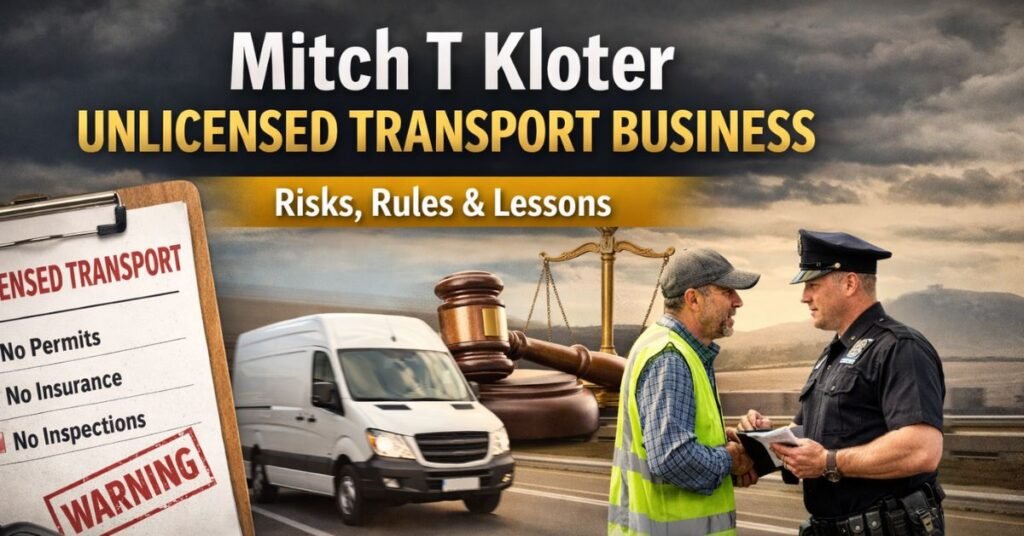
The phrase mitch t kloter unlicensed transport business has been circulating online, often prompting confusion, concern, and questions. Is it a business? A case? A cautionary tale? More importantly, why does unlicensed transport matter so much, and what can individuals, customers, and entrepreneurs learn from it?
This guide breaks everything down clearly and responsibly. You’ll learn what an unlicensed transport business actually is, why licensing exists in the first place, the real-world risks involved, and how transport operators can do things the right way. Whether you’re a curious reader, a business owner, or someone researching transport compliance, this article is designed to give you clarity, context, and practical insight—without hype, fear-mongering, or speculation.
By the end, you’ll understand not just the keyword, but the bigger picture behind unlicensed transport operations and how to avoid costly mistakes.
Topic Explanation: What “Unlicensed Transport Business” Really Means
At its core, an unlicensed transport business is exactly what it sounds like: a transportation operation that provides services without holding the legally required permits, registrations, or approvals from relevant authorities.
Think of licensing like a driver’s license for a business. Just as individuals must prove competence before driving, transport companies must demonstrate compliance before operating. This typically includes vehicle registration, commercial insurance, safety inspections, driver qualifications, and sometimes local or federal operating authority.
When people search for mitch t kloter unlicensed transport business, they are often trying to understand a specific situation or allegation tied to broader industry concerns. Rather than focusing on any one name, it’s more useful—and responsible—to understand the category of activity the term represents.
Unlicensed transport can take many forms:
- Passenger rides offered without commercial permits
- Freight hauling without operating authority
- Shuttle or courier services bypassing insurance requirements
- Independent drivers unknowingly violating transport laws
A helpful analogy is food service. Imagine a restaurant operating without health inspections. Even if the food tastes good, the lack of oversight puts customers at risk. Transport licensing works the same way: it exists to protect safety, accountability, and fairness.
Understanding this foundation is critical before judging any situation or deciding how to proceed as a consumer or operator.
Benefits & Use Cases: Why Licensing Exists and Who It Protects
It’s easy to assume licensing is just bureaucratic red tape, but in transport, licensing serves very real and practical purposes. When done properly, it benefits almost everyone involved.
First, licensing protects customers and passengers. Licensed transport operators are typically required to carry commercial insurance, follow safety protocols, and maintain vehicles to specific standards. If something goes wrong—an accident, loss of cargo, or injury—there’s a legal and financial framework to handle it.
Second, licensing protects drivers and operators themselves. Many unlicensed operators don’t realize that one accident can wipe them out financially. Without proper coverage, they may be personally liable for damages, medical costs, or legal fees.
Third, licensing supports fair competition. Legitimate transport businesses invest time and money into compliance. When unlicensed operators undercut prices by skipping regulations, it creates an uneven playing field and drives standards down across the industry.
Common legitimate use cases for licensed transport include:
- Ride-hailing and shuttle services
- Local and interstate freight hauling
- Courier and last-mile delivery businesses
- Specialized transport (medical, school, hazardous goods)
The takeaway is simple: licensing isn’t about control—it’s about trust. When licensing is ignored, that trust breaks down, and everyone absorbs the risk.
Step-by-Step Guide: How Transport Businesses Should Operate Legally
If there’s one thing years of real-world business observation teaches, it’s this: most compliance failures happen because people don’t know the steps—or assume they don’t apply to them. Here’s a clear, practical roadmap for operating a transport business legally.
Step one is defining your transport activity. Are you carrying passengers or goods? Operating locally or across state lines? Using personal vehicles or a fleet? Each answer changes the licensing requirements.
Step two is registering the business properly. This includes business formation, tax registration, and commercial classification. Many operators mistakenly believe a sole proprietorship doesn’t need formal registration. That’s rarely true in transport.
Step three involves obtaining transport-specific licenses. Depending on location, this may include:
- Operating authority or permits
- Commercial vehicle registration
- Driver certifications or endorsements
- Local municipality approvals
Step four is insurance and safety compliance. Commercial insurance, routine inspections, and driver training are not optional add-ons—they’re core requirements.
Finally, step five is ongoing compliance. Licensing isn’t “set it and forget it.” Renewals, reporting, and audits are part of running a legitimate operation.
Businesses that skip steps often don’t fail immediately—but when problems arise, they escalate fast.
Tools, Comparisons & Recommendations
Navigating transport compliance manually can be overwhelming, especially for small operators. Thankfully, there are tools and services designed to simplify the process.
Compliance management platforms help track license renewals, inspections, and documentation. These tools reduce human error and ensure nothing slips through the cracks. Paid options typically offer reminders, digital storage, and regulatory updates, while free tools may only cover basic tracking.
Professional consultants are another option. While they cost more upfront, they often save money long-term by preventing violations and fines. This is especially useful for operators expanding into new regions or service types.
When comparing free vs. paid solutions, consider:
- Complexity of your operation
- Number of vehicles and drivers
- Geographic coverage
- Risk tolerance
A small local courier may manage with basic tools, while a multi-vehicle passenger service almost always benefits from professional oversight.
The best recommendation? Match your compliance investment to your risk exposure. Transport is not an industry where cutting corners pays off.
Common Mistakes & Fixes
Unlicensed transport operations often start with good intentions. The most common mistake is assuming licensing doesn’t apply to “small” or “temporary” work. In reality, even one paid trip can trigger legal requirements.
Another frequent error is relying on personal auto insurance for commercial activity. Most personal policies explicitly exclude business use, leaving drivers exposed.
Some operators also misunderstand jurisdiction. Just because a service is legal in one city or state doesn’t mean it’s legal in another.
Fixes are straightforward but require action:
- Verify requirements before accepting payment
- Upgrade insurance before offering services
- Consult authorities or professionals when expanding
The pattern is consistent: assumptions cause problems; verification prevents them.
Conclusion
The keyword mitch t kloter unlicensed transport business reflects a broader issue that extends far beyond one name or situation. It highlights the importance of understanding how transport licensing works, why it exists, and what happens when it’s ignored.
Licensed transport builds trust, protects livelihoods, and keeps roads safer. Unlicensed operations, even when well-meaning, introduce unnecessary risk—for operators, customers, and communities.
If you’re researching this topic, take it as an opportunity to learn, not jump to conclusions. And if you’re involved in transport in any capacity, let compliance be part of your business strategy, not an afterthought.
The smartest transport businesses don’t just move people or goods—they move responsibly.
FAQs
What is an unlicensed transport business?
An operation providing transport services without required legal permits or approvals.
Is unlicensed transport always illegal?
In most jurisdictions, yes. Even small-scale paid transport often requires licensing.
Why do people operate without licenses?
Common reasons include lack of awareness, cost concerns, or misunderstanding regulations.
What risks do customers face?
Safety risks, lack of insurance coverage, and limited legal recourse if something goes wrong.
Can an unlicensed business become licensed later?
Often yes, but penalties or fines may apply depending on the situation.

Michael Grant is a business writer with professional experience in small-business consulting and online entrepreneurship. Over the past decade, he has helped brands improve their digital strategy, customer engagement, and revenue planning. Michael simplifies business concepts and gives readers practical insights they can use immediately.