Cell signaling is the intricate communication network that governs virtually every decision a living cell makes — whether to grow, divide, move, or die. Understanding cell signal technology means understanding how life coordinates itself at a molecular level. From the moment a hormone is released into your bloodstream to the instant your immune system identifies an invader, cellular communication is happening at extraordinary speed and precision. This guide explores the core science of signal transduction, the major cellular response pathways, and why mastering this knowledge is central to modern medicine and biology.
What is Cell Signal Technology? (The Core Concepts)
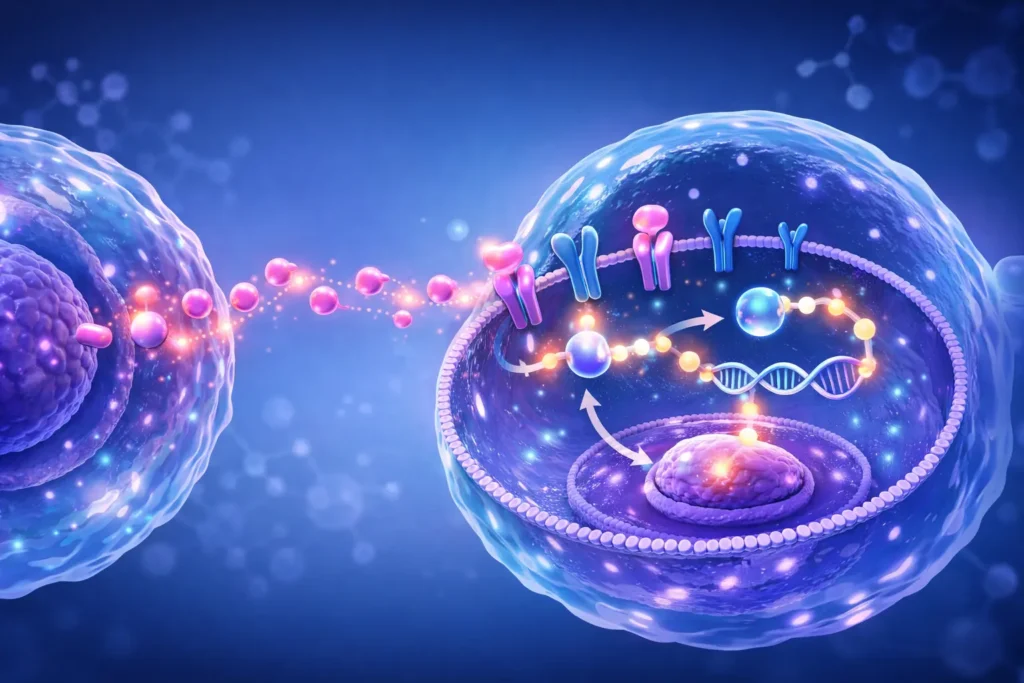
At its most fundamental level, cell signal technology refers to the biochemical mechanisms by which cells detect and respond to information from their environment or from neighboring cells. These signals can take the form of proteins, small molecules, gases, or even physical forces. The result is a highly coordinated signaling cascade that ultimately changes a cell’s behavior.
The Basic Model of Cell Signaling
All cell signaling can be broken down into three essential stages:
- Reception — A signal molecule (called a ligand) binds to a specific receptor protein on or inside the target cell. This binding causes a conformational change in the receptor, activating it.
- Transduction — The activated receptor triggers a series of molecular switches inside the cell, a process known as the signaling cascade. This often involves relay proteins, enzymes, and second messengers.
- Response — The final output of the cascade. This could mean changes in gene expression, activation of enzymes, cell movement, secretion of a substance, or even cell death.
This elegant three-step process allows a single signal molecule to trigger a massive, amplified response inside a cell. A single activated receptor can ultimately alter the behavior of thousands of molecules downstream.
Key Players in the Signaling Process
To understand cell signaling, you need to know its main molecular components:
- Ligands: Small signaling molecules (hormones, growth factors, neurotransmitters) that bind to receptors. The ligand is the “key,” and the receptor is the “lock.”
- G-Protein Coupled Receptors (GPCRs): The largest family of cell surface receptors. When a ligand binds, they activate intracellular G-proteins, which then regulate enzymes or ion channels. GPCRs govern sensory perception, mood regulation, and immune responses.
- Receptor Tyrosine Kinases (RTKs): Enzyme-linked receptors critical for growth and differentiation. When activated, they phosphorylate target proteins, initiating a cascade.
- Ion Channel Receptors: Upon ligand binding, these receptors open to allow ions (like Na⁺ or Ca²⁺) to flow across the membrane — a key mechanism in neurons.
- Intracellular Receptors: These receptors sit inside the cell and are activated by ligands that can pass through the membrane, such as steroid hormones like estrogen and cortisol.
- Second Messengers: Small molecules or ions — such as cyclic AMP (cAMP) and calcium ions (Ca²⁺) — that relay and amplify the signal inside the cell after receptor activation.
Major Types of Cell Signaling
Cells don’t always communicate the same way. The type of signaling used depends on how far the signal needs to travel and the nature of the relationship between the cells involved.
- Endocrine Signaling: Specialized cells release hormones (e.g., insulin, cortisol) into the bloodstream, traveling long distances to reach target cells throughout the body. This is the foundation of the entire hormonal system.
- Paracrine Signaling: A cell releases a signal molecule that affects neighboring cells in the same tissue. Wound healing and local inflammatory responses rely heavily on paracrine signaling.
- Autocrine Signaling: A cell releases a signal that acts on itself. This is common in immune cells and is frequently exploited by cancer cells to drive their own uncontrolled growth.
- Juxtacrine Signaling (Contact-Dependent): Requires direct physical contact between cells. The signal molecule remains attached to the signaling cell and interacts directly with receptors on the adjacent cell. The Notch pathway is the defining example.
Exploring the Major Signaling Pathways
While dozens of signaling pathways have been characterized, a handful are so central to life and disease that they merit close examination.
The MAPK/ERK Pathway: From Growth Signals to Gene Expression
The Mitogen-Activated Protein Kinase (MAPK)/ERK pathway is one of the most studied signaling routes in all of biology. Typically activated by growth factors binding to RTKs, its core sequence runs: growth factor → RTK → Ras (a small G-protein) → Raf → MEK → ERK. Once ERK is activated, it translocates to the nucleus and switches on genes controlling proliferation and differentiation, making it a master regulator of the cell cycle.
Mutations that keep Ras permanently “switched on” are found in approximately 30% of all human cancers, making this pathway one of the most important targets in oncology.
The PI3K/AKT/mTOR Pathway: Regulating Cell Survival and Metabolism
The PI3K/AKT pathway governs cell survival, growth, and metabolism. When a growth factor activates an RTK, the enzyme PI3K produces the lipid second messenger PIP3, which recruits and activates AKT (Protein Kinase B). Activated AKT promotes cell survival by blocking apoptosis (programmed cell death) and activating mTOR, which coordinates protein synthesis and cell growth. This pathway also mediates insulin’s effects on glucose metabolism. Dysregulation of the PI3K/AKT/mTOR axis is implicated in cancer, diabetes, and metabolic syndrome.
The JAK-STAT Pathway: Direct Signaling to the Nucleus
The JAK-STAT pathway offers a remarkably direct route from the cell surface to the nucleus, primarily activated by cytokines and interferons. When a cytokine binds its receptor, Janus Kinases (JAKs) are activated and phosphorylate STAT (Signal Transducer and Activator of Transcription) proteins. The phosphorylated STATs dimerize, travel to the nucleus, and activate target genes. This pathway is critical for fighting viral infections, regulating inflammation, and controlling immune cell differentiation. JAK inhibitors are now approved treatments for rheumatoid arthritis and certain cancers.
The Wnt Signaling Pathway: Controlling Development and Stem Cells
The Wnt pathway is essential for embryonic development, tissue maintenance, and stem cell renewal. In the absence of Wnt protein, a “destruction complex” continuously tags β-catenin for degradation. When Wnt binds to the Frizzled receptor, this complex is disrupted, β-catenin accumulates, enters the nucleus, and activates developmental genes. Mutations that aberrantly stabilize β-catenin are a major driver of colorectal cancer and several other malignancies.
The Notch Signaling Pathway: Direct Cell-Cell Communication
The Notch pathway exemplifies juxtacrine signaling. When a Delta ligand on one cell binds to a Notch receptor on an adjacent cell, it triggers proteolytic cleavage of the receptor. The released intracellular fragment travels to the nucleus and activates genes governing cell fate determination and lateral inhibition — a process ensuring diverse cell types develop in the right proportions. This pathway is fundamental to the formation of the nervous system, gut lining, and vasculature.
Why is Cell Signal Technology Important?
Role in Normal Physiology and Homeostasis
Cell signaling is the operating system of the human body. Every heartbeat is coordinated by electrical and chemical signals. The immune system deploys and recalls cells using cytokine signals. The pancreas releases insulin in response to blood glucose, and cells signal back to confirm they have received the message. These constant feedback loops maintain homeostasis — the state of dynamic balance that keeps us alive and healthy.
During development, precise signaling gradients tell cells where they are in the embryo, what type of cell they should become, and when to stop dividing. Disruptions to these signals at the wrong time can have catastrophic developmental consequences.
When Signaling Goes Wrong: The Basis of Disease
Many of the most devastating human diseases are fundamentally diseases of cell signaling.
Cancer is the most prominent example. Cancer cells often carry mutations in oncogenes (genes that, when mutated, send constant “grow” signals) or tumor suppressor genes (which normally brake the cell cycle). The result is constitutive activation of growth pathways — the cell is permanently instructed to divide. Mutations in RAS, BRAF, PIK3CA, and other signaling genes are central to the pathogenesis of lung, colon, breast, pancreatic, and many other cancers.
Type 2 Diabetes is fundamentally a failure of insulin signaling. Cells in muscle and fat tissue become resistant to insulin’s signal, so the glucose “message” cannot be efficiently received. The pancreas compensates by producing more insulin, but over time this system fails.
Autoimmune diseases like rheumatoid arthritis and lupus involve misdirected immune signaling, where the body’s cells attack healthy tissue. Modern treatments like JAK inhibitors and biologic drugs that block specific cytokines directly target the signaling pathways responsible.
Understanding cell signal technology is therefore not merely academic — it is the foundation for designing targeted therapies for some of the world’s most challenging diseases. Researchers study these pathways using specific molecular tools; to detect the phosphorylated form of ERK in a tissue sample, for example, a researcher uses validated antibodies from specialized life science suppliers to confirm whether a pathway is active in a patient or experimental model.
faqs
What is cell signaling in simple terms?
Cell signaling is the way cells communicate with each other and their environment. A sending cell releases a signal molecule, a receiving cell detects it via a receptor, and the receiving cell changes its behavior in response.
What are the main types of cell signaling?
The four main types are endocrine (long-distance, via bloodstream), paracrine (local, affecting neighboring cells), autocrine (a cell signaling itself), and juxtacrine (requiring direct cell-to-cell contact).
What are the three stages of cell signaling?
Reception (ligand binds to receptor), Transduction (the signal is relayed and amplified via a cascade), and Response (the cell changes its behavior — altering gene expression or activating enzymes).
How does the MAPK/ERK pathway work?
A growth factor binds to a Receptor Tyrosine Kinase, which activates Ras. Ras activates Raf, then MEK, then ERK. Activated ERK enters the nucleus and turns on genes promoting cell growth and division.
What is a ligand in biology?
A ligand is a molecule that binds to a specific receptor protein to initiate a biological signal. Ligands include hormones, growth factors, neurotransmitters, and cytokines.
What is the difference between a receptor and a ligand?
The ligand is the signaling molecule (the “key”), and the receptor is the protein it binds to (the “lock”). The receptor changes shape upon ligand binding to initiate a downstream signaling cascade.
How does cell signaling relate to cancer?
Mutations in signaling proteins can cause growth-promoting pathways like MAPK/ERK or PI3K/AKT to become permanently active even without a proper signal. Cells then divide uncontrollably, forming tumors.
What is the role of phosphorylation in cell signaling?
Phosphorylation — adding a phosphate group to a protein via a kinase enzyme — is the most common molecular switch in cell signaling. It can activate or inactivate proteins, change their location, or alter which other proteins they interact with. The reversal by phosphatases is equally critical for switching signals off.
Understanding cell signal technology opens a window into the molecular logic of life itself. From the development of an embryo to the spread of a tumor, the principles of cellular communication underpin it all — and continue to inspire new generations of targeted therapies and biological research.

Adrian Cole is a technology researcher and AI content specialist with more than seven years of experience studying automation, machine learning models, and digital innovation. He has worked with multiple tech startups as a consultant, helping them adopt smarter tools and build data-driven systems. Adrian writes simple, clear, and practical explanations of complex tech topics so readers can easily understand the future of AI.