

Introduction
If you’ve ever stood on a construction site and imagined your own name on the project signboard, you’re not alone. Thousands of skilled builders, site supervisors, engineers, and tradespeople dream of running their own company—but most never move beyond the idea stage. The missing piece is usually not talent, experience, or even money. It’s clarity. And that clarity begins with a building contractor business plan.
A well-crafted business plan is more than paperwork for banks or investors. It’s the blueprint of your future company—the same way architectural drawings guide a building from foundation to finishing. Without it, even the most experienced contractor risks cash-flow problems, legal trouble, poor project management, or stalled growth.
In this in-depth guide, you’ll learn exactly how to create a practical, real-world business plan for a construction or contracting business. We’ll walk through structure, finances, marketing, operations, tools, mistakes to avoid, and expert insights drawn from real construction industry practices. Whether you’re starting solo, launching a small residential crew, or planning a large commercial contracting firm, this article will give you a clear path forward.
By the end, you won’t just understand what a contractor business plan is—you’ll know how to build one that actually works in the real world.
What Is a Building Contractor Business Plan and Why It Matters
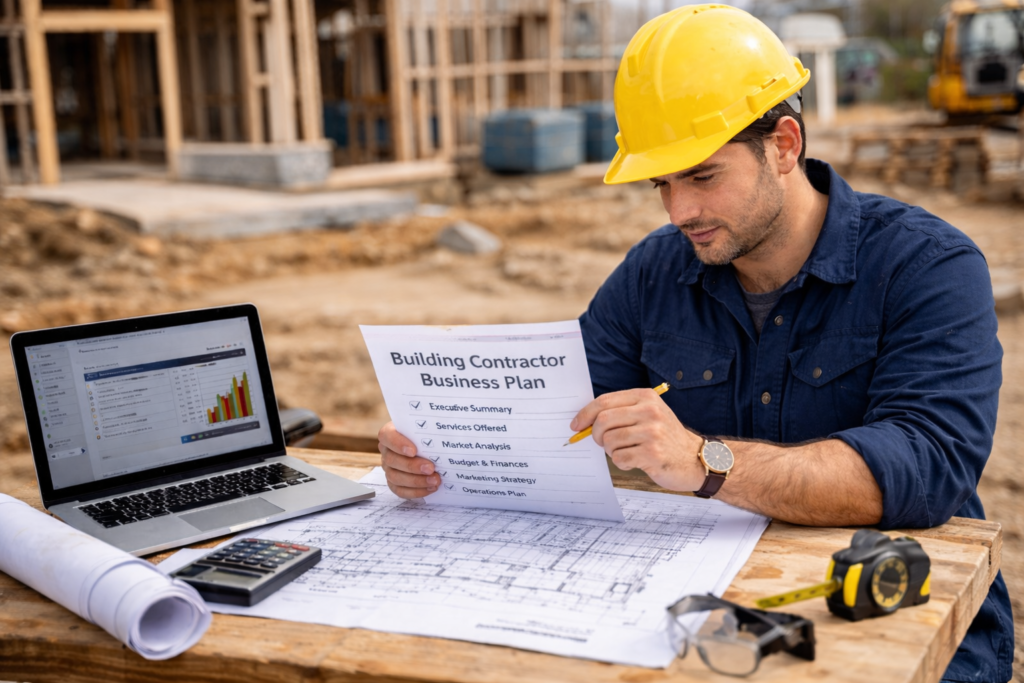
At its simplest, a building contractor business plan is a written roadmap explaining how your construction company will start, operate, earn revenue, and grow. But in practice, it’s much more powerful than that.
Think of it like a site layout drawing. Without measurements, materials, and timelines, even a skilled mason cannot build a straight wall. In the same way, without a structured plan, even experienced contractors struggle to manage projects, workers, costs, and clients.
A strong contractor business plan typically explains:
- What type of construction work you will do
- Who your target customers are
- How you will price jobs and control costs
- What licenses, equipment, and staff you need
- How much money is required to start and operate
- How you will attract and retain clients
This document matters for three major reasons.
First, it protects your money. Construction has thin margins and unpredictable expenses. Planning reduces financial surprises.
Second, it builds credibility. Banks, investors, and even large clients trust contractors who present structured plans instead of vague promises.
Third, it improves decision-making. When challenges appear—and they always do—you can return to the plan for guidance.
In short, a building contractor business plan turns a risky dream into a manageable, strategic business.
Who Needs a Contractor Business Plan (Real-World Use Cases)
Many people assume only large construction companies need formal planning. In reality, every contractor—from a one-person renovation specialist to a multi-million-dollar commercial builder—benefits from having a structured plan.
Consider a small residential contractor starting with kitchen remodels. Without a plan, pricing might be inconsistent, material purchases disorganized, and marketing nonexistent. With a plan, the same contractor can estimate costs accurately, schedule work efficiently, and grow toward full home construction.
Now think about a mid-size contractor aiming to win government or commercial projects. These clients often require financial projections, safety policies, staffing plans, and proof of operational capacity. A business plan becomes essential for qualifying bids.
Even subcontractors—electricians, plumbers, or concrete specialists—use simplified business plans to manage crews, equipment investment, and expansion into new service areas.
Common scenarios where a building contractor business plan becomes critical include:
- Starting a new construction company
- Applying for bank loans or investor funding
- Expanding from residential to commercial work
- Hiring employees or forming teams
- Entering competitive tender bidding
- Scaling into multiple project sites
In each case, planning reduces risk and increases long-term profitability.
Key Benefits of Creating a Strong Contractor Business Plan
Writing a business plan may feel like extra work when you’d rather be on-site managing projects. But contractors who invest time in planning almost always outperform those who don’t.
One of the biggest benefits is financial clarity. Construction businesses often fail not because of lack of work, but because of poor cash-flow management. A detailed plan forces you to estimate startup costs, operating expenses, profit margins, and payment timelines before problems arise.
Another major advantage is operational efficiency. When roles, workflows, suppliers, and timelines are clearly defined, projects run smoother. Delays decrease. Rework reduces. Client satisfaction increases.
Marketing strength is another overlooked benefit. Many contractors rely only on word-of-mouth. A business plan encourages structured marketing—local SEO, partnerships with architects, online portfolios, and referral systems—which leads to steady project pipelines instead of unpredictable gaps.
There’s also strategic growth. Planning helps you decide when to buy equipment, hire staff, or enter new markets rather than making risky decisions based on temporary success.
Ultimately, a building contractor business plan provides:
- Better budgeting and cost control
- Clear project management systems
- Stronger credibility with clients and lenders
- Consistent marketing and lead generation
- Safer, smarter business expansion
These advantages compound over time, turning small contractors into stable, scalable companies.
Step-by-Step Guide to Writing a Building Contractor Business Plan
Creating a contractor business plan doesn’t require complicated business degrees or corporate language. What matters is clarity, accuracy, and practicality. Below is a structured process used by real construction professionals.
Define Your Construction Services and Niche
Start by clearly describing what type of work your company will perform. Construction is a broad industry, and trying to do everything often leads to confusion and weak branding.
Decide whether you will focus on:
- Residential homes or renovations
- Commercial buildings or offices
- Infrastructure or government projects
- Specialized trades like roofing, plumbing, or electrical
- Design-build or turnkey construction
Choosing a niche helps with pricing, marketing, staffing, and equipment planning. It also positions your company as an expert rather than a generalist.
Research the Local Construction Market
Every successful contractor understands local demand. Study your city or region carefully.
Look at:
- Population growth and housing demand
- Major upcoming development projects
- Competitor pricing and services
- Permit regulations and zoning rules
- Material and labor cost trends
This research ensures your business plan reflects real opportunities rather than assumptions.
Create a Detailed Startup Budget
Money planning is where most contractor dreams succeed or fail. List every expected cost before launching.
Typical startup expenses include:
- Business registration and licenses
- Insurance and legal fees
- Tools, machinery, and vehicles
- Office setup or storage yard
- Initial labor wages
- Marketing and branding
- Emergency cash reserve
Also estimate monthly operating costs and expected revenue from projects. This section becomes crucial when seeking loans or investors.
Plan Operations, Staffing, and Workflow
Explain how projects will actually run from first client call to final handover.
Include:
- Project estimation process
- Contract signing procedures
- Procurement and supplier management
- Site supervision and safety protocols
- Quality control inspections
- Payment collection schedule
If hiring workers, define roles such as site supervisor, foreman, skilled laborers, and administrative staff. Clear structure prevents confusion on-site.
Develop a Marketing and Client Acquisition Strategy
Even the best builders need consistent clients. Outline how customers will find your company.
Effective contractor marketing often includes:
- Google Business profile and local SEO
- Professional website with project photos
- Partnerships with architects and real estate agents
- Social media showcasing before-and-after work
- Referral incentives for past clients
- Participation in local tenders
Your business plan should explain both short-term lead generation and long-term brand growth.
Write Financial Projections and Profit Plans
Finally, include realistic income forecasts for at least three years.
Estimate:
- Average project value
- Monthly number of projects
- Gross revenue
- Material and labor costs
- Net profit margins
- Break-even timeline
This section demonstrates whether the business is financially sustainable.
Tools, Software, and Resources for Contractor Business Planning
Modern contractors have access to powerful digital tools that simplify planning, estimating, and management. Using the right software can dramatically improve efficiency and accuracy.
Free tools are useful when starting small. Spreadsheet programs help with budgeting and cost estimation. Basic project management apps track tasks and deadlines. Cloud storage keeps drawings and documents organized.
Paid construction management software offers deeper features such as:
- Automated cost estimation
- Scheduling and Gantt charts
- Labor tracking and payroll integration
- Invoice generation and payment tracking
- Client communication portals
- Real-time project reporting
Free options save money but require more manual work. Paid platforms increase efficiency and professionalism but add monthly costs. Many growing contractors begin with free tools and upgrade once revenue stabilizes.
When choosing tools, prioritize simplicity, mobile access, and construction-specific features rather than generic business apps.
Common Mistakes Contractors Make in Business Planning (and How to Fix Them)
Even experienced builders make planning errors that harm profitability. Recognizing these mistakes early can save years of struggle.
One frequent problem is underestimating costs. Contractors sometimes price projects too low to win work, only to discover profits disappear after materials, labor, and delays. The fix is detailed cost estimation with contingency margins.
Another mistake is ignoring cash flow. Construction payments often arrive late, while wages and materials must be paid immediately. Smart contractors maintain emergency reserves and staged payment contracts.
Lack of marketing is also common. Relying solely on referrals creates unstable income. Structured online presence and partnerships solve this issue.
Poor documentation causes legal and financial disputes. Written contracts, change orders, and invoices protect both contractor and client.
Finally, many contractors attempt rapid expansion without systems. Hiring too fast or taking too many projects leads to quality decline and reputation damage. Gradual, planned growth is safer.
Avoiding these mistakes dramatically increases survival and success rates.
Conclusion
Starting or growing a construction company without a plan is like building a house without drawings—you might finish something, but it won’t be strong, efficient, or profitable. A thoughtful building contractor business plan transforms experience and ambition into a structured, scalable business.
Throughout this guide, we explored what a contractor business plan is, why it matters, who needs one, and how to build it step by step. We covered finances, operations, marketing, tools, and real-world mistakes that derail contractors. The central lesson is simple: planning doesn’t limit your freedom—it protects your future.
If you’re serious about launching or expanding your construction business, start drafting your plan today. Even a simple first version creates clarity. Refine it as your company grows. And remember, the most successful contractors aren’t just skilled builders—they’re strategic planners.
FAQs
What should be included in a building contractor business plan?
A complete plan includes company overview, services, market research, pricing strategy, operational workflow, staffing, marketing plan, startup costs, and financial projections.
How long should a contractor business plan be?
Most effective plans range from 15 to 30 pages, depending on business size and complexity. Clarity matters more than length.
Do small contractors really need a business plan?
Yes. Even solo contractors benefit from budgeting, pricing strategy, and marketing structure provided by a written plan.
How much money is needed to start a construction company?
Startup costs vary widely by country and specialization, but small contractors often begin with basic tools, licensing, insurance, and working capital.
Can I get a bank loan with a contractor business plan?
A strong, realistic plan significantly improves approval chances because lenders can evaluate risk and repayment ability.

Michael Grant is a business writer with professional experience in small-business consulting and online entrepreneurship. Over the past decade, he has helped brands improve their digital strategy, customer engagement, and revenue planning. Michael simplifies business concepts and gives readers practical insights they can use immediately.