
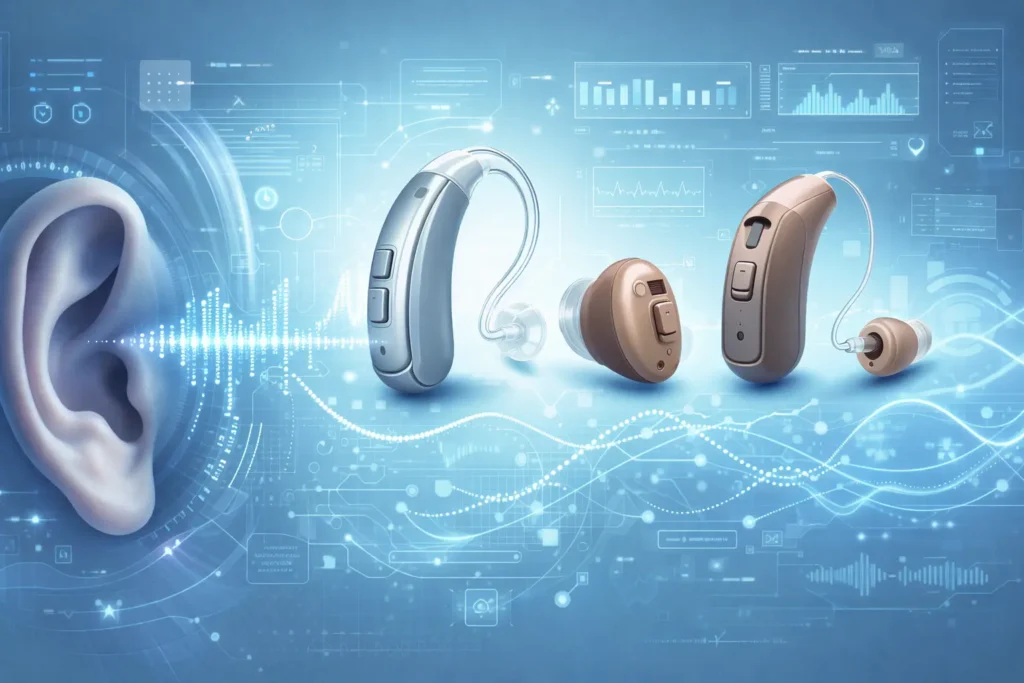
Hearing aid technology has undergone a remarkable transformation over the past two decades. What was once a simple analog amplifier worn discreetly behind the ear is now a wearable minicomputer — capable of streaming music from your smartphone, translating foreign languages in real time, detecting falls, and even monitoring indicators of brain health. For the estimated 430 million people worldwide living with disabling hearing loss, according to the World Health Organization, these advances represent a profound improvement in quality of life.
This comprehensive guide walks you through everything you need to know about digital hearing aids: how they work, the different styles available, the modern features that matter most, cutting-edge innovations on the horizon, and how to choose the right option — whether prescription or over-the-counter. Whether you are a first-time buyer, a caregiver, or simply curious about where hearing technology is headed, you will find clear, accurate, and actionable information here.
1. How Hearing Aid Technology Works
At their core, all hearing aids — regardless of style or price — perform the same fundamental task: they capture sound from the environment, process it, and deliver an amplified and refined version of that sound into the ear. What separates a basic entry-level device from a premium AI-powered model is the sophistication of the processing that happens between capture and delivery.
The Core Components: Microphone, Amplifier, and Speaker
Every hearing aid contains three essential parts:
- Microphone: Picks up sound waves from the surrounding environment and converts them into electrical signals. Most modern hearing aids feature multiple microphones to improve directional capabilities.
- Amplifier (Digital Signal Processor): The ‘brain’ of the hearing aid. In digital devices, the amplifier converts the electrical signal into binary digital data, applies sophisticated processing algorithms, and then converts it back to an electrical signal for delivery.
- Receiver (Speaker): Converts the processed electrical signal back into sound waves and delivers them into the ear canal. The receiver’s position varies by hearing aid style.
- Battery: Powers the device. Modern hearing aids use either disposable zinc-air batteries or built-in lithium-ion rechargeable batteries.
Analog vs. Digital Signal Processing (DSP)
The shift from analog to digital signal processing (DSP) represents the single greatest leap in hearing aid history. Analog hearing aids simply amplified all incoming sounds — speech, noise, music, and background clatter — by the same amount across all frequencies. The result was often uncomfortably loud and indiscriminate.
Digital hearing aids, by contrast, convert sound into binary code (streams of 0s and 1s) and analyze it thousands of times per second. This allows the processor to apply frequency-specific amplification, boosting only the pitches the wearer has difficulty hearing (most commonly high-frequency sounds) while leaving other frequency ranges untouched or even reduced. The result is a far more natural, comfortable, and intelligible listening experience.
Today, analog hearing aids are largely obsolete. Even the most affordable digital models offer programmability and a level of customization that far exceeds anything analog technology could achieve.
Why Two Hearing Aids Are Better Than One (Binaural Processing)
Humans are designed to hear with two ears — a system called binaural hearing. Each ear sends slightly different timing and intensity information to the brain, allowing us to locate the direction of sounds, understand speech in noisy environments, and experience a rich, three-dimensional soundscape.
Modern premium hearing aid pairs communicate wirelessly with each other in real time, a feature known as binaural processing. When sound is detected on one side, both devices automatically adjust volume and directionality in unison. This brain integration approach dramatically improves speech clarity in complex listening situations and reduces the listening effort that causes mental fatigue over a long day.
2. Choosing Your Hearing Aid Style: From BTE to Invisible
Hearing aid styles differ in size, placement, power capacity, battery life, and suitability for different degrees of hearing loss. Choosing the right style is one of the most important decisions in the process, and it should be guided by your audiologist based on your specific hearing profile, lifestyle, and aesthetic preferences.
Behind-the-Ear (BTE) and Open-Fit: Power and Comfort
Behind-the-ear (BTE) hearing aids rest behind the outer ear and deliver sound through a thin plastic tube connected to a custom earmold or a soft ear tip sitting in the canal. They are the most powerful style available and are suitable for virtually all degrees of hearing loss, from mild to profound.
The open-fit BTE variant uses a very thin tube and a small open dome tip rather than a custom earmold. This allows low-frequency sounds to pass naturally into the ear, making it an ideal solution for people with high-frequency hearing loss who have relatively normal low-frequency hearing. It also reduces the ‘plugged up’ sensation many first-time wearers describe.
In-the-Ear (ITE) and In-the-Canal (ITC): Balancing Visibility and Features
In-the-ear (ITE) hearing aids are custom-made to fit within the outer bowl of the ear (the concha). They come in full-shell and half-shell configurations. ITE aids are larger than canal styles, which means they can accommodate more features — including directional microphones, volume controls, and Bluetooth connectivity — while remaining relatively easy to handle.
In-the-canal (ITC) models are smaller and fit partially inside the ear canal, making them less visible. They offer a balance between discretion and functionality, though their smaller size limits battery capacity and the number of features they can support.
Completely-in-Canal (CIC) and Invisible: Deep Fit Technology
Completely-in-canal (CIC) hearing aids sit deep within the ear canal, with only a small removal handle visible at the opening. Their position inside the canal naturally reduces wind noise and takes advantage of the outer ear’s natural acoustic properties. However, their small size typically means shorter battery life and fewer advanced features.
At the extreme end of the discretion spectrum are invisible-in-canal (IIC) devices, which are fitted so deeply inside the canal that they are entirely invisible from the outside. These represent the pinnacle of cosmetic discretion but are not suitable for severe or profound hearing loss and may be difficult to handle for users with dexterity limitations.
Style Comparison Chart
| Style | Visibility | Battery Life | Best For | Features |
| Behind-the-Ear (BTE) | Visible | Up to 30 hrs (rechargeable) | Moderate to profound loss | Bluetooth, telecoil, directional mics |
| In-the-Ear (ITE) | Somewhat visible | Up to 24 hrs | Mild to severe loss | Volume control, Bluetooth |
| In-the-Canal (ITC) | Slightly visible | Up to 20 hrs | Mild to moderate loss | Compact, directional mics |
| Completely-in-Canal (CIC) | Nearly invisible | Up to 16 hrs | Mild to moderate loss | Discreet, reduced wind noise |
| Invisible-in-Canal (IIC) | Invisible | Up to 12 hrs | Mild to moderate loss | Maximum discretion |
3. Modern Features That Matter Most (2026 Update)
The gap between a basic hearing aid and a premium model comes down, in large part, to the richness of modern features. Here are the most impactful capabilities available in today’s leading devices.
Wireless Connectivity: Bluetooth and Smartphone Integration
Bluetooth connectivity has transformed the hearing aid from a passive amplifier into an active participant in the wearer’s digital life. Premium hearing aids can stream audio directly from smartphones, televisions, tablets, and computers — delivering sound straight into both ears at a quality that often exceeds what even people with normal hearing experience through speakers.
iPhone users benefit from the Made for iPhone (MFi) protocol, which provides low-latency, high-quality audio streaming and hands-free phone calls directly through the hearing aids. Android users connect via the ASHA (Audio Streaming for Hearing Aids) standard, supported on Android 10 and newer. Companion smartphone apps — such as the My Starkey app or the Phonak myPhonak app — give wearers granular control over volume, directional focus, noise reduction, and personalized program settings.
Rechargeable Hearing Aids: Lithium-Ion vs. Disposable Batteries
Rechargeable hearing aids have become the dominant choice for new buyers. Powered by lithium-ion batteries (the same technology in smartphones and electric vehicles), modern rechargeable aids deliver 19 to 30 hours of use on a single overnight charge — even with Bluetooth streaming active.
Many models come with portable charging cases that hold multiple additional charges, similar to wireless earbud cases. Some premium cases support Qi wireless charging (inductive charging), eliminating the need for cables entirely. The batteries within the hearing aids typically retain effective capacity for 500 or more charge cycles — approximately 3 to 5 years of daily use — before requiring replacement by a professional.
For reference, the key battery options currently available are compared below:
| Technology | Battery Life | Charging Time | Charge Cycles | Best For |
| Lithium-Ion Rechargeable | 19 – 30 hours | ~3 hours (full) | 500+ cycles | Daily convenience users |
| Qi Wireless Charging | 19 – 24 hours | ~3.5 hours | 500+ cycles | Tech-forward users |
| Disposable Zinc-Air (Size 312) | 3 – 10 days | N/A | Single use | Backup / occasional use |
| Disposable Zinc-Air (Size 13) | 5 – 14 days | N/A | Single use | BTE/ITE power users |
| Silver-Zinc Rechargeable | ~24 hours | ~4 hours | 200+ cycles | Eco-conscious users |
Automatic Environment Adaptation: Scanning and Motion Sensors
The most advanced hearing aids scan the acoustic environment up to 10,000 times per second, using sophisticated classification algorithms to identify whether the wearer is in a quiet room, a noisy restaurant, a car, or outdoors. Once classified, the device automatically switches to the most appropriate listening program — no manual adjustment needed.
Some models incorporate motion sensors (accelerometers) to track the wearer’s physical activity. These sensors detect whether the person is walking, running, sitting still, or even eating — and adjust the acoustic settings accordingly. Talking while eating, for example, generates distinctive jaw movement patterns that the sensors can identify and compensate for.
Own Voice Processing (OVP): Ending the Plugged-Up Feeling
One of the most common complaints from new hearing aid wearers is that their own voice sounds hollow, boomy, or unnatural — a phenomenon called the occlusion effect. Modern hearing aids address this directly through own voice processing (OVP), a feature that identifies the wearer’s own voice (using bone conduction characteristics and timing signatures) and applies a separate set of processing parameters to make it sound natural and clear. This significantly improves the initial adjustment period for new wearers.
Telecoils (T-Coils) and Induction Loops for Public Venues
A telecoil (or T-coil) is a small copper coil inside a hearing aid that acts as a wireless receiver for induction loop systems installed in public spaces. When a wearer activates the telecoil setting, the hearing aid picks up the electromagnetic field broadcast by the loop system — delivering a clean, direct audio feed from the venue’s microphone or sound system, completely bypassing the background noise of the room.
Telecoils are available in many theaters, houses of worship, airports, courtrooms, and conference halls. If you regularly attend these types of venues, asking your audiologist about telecoil-equipped models is strongly recommended.
4. Advanced Performance Technologies for Clearer Sound
Beyond features like Bluetooth and rechargeability, the performance technologies built into a hearing aid’s signal processing engine are what ultimately determine the quality of the listening experience, especially in challenging environments.
Directional Microphones: Focusing on Speech vs. Noise
Most modern hearing aids feature directional microphone systems with two or more microphones that work together to create a focused ‘beam’ of amplification pointing toward the desired sound source, while attenuating sounds arriving from other directions. This improvement in signal-to-noise ratio (SNR) can make the difference between following a conversation and struggling to make out a single word in a noisy restaurant.
There are two main types: fixed directional microphones, which always focus forward, and adaptive directional systems, which continuously rotate the pickup pattern to track the primary speech source and reject the dominant noise source. The most advanced systems can simultaneously maintain multiple directional beams in different directions, allowing the wearer to follow conversations in a group setting.
Feedback Cancellation: Eliminating Whistling for Good
Acoustic feedback — the high-pitched whistle that hearing aids can produce when amplified sound escapes the ear canal and is re-amplified by the microphone — was one of the most common complaints about hearing aids for decades. Modern feedback cancellation algorithms continuously monitor the audio signal for the signatures of incipient feedback and apply a phase-canceling counter-signal in milliseconds, before the whistle is even audible to the wearer.
This technology has advanced to the point where feedback is now a rare exception rather than a daily annoyance for most modern hearing aid wearers. When whistling does occur, it is usually a sign of earwax buildup, a poor-fitting earmold, or a damaged receiver tube — all addressable with a quick visit to an audiologist.
Noise Reduction Algorithms: Calm in Chaos
While directional microphones handle spatial noise (sounds coming from behind and the sides), noise reduction algorithms target the character of the sound itself. These digital signal processing strategies identify sounds with the spectral and temporal patterns of steady-state background noise (HVAC systems, traffic, crowd murmur) and reduce their gain, while leaving the dynamic, rapidly changing patterns of speech relatively untouched.
The result is a listening environment that feels less cluttered and more focused, reducing the cognitive load on the brain and the listener fatigue that accumulates over a long day of hearing aid wear.
Music Processing: Differentiating Melody from Conversation
Hearing aids are optimized by default for speech intelligibility — which means they actively suppress many of the characteristics that make music sound rich and beautiful. Dedicated music processing programs address this by switching off noise reduction (which can distort harmonic richness), widening the input dynamic range (so musical peaks are not clipped), and applying a more natural, flat amplification curve. Many audiologists can program a dedicated ‘music’ environment into the hearing aid, accessible with a tap of a button or through the companion app.
5. The Cutting Edge: AI, Sensors, and Health Tracking
The most exciting development in hearing aid technology is the transformation of these devices from single-purpose hearing instruments into multi-function health wearables. This shift is accelerating rapidly.
Hearing Aids as Wearable Health Monitors
Hearing aids are positioned inside or immediately beside the ear canal — one of the most physiologically informative locations on the human body. Capitalizing on this position, the latest devices incorporate inertial sensors for fall detection, step counting, and activity tracking. Some models by Starkey include algorithms that detect the sudden acceleration pattern of a fall and automatically send alert notifications to designated contacts via the companion smartphone app.
Beyond falls, researchers and manufacturers are exploring integration of photoplethysmography (PPG) sensors for heart rate monitoring and even indicators of cardiovascular health directly through ear-worn devices. As these technologies mature, hearing aids will likely become primary personal health monitoring platforms, with implications far beyond audiology.
Artificial Intelligence (AI) for Personalized Sound
Artificial intelligence (AI) in hearing aids goes beyond automatic environment detection. Machine learning models trained on millions of acoustic environments allow hearing aids to make fine-grained, context-sensitive adjustments that rule-based algorithms cannot. Some AI systems learn the individual wearer’s preferences over time — noting when manual volume adjustments are made in specific environments — and automatically apply those preferences in similar situations in the future, without any action from the wearer.
AI also powers advances in speech separation — the ability to isolate a single voice in a crowded room. Unlike earlier directional systems that simply suppressed sounds from behind, AI-driven systems analyze the spectral and temporal patterns of multiple simultaneous voices and selectively enhance the one the wearer is facing, even in highly reverberant spaces.
Language Translation in Real Time
Several premium hearing aid systems now offer real-time language translation through integration with their smartphone companion apps. By pairing the hearing aid with a smartphone microphone and a translation engine, wearers can receive translated versions of conversations in foreign languages — delivered directly into their hearing aids. While this feature is still maturing and dependent on a smartphone connection and data coverage, it represents a striking expansion of what a hearing aid can do.
Tinnitus Masking and Therapy Technology
Tinnitus — the perception of ringing, buzzing, or other sounds in the absence of external stimuli — affects a large proportion of people with hearing loss. Many modern hearing aids include built-in tinnitus masking and sound therapy programs. Starkey’s Multiflex Tinnitus Technology, for example, generates a customizable, broadband masking signal that can be precisely tuned by the audiologist to blend with or overlay the specific character of the wearer’s tinnitus, providing relief during periods of heightened awareness.
6. Making the Right Choice: Prescription vs. Over-the-Counter (OTC)
In 2022, the U.S. Food and Drug Administration (FDA) established a new category of over-the-counter hearing aids for adults with mild to moderate hearing loss. This regulatory change fundamentally altered the hearing aid landscape, introducing new options at significantly lower price points. Understanding the differences is essential for making an informed decision.
What You Get with Prescription Hearing Aids
Prescription hearing aids are FDA-registered Class II medical devices that must be fitted and programmed by a licensed audiologist or hearing health professional. The process begins with a comprehensive hearing evaluation, followed by device selection and programming using real-ear measurement (REM) — a verification procedure that confirms the hearing aid is delivering precisely the right amplification at each frequency for the individual wearer’s ear canal.
This professional fitting process is not a luxury — it is clinically proven to significantly improve outcomes. Studies published in audiology journals consistently show that hearing aids fitted with real-ear measurement outperform self-fitted devices on objective speech recognition measures. Prescription users also receive ongoing care: follow-up appointments, programming adjustments as hearing changes, repair services, and a typically 30 to 60-day trial period.
Who OTC Hearing Aids Are For
OTC hearing aids are self-fitting devices intended for adults aged 18 and over with perceived mild to moderate hearing loss. They are sold directly to consumers without a prescription, at major retailers and online. Their lower cost (typically $200 to $1,500 per pair) makes them accessible to people who cannot afford prescription devices or who face barriers to accessing audiology care.
However, OTC devices have real limitations. They are not suitable for children, not designed for severe or profound hearing loss, and cannot be fine-tuned with the precision of a professionally programmed device. Without a baseline audiogram, users also risk missing underlying medical causes of hearing loss that require clinical attention, such as conductive hearing loss, sudden sensorineural loss, or acoustic neuroma.
Feature, Cost, and Limitation Comparison Table
| Feature | Prescription Hearing Aids | OTC Hearing Aids |
| Who It’s For | Mild to profound hearing loss (all types) | Mild to moderate loss only |
| Fitting Process | Audiologist performs real-ear measurement | Self-fitting via smartphone app |
| Technology Level | Full range: AI, health tracking, binaural | Basic to moderate digital features |
| Connectivity | Bluetooth, telecoil, remote mic | Bluetooth (limited models) |
| Average Cost | $1,000 – $6,000+ per pair | $200 – $1,500 per pair |
| Trial Period | 30 – 60 days (with audiologist support) | 30 days (varies by retailer) |
| Follow-Up Care | Ongoing audiologist adjustments | Limited or none |
| FDA Regulation | Class II medical device, prescription required | Class II OTC (since 2022) |
7. The Fitting Process: Why Technology Alone Is Not Enough
Even the most technologically advanced hearing aid will underperform if it is not properly fitted and programmed. The fitting process is a critical determinant of outcomes that is often underappreciated by first-time buyers.
The Role of the Audiologist in Programming Digital Aids
An audiologist is a doctoral-level hearing health professional trained to diagnose hearing disorders and prescribe, fit, and manage hearing technology. During a prescription hearing aid fitting, the audiologist uses a standardized prescriptive formula (such as NAL-NL2 or DSL) based on the patient’s audiogram to calculate the precise amount of gain required at each frequency. This target is then programmed into the hearing aid using specialized fitting software.
The audiologist also counsels the new wearer on realistic expectations, use and care, and the adjustment process. They set up multiple listening programs optimized for different environments (quiet conversation, noisy restaurant, telephone, music) and teach the wearer how to switch between them.
Real-Ear Measurement (Verification): What It Is and Why It Matters
Real-ear measurement (REM), also called probe-microphone measurement, is the gold-standard verification procedure for hearing aid fittings. A thin silicone probe tube is placed in the ear canal alongside the hearing aid, and a speaker plays test signals. The probe microphone measures the actual sound pressure level at the eardrum, confirming that the hearing aid is delivering exactly the prescribed amplification targets — not just the manufacturer’s theoretical default.
Surveys of audiology practices consistently find that a significant proportion of hearing aids are dispensed without REM verification, meaning many wearers are wearing devices that are either over-amplifying or under-amplifying critical frequency regions. If your audiologist does not perform real-ear measurement as part of the fitting process, it is entirely appropriate to request it.
Trial Periods, Warranties, and Adjustment Expectations
Virtually all prescription hearing aid dispensers offer a 30 to 60-day trial period during which the device can be returned for a partial or full refund if the wearer is not satisfied. This period is essential for realistic evaluation, because hearing aid acclimatization takes time — the auditory system and the brain require weeks to adapt to the new pattern of stimulation.
New hearing aid wearers should expect some initial discomfort with their own voice, awareness of ambient sounds they had stopped noticing (refrigerator hum, footsteps, rustling clothing), and occasional adjustment fatigue. These are normal and expected parts of the process. Most manufacturers offer warranties of one to three years covering device defects, and many include loss and damage coverage as well.
A useful framework for new wearers is the 7-day adjustment schedule:
- Days 1-2: Wear in quiet, familiar environments only. Focus on speech with family members.
- Days 3-4: Gradually extend wearing time to 6-8 hours. Try listening to the television.
- Day 5: Venture into a mildly noisy environment (a coffee shop, a small gathering).
- Days 6-7: Aim for full-day wear. Note specific environments where listening is difficult.
- Follow-up appointment: Share your notes with your audiologist for fine-tuning adjustments.
8. faqs
What is the latest technology in hearing aids?
The latest hearing aid technology (2026) includes AI-powered sound processing, Bluetooth LE Audio, real-time language translation, fall detection, heart rate monitoring, and binaural wireless communication between devices. Brands like Starkey, Oticon, and Phonak lead with health-tracking features embedded in premium models.
Are digital hearing aids better than analog?
Yes, in virtually all cases. Digital hearing aids convert sound into binary data, allowing frequency-specific amplification, adaptive noise reduction, and programmable settings tailored to your unique hearing profile. Analog aids simply amplify all sounds equally, without the ability to differentiate speech from background noise.
Can I connect my hearing aids to my iPhone or Android?
Yes. Most premium hearing aids support Bluetooth streaming. iPhone users benefit from the ‘Made for iPhone’ (MFi) protocol for seamless, low-latency connection. Android users can connect via the ASHA (Audio Streaming for Hearing Aids) standard, supported on Android 10 and newer. Companion apps allow volume control, program changes, and sound customization.
How long do rechargeable hearing aid batteries last?
On a single overnight charge, most rechargeable hearing aids deliver 19 to 30 hours of use, even with Bluetooth streaming active. Lithium-ion batteries typically retain effective capacity for 500 or more charge cycles before needing replacement, usually every 3 to 5 years.
What is the difference between prescription and OTC hearing aids?
Prescription hearing aids are fitted by an audiologist using real-ear measurement, covering mild to profound hearing loss with the full range of advanced technology. OTC hearing aids, legalized in the U.S. in 2022, are self-fitting devices designed for adults with mild to moderate loss. They cost significantly less but lack professional fine-tuning and ongoing clinical support.
Why do my hearing aids whistle?
Whistling (acoustic feedback) occurs when amplified sound leaks out of the ear canal and is picked up by the microphone again. Common causes include a poor earmold fit, earwax buildup blocking the canal, or volume set too high. Most modern hearing aids include automatic feedback cancellation algorithms that suppress this in real time.
What are directional microphones?
Directional microphones focus on sound coming from in front of you while reducing noise from the sides and behind. Adaptive directional systems automatically shift focus based on your environment — tightening in noisy restaurants and opening up in quiet rooms. This improves the signal-to-noise ratio (SNR), making speech clearer in challenging listening situations.
How much do advanced hearing aids cost?
Entry-level digital hearing aids start around $500 per pair, mid-range models fall between $2,000 and $4,000, and premium AI-powered devices can reach $6,000 or more per pair. OTC options range from $200 to $1,500. Costs vary by technology tier, brand, and whether professional fitting and follow-up care are included.
Does Medicare cover hearing aid technology?
Traditional Medicare (Parts A and B) does not cover hearing aids for adults, though it does cover diagnostic hearing tests ordered by a physician. Some Medicare Advantage plans (Part C) may offer partial hearing aid benefits. Medicaid coverage varies by state and may cover hearing aids for children. Veterans may receive hearing aids through the VA at no cost.
What is binaural processing?
Binaural processing refers to the wireless communication between a pair of hearing aids, allowing them to share and synchronize audio data in real time. This mimics how the brain naturally integrates sound from both ears — improving spatial awareness, sound localization, and speech understanding in noisy environments. Both devices automatically balance volume and programs together.
How do I know if I need a telecoil?
A telecoil (T-coil) is a small copper coil inside the hearing aid that picks up electromagnetic signals from loop systems installed in public venues — theaters, churches, airports, and banks. If you regularly attend these environments, a telecoil can dramatically improve clarity by delivering audio directly from the venue’s sound system, bypassing background noise entirely.
Can hearing aids track falls or heart rate?
Yes — newer premium hearing aids include inertial sensors (accelerometers) and, in some models, optical sensors capable of detecting physical activity, falls, and even indicators of heart health. Starkey’s Livio AI, for example, offers fall detection with automatic alert notifications to a caregiver. These health-tracking features represent a major new direction for the hearing aid industry.
9. The Future of Hearing Technology: What’s Next?
The next decade promises changes that will make today’s premium hearing aids look modest by comparison. Several converging technology trends are driving this acceleration.
Hearables: Mainstream Earbuds with Medical-Grade Features
The line between consumer audio devices and medical hearing technology is blurring rapidly. Apple’s AirPods Pro already include a ‘Hearing Aid’ feature (available in supported markets following FDA clearance in 2024) that uses the built-in microphones and custom amplification modes to assist people with mild to moderate hearing loss. As consumer audio giants invest in hearing health features, the competitive pressure on traditional hearing aid manufacturers is intensifying — and the beneficiaries are consumers.
In the coming years, expect to see seamless hearing health monitoring built into everyday earbuds, with audiological assessments conducted through the companion app rather than a clinical booth.
Improved Brain-Computer Interfaces for Hearing
Researchers at institutions including Columbia University and the University of California are exploring auditory attention decoding (AAD) — a technology that reads neural signals from the brain to determine which speaker in a noisy environment the listener is focusing on, and then boosts that speaker’s voice in the hearing aid. Early proof-of-concept studies have been published in peer-reviewed journals, and while clinical application is still years away, the implications for ‘cocktail party’ listening situations are extraordinary.
Longer Battery Life and Self-Cleaning Surfaces
Battery technology continues to advance, with next-generation solid-state batteries projected to deliver significantly greater energy density in the same physical footprint. For hearing aids, this could translate into week-long battery life, eliminating even the minor inconvenience of nightly charging.
On the maintenance front, self-cleaning nano-coating technologies — hydrophobic and oleophobic surface treatments at the nano scale — are already appearing in premium devices under trade names like Starkey’s Nanoshield. Future iterations may incorporate active photocatalytic coatings that break down cerumen (earwax) deposits and microbial contamination, reducing the maintenance burden and extending device longevity.
A Final Word
Hearing aid technology in 2026 is genuinely extraordinary. The devices available today are not merely amplifiers — they are sophisticated, AI-powered health wearables capable of transforming the listening experience for tens of millions of people. Whether you are navigating the market for the first time or helping a family member make a decision, the most important step remains seeing a qualified audiologist for a comprehensive hearing evaluation.
The right hearing aid, properly fitted, can reconnect you with conversations you have been missing, reduce the cognitive burden of effortful listening, and deliver a meaningful improvement in quality of life. Technology is only part of the answer — the right professional support is the other half.

Adrian Cole is a technology researcher and AI content specialist with more than seven years of experience studying automation, machine learning models, and digital innovation. He has worked with multiple tech startups as a consultant, helping them adopt smarter tools and build data-driven systems. Adrian writes simple, clear, and practical explanations of complex tech topics so readers can easily understand the future of AI.