
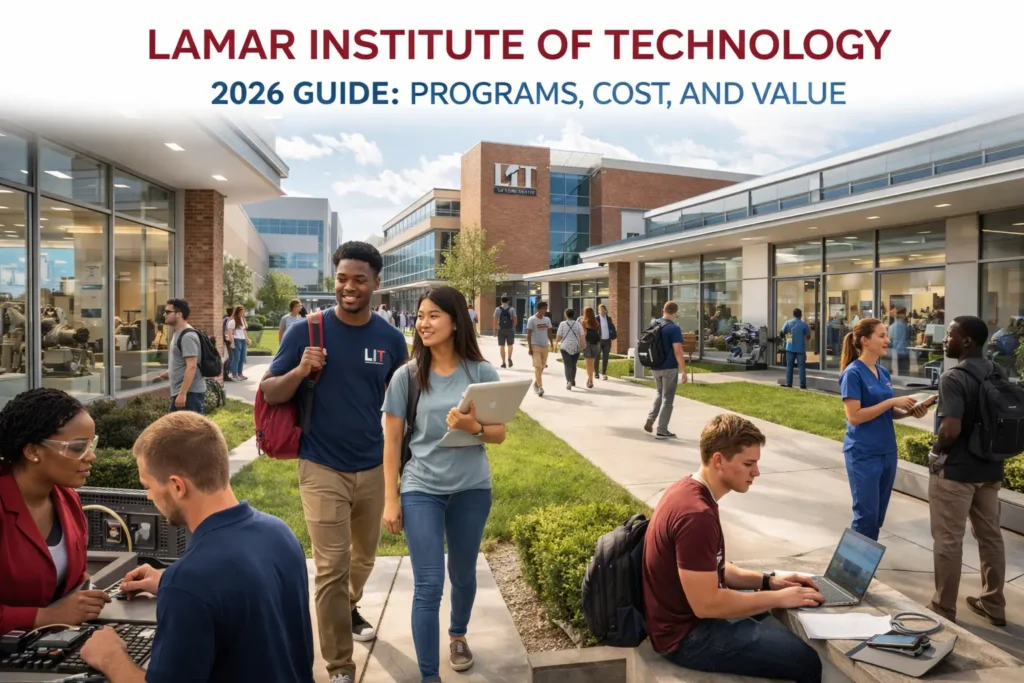
Whether you are a recent high school graduate, a working adult looking to advance your career, or someone ready to make a change, Lamar Institute of Technology (LIT) in Beaumont, Texas, offers a clear, affordable path to a rewarding career. This comprehensive 2026 guide covers everything you need to know — from programs and tuition to admissions and outcomes — so you can make a confident, well-informed decision.
At a Glance: Why Choose LIT?
Lamar Institute of Technology is a public, 2-year technical college located in Beaumont, TX, in the heart of Southeast Texas. Its mission is straightforward: provide career-focused, hands-on technical education that connects students directly to in-demand jobs. With open admissions, zero application fees, and one of the lowest tuition rates in Texas, LIT is designed for students who want results without the financial burden of a traditional four-year university.
A Public Technical School with Proven ROI
The return on investment at LIT is compelling and backed by real data. Consider these outcomes:
- 89–95% of graduates: find employment or transfer to a four-year institution within one year of completing their program.
- Median alumni earnings: reach approximately $59,000 after five years — roughly 34% higher than the median for workers without a post-secondary credential.
- Low in-state tuition: of approximately $2,844 per year makes LIT one of the most affordable paths to a skilled career in Texas.
- Hands-on, career-focused curriculum: means graduates are job-ready from day one — not spending years in theoretical coursework.
For students seeking a focused, efficient route from education to employment, LIT’s track record speaks for itself.
Quick Facts: Location, Type, and Enrollment
| Detail | Information |
| Full Name | Lamar Institute of Technology |
| Location | 855 E Lavaca, Beaumont, TX 77705 |
| Type | Public, 2-Year Technical College |
| Founded | 1995 |
| Governance | Texas State University System |
| President | Sidney E. Valentine |
| Acceptance Rate | 100% (Open Admissions) |
| Student-Faculty Ratio | 21:1 |
| Accreditation | SACSCOC (Southern Association of Colleges and Schools) |
| Application Fee | $0 |
| Programs Offered | 50+ certificate and associate degree programs |
| Online Programs | Yes — fully online and hybrid options available |
Academics: Top Programs and Degrees at LIT
LIT offers more than 50 programs of study leading to associate degrees or certificates. Programs are organized into four broad divisions, each closely aligned with regional employer needs and national workforce trends. Below is a detailed look at what each division offers, what you will learn, and where a credential can take you.
Industrial and Engineering Technology
This division is one of LIT’s strongest, serving the industrial and petrochemical corridor that defines Southeast Texas’s economy. Programs prepare students for immediate employment in some of the highest-paying blue-collar and technical roles in the country.
- Process Operating Technology: Learn to operate and monitor chemical processing equipment used in refineries, chemical plants, and manufacturing facilities. Graduates are in exceptionally high demand in the Gulf Coast region. Typical careers include process operator, plant operator, and production technician.
- Instrumentation Technology: Focuses on installing, calibrating, and maintaining the measurement and control instruments used in industrial processes. Graduates pursue roles as instrument technicians and control systems specialists.
- Welding Technology: Provides training in SMAW, MIG, TIG, and flux-core welding. Certified welders are in short supply nationally, with strong earning potential. Careers include structural welder, pipe welder, and welding inspector.
- HVAC Technology (Heating, Ventilation, and Air Conditioning): Trains students to install, maintain, and repair climate-control systems in residential and commercial settings. Licensed HVAC technicians enjoy steady employment and strong wages.
- Chemical Technology: Prepares students to work as chemical technicians in labs, manufacturing, and quality-control environments alongside engineers and scientists.
Allied Health and Nursing
Healthcare is a rapidly growing field, and LIT’s allied health programs are designed with rigorous clinical training to prepare graduates for licensure and immediate practice.
- Dental Hygiene: An ADA-accredited program that prepares students to become licensed dental hygienists — one of the consistently top-rated careers for job satisfaction and work-life balance. The program includes extensive clinical hours in real patient-care settings.
- Radiologic Technology: Accredited by JRCERT, this program prepares students to become licensed radiologic technologists (X-ray techs). Clinical placements are integrated throughout the curriculum.
- Clinical Laboratory Science (Medical Lab Technician): Trains students to perform diagnostic tests on blood, tissue, and other specimens. Lab technicians work in hospitals, clinics, and research labs.
- Medical Office and Health Information Management: Covers medical coding, health records management, and office administration — ideal for students interested in healthcare without direct clinical work.
- Respiratory Care / CoARC-Accredited Programs: Prepares students for roles supporting patients with breathing disorders under the supervision of physicians.
Allied health programs at LIT carry program-specific accreditations from national bodies such as the ADA, JRCERT, and CoARC, which are typically required for professional licensure. This is a critical differentiator — a credential from an accredited program is essential for sitting for board exams.
Public Service and Safety
LIT’s public service programs prepare students for roles that serve and protect the community. These careers are stable, meaningful, and offer clear advancement pathways.
- Law Enforcement / Police and Criminal Justice: Prepares graduates for careers as licensed peace officers in local, county, and state agencies. Texas Commission on Law Enforcement (TCOLE) requirements are integrated into the curriculum.
- Fire Protection Technology: Trains students in firefighting, emergency response, hazardous materials handling, and fire safety inspection.
- Emergency Medical Technology (EMT/Paramedic): Covers emergency pre-hospital care from basic EMT skills through advanced paramedic-level training.
- Homeland Security and Emergency Management: A growing field focused on disaster preparedness, response coordination, and public safety planning.
Business, Liberal Arts, and General Studies
For students who want foundational skills, plan to transfer to a four-year university, or are exploring career directions, LIT’s liberal arts and business programs offer flexibility.
- Business Administration: Covers fundamental business concepts including management, marketing, finance, and entrepreneurship.
- Liberal Arts: A broad academic program that fulfills general education requirements and transfers seamlessly to universities within the Texas State University System.
- Early Childhood Education / Child Care Provider: Prepares students to work in licensed childcare and early education settings, with coursework in child development and classroom management.
Online and Dual Credit Programs
Flexibility is a core part of LIT’s approach to education:
- LIT Online: Multiple programs and courses are available fully online or in hybrid formats, making LIT accessible to working adults, parents, and students in rural areas who cannot attend classes on campus every day.
- Dual Credit: High school students can earn college credit through LIT while still completing their secondary education, reducing the time and cost needed to earn a post-secondary credential.
- Continuing Education: Non-credit workforce training courses are available for professionals seeking to upskill or maintain certifications.
LIT Admissions: A Simple Path to Enrollment
One of LIT’s most welcoming features is its open admissions policy. There is no competitive selection process, no minimum GPA, and no application fee. If you have a high school diploma or GED and the desire to learn a trade, LIT will accept you. Here is how to get started.
Step 1: Choose Your Path of Study
Before applying, spend time on the LIT website reviewing the programs of study. Consider your career interests, the local job market, and whether you prefer certificate (shorter, typically 1 year) or associate degree (2-year) programs. If you are unsure, LIT’s academic advising team can help you identify the right fit.
Step 2: Complete Your Application
Applications are submitted online through the LIT.edu portal. There is no application fee, which removes a common barrier for prospective students. You will need to provide:
- Proof of high school graduation (diploma, official transcript, or GED certificate)
- Government-issued photo ID
- Social Security Number (for financial aid purposes)
- Contact information and emergency contacts
Step 3: Check Admission Requirements and Placement Testing
While LIT has open admissions, some academic programs — especially allied health programs — have specific prerequisite requirements or competitive selection processes within the program itself. Additionally:
- TSI Assessment (Texas Success Initiative): Entering students may need to take the TSI Assessment to determine placement in English, reading, and math courses. Students who are TSI exempt (e.g., met certain ACT/SAT score thresholds) do not need to take this test. Check with LIT’s admissions office to confirm your status.
- Program-specific prerequisites: Health programs such as Dental Hygiene and Radiologic Technology may require prerequisite science courses, clinical background checks, or immunization records. Verify requirements for your chosen program directly.
Important Dates and Deadlines
LIT operates on a semester calendar with fall, spring, and summer terms. While open admissions means you can typically apply up until the start of term, acting early ensures access to financial aid, advising, and preferred course sections.
- FAFSA Priority Deadline: January 15 for priority financial aid consideration for the following academic year.
- Registration: Early registration is available to continuing students; new students register after completing orientation.
- Academic Calendar: Check LIT.edu for specific semester start/end dates, registration windows, and holidays.
Cost, Tuition, and Financial Aid
Cost is one of the most important factors in choosing a college. LIT’s pricing is structured to be genuinely accessible, and when combined with available financial aid, the out-of-pocket cost for many students is remarkably low.
2025-2026 Tuition Breakdown
| Cost Category | Estimated Amount | Notes |
| In-State Tuition & Fees | ~$2,844/year | For Texas residents; among the lowest in the state |
| Out-of-State Tuition & Fees | ~$12,924/year | For non-Texas residents |
| Books & Supplies | ~$1,200/year (estimated) | Varies by program; some courses use low-cost/open resources |
| Average Net Price (after aid) | ~$8,381/year | Average cost for students receiving financial aid |
| Room & Board | Not applicable | LIT does not have on-campus housing; students arrange own housing |
Note: LIT does not offer on-campus dormitories. Students are responsible for arranging their own housing. Beaumont’s cost of living is moderate compared to major Texas metros, making it feasible for students to find affordable off-campus housing near campus.
How to Pay for College: Aid Options
Most LIT students are eligible for some form of financial assistance. Here is a breakdown of the main options:
- FAFSA (Free Application for Federal Student Aid): The first and most important step in securing financial aid. Submit your FAFSA at studentaid.gov. This single form unlocks access to federal grants, loans, and work-study opportunities. Priority deadline: January 15.
- Pell Grant: A federal need-based grant that does not need to be repaid. For the 2025-2026 academic year, maximum annual Pell awards are approximately $7,395. Many LIT students qualify, making the actual tuition cost extremely low or even zero after the grant.
- TEOG (Texas Educational Opportunity Grant): A state-funded grant for financially disadvantaged students attending public community or technical colleges. Does not require repayment.
- TPEG (Texas Public Education Grant): Administered by LIT directly from a state-mandated fund. Need-based and does not require repayment.
- Scholarships: LIT and its affiliated foundation offer institutional scholarships. External scholarships from civic organizations, employers, and professional associations are also available and encouraged.
- Federal Student Loans: Subsidized and unsubsidized federal loans are available for eligible students. While borrowing should be approached carefully, federal loans offer favorable terms and income-driven repayment options.
The LIT Value Proposition: Your Return on Investment
Here is the bottom line. Suppose a Texas resident student pays the average net price of $8,381 per year and completes a 2-year associate degree — a total investment of approximately $16,762. If that graduate enters the workforce earning the median LIT alumni salary of $59,000 per year, they will recoup their entire educational investment in less than four months of working. That is an exceptional ROI by any measure.
Compare this to a four-year university graduate who may carry $30,000 to $60,000+ in student loan debt, and the value of a targeted technical credential from LIT becomes crystal clear. LIT is not a compromise — for many career paths, it is the smarter financial choice.
Student Life and Campus Experience
LIT is a commuter campus — most students live off campus and many work while attending school. The culture is practical and goal-oriented, reflecting a student body that is focused on career advancement. While it does not offer the traditional residential college experience, LIT provides meaningful support services and a welcoming community.
What Students Say: Reviews and Polls
Third-party student review platforms consistently highlight several themes about the LIT experience:
- Supportive, accessible professors: Students frequently note that instructors are knowledgeable professionals with real-world experience, not just academics, and that they are genuinely invested in student success. Small class sizes (student-faculty ratio of 21:1) mean instructors know students by name.
- Flexible scheduling: Many courses are offered in the evenings or online, accommodating students who work full or part-time. This flexibility is cited as a key reason students choose LIT over other institutions.
- Practical, career-relevant curriculum: Students appreciate that what they learn in class connects directly to what employers want. Less time on theory, more time on applied skills.
- Diverse student community: LIT’s student body reflects the diverse communities of Southeast Texas. Many students are first-generation college attendees, returning adult learners, or career-changers.
- Areas for improvement: Some students note that campus amenities are more limited than at larger universities, and that the graduation rate (approximately 30-32%) suggests that some students face challenges completing their programs. LIT is aware of retention challenges and has expanded advising and support services in response.
Campus Facilities and Location
- LIT’s campus is located at 855 E Lavaca in Beaumont, TX, offering modern lab facilities, computer labs, and dedicated spaces for technical training.
- Students have access to the Lamar University library system, a significant resource for research and study.
- A recreational sports center is available to LIT students.
- Adequate on-campus parking is available — a practical concern for commuter students.
- Beaumont is a mid-sized city with affordable housing, major employers in the energy and healthcare sectors, and proximity to the Gulf Coast.
- A virtual campus tour is available on LIT.edu for prospective students who want to explore the campus before visiting in person.
Student Support Services
LIT provides a range of services to help students succeed from enrollment through graduation:
- Academic Advising: Advisors help students choose the right program, plan their course schedule, understand requirements, and navigate any academic challenges they encounter.
- Career Counseling and Job Placement: LIT’s career services team connects students and graduates with local employers, job fairs, and internship opportunities. The high placement rate (89-95%) reflects the strength of these connections.
- Tutoring and Academic Assistance: Free tutoring is available to help students who need extra support in coursework.
- Financial Aid Counseling: Staff help students understand their aid packages, apply for scholarships, and navigate the FAFSA process.
Accreditation and Outcomes
Accreditation is not just a credential for the institution — it is a quality guarantee for you, the student. An accredited degree or certificate ensures that your credential will be recognized by employers, professional licensing boards, and transfer institutions.
Institutional and Programmatic Accreditation
Institutional Accreditation: LIT is accredited by the Southern Association of Colleges and Schools Commission on Colleges (SACSCOC), the regional accrediting body for degree-granting institutions in the Southeast United States. SACSCOC accreditation is the gold standard for institutional credibility and is required for students to access federal financial aid.
In addition to institutional accreditation, several LIT programs hold specialized accreditations from their respective professional bodies. These are especially important in allied health fields, where program accreditation is typically a prerequisite for professional licensure:
| Program | Accrediting Body | Why It Matters |
| Dental Hygiene | American Dental Association (ADA) — Commission on Dental Accreditation | Required to sit for national board exams and obtain state licensure as a dental hygienist |
| Radiologic Technology | Joint Review Committee on Education in Radiologic Technology (JRCERT) | Required for ARRT certification and employment as a licensed radiologic technologist |
| Respiratory Care | Commission on Accreditation for Respiratory Care (CoARC) | Required for national board exam eligibility and state licensure |
| Institutional (All Programs) | SACSCOC | Required for federal financial aid eligibility and transfer credit recognition |
Graduation, Transfer, and Job Placement Rates
| Outcome Metric | LIT Data | Context |
| Graduation Rate | ~30-32% | Common for open-access 2-year technical colleges; many students stop-out and return or transfer without completing |
| Retention Rate (1st to 2nd year) | Approximately 55% | Reflects LIT’s expansion of support services to improve student persistence |
| Employment or Transfer Rate | 89-95% within 1 year | Of graduates who complete their program; reflects strong regional employer demand |
| Median Earnings (5 years post-graduation) | ~$59,000/year | Approximately 34% higher than median earnings for those without a post-secondary credential |
It is worth contextualizing the graduation rate. A 30-32% graduation rate is typical — even expected — for open-access, 2-year technical colleges that serve non-traditional students, working adults, and first-generation college students who face significant life challenges alongside their studies. The more meaningful metric for LIT students is the outcome for those who do complete: 89-95% employed or transferred, earning median wages well above the regional average.
faqs
What is the acceptance rate for Lamar Institute of Technology?
LIT has a 100% acceptance rate. It operates under an open admissions policy, meaning any applicant who holds a high school diploma or GED is accepted. There is no competitive selection process at the institutional level, though some individual programs (such as Dental Hygiene) may have limited seats and their own selection criteria.
How much is tuition at Lamar Institute of Technology?
In-state (Texas resident) tuition and fees run approximately $2,844 per year, making LIT one of the most affordable higher education options in Texas. Out-of-state tuition is approximately $12,924 per year. After financial aid, the average net price paid by students receiving aid is approximately $8,381 per year.
Does Lamar Institute of Technology have dorms or on-campus housing?
No. LIT is a commuter college and does not offer on-campus residential housing. Students arrange their own housing off campus. Beaumont offers a range of affordable housing options within reasonable commuting distance.
What programs is Lamar Institute of Technology known for?
LIT is particularly well-regarded for its industrial and engineering technology programs — especially Process Operating Technology, Instrumentation Technology, and Welding Technology — which serve the region’s robust petrochemical industry. In allied health, Dental Hygiene and Radiologic Technology are flagship programs with nationally-recognized accreditations.
Is Lamar Institute of Technology a good school?
By the metrics that matter most for a technical college — cost, program accreditation, employer connections, and graduate outcomes — LIT is an excellent choice. Students consistently praise the quality and accessibility of instructors, the practical relevance of the curriculum, and the flexible scheduling. The return on investment, with median alumni earnings of approximately $59,000 and an investment of roughly $2,844 per year in-state tuition, is among the best in Texas higher education.
What is the graduation rate at LIT?
The graduation rate is approximately 30-32%. This is typical for open-access 2-year colleges that serve a diverse population including working adults, first-generation students, and career-changers who face more life challenges than traditional 18-22 year-old students. Students who do complete their programs see exceptional employment outcomes.
How do I apply to Lamar Institute of Technology?
Applications are submitted online through LIT.edu at no cost. You will need your high school diploma or GED, a photo ID, and your Social Security Number (for financial aid). There is no application fee. After applying, you may need to complete TSI Assessment testing unless you are TSI-exempt. The full process typically takes only a few days.
Does LIT offer online classes?
Yes. LIT offers numerous courses and several complete programs in fully online and hybrid formats through LIT Online. Online options are especially popular among working students and those in surrounding communities who cannot attend daily in-person classes. Contact LIT’s admissions office to confirm which programs have online pathways.
What financial aid is available at LIT?
LIT students may be eligible for federal Pell Grants (up to approximately $7,395 per year for qualifying students), Texas state grants (TEOG and TPEG), institutional scholarships through the LIT Foundation, and federal student loans. Students should submit the FAFSA by January 15 for priority consideration. Many students find that grant aid fully covers their in-state tuition.
How much do LIT graduates earn?
The median annual earnings for LIT graduates approximately five years after completing their program is around $59,000. This figure varies by program — industrial technology and allied health graduates often earn significantly above this median, while liberal arts or general studies graduates may earn less in the early years. Across all programs, median earnings are approximately 34% higher than for workers without any post-secondary credential.
Is Lamar Institute of Technology accredited?
Yes. LIT holds institutional accreditation from SACSCOC (Southern Association of Colleges and Schools Commission on Colleges), the regional accrediting body recognized by the U.S. Department of Education. This accreditation is required for students to access federal financial aid and ensures that credits are recognized by employers and transfer institutions. Several individual programs also hold specialized professional accreditations.
Take the Next Step
If you are ready to invest in your future, Lamar Institute of Technology offers one of the most direct, affordable, and high-ROI paths to a skilled career in Texas. Whether you are drawn to the energy industry, healthcare, public safety, or any of the other exciting fields LIT serves, your next step is simple.
Visit LIT Today
Nothing replaces seeing the campus in person. Schedule an in-person tour through LIT.edu to meet faculty, see the labs, and get a feel for the community that could become your home for the next one to two years. If an in-person visit is not possible, LIT also offers a virtual tour on its website.
Apply Now
With open admissions, no application fee, and a straightforward online process, there is no reason to wait. Visit LIT.edu to start your application today. Your career in Process Operating, Dental Hygiene, Welding, Law Enforcement, Radiologic Technology — or one of 50+ other programs — is closer than you think.
Sources: LIT.edu, US News & World Report, College Board, Niche.com, SACSCOC, Texas Higher Education Coordinating Board, National Center for Education Statistics. Data reflects the 2025-2026 academic year and is reviewed annually.

Adrian Cole is a technology researcher and AI content specialist with more than seven years of experience studying automation, machine learning models, and digital innovation. He has worked with multiple tech startups as a consultant, helping them adopt smarter tools and build data-driven systems. Adrian writes simple, clear, and practical explanations of complex tech topics so readers can easily understand the future of AI.