
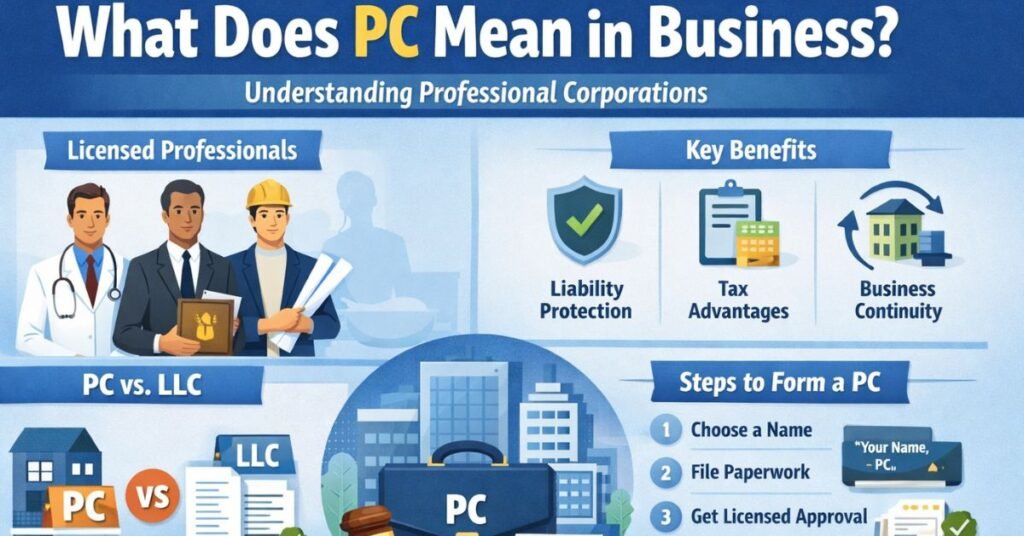
If you’ve ever browsed business documents, legal filings, company names, or professional services websites, you’ve probably seen the abbreviation “PC” after a company name. And naturally, many people ask: what does PC mean in business?
The short answer is simple: PC stands for Professional Corporation.
However, the full story is much more interesting—and important—than that quick definition.
A Professional Corporation (PC) is a specific type of legal business structure used primarily by licensed professionals such as doctors, lawyers, accountants, architects, and engineers. It allows these professionals to operate their practice as a corporation while maintaining the professional licensing standards required by their industry.
In practical terms, a PC offers many of the advantages of a traditional corporation—such as liability protection, tax planning opportunities, and organizational structure—while still complying with strict regulations governing licensed professions.
For professionals building a practice, choosing the right structure can significantly impact taxes, legal protection, growth opportunities, and long-term financial stability. That’s why understanding what PC means in business is not just academic—it’s a strategic decision.
In this comprehensive guide, we’ll explore:
- The full meaning of PC in business
- How Professional Corporations work
- The advantages and disadvantages of a PC
- How it compares to LLCs, partnerships, and standard corporations
- A step-by-step process for forming one
- Common mistakes professionals make
- Real-world examples and use cases
Whether you’re a professional planning to launch your own firm or a business enthusiast curious about corporate structures, this guide will give you a clear, practical understanding of Professional Corporations and how they function in the modern business world.
What Does PC Mean in Business?
At its core, the answer to what does PC mean in business is straightforward.
PC stands for Professional Corporation.
A Professional Corporation (PC) is a corporate business entity formed by licensed professionals to provide services within their field of expertise.
These professionals may include:
- Doctors
- Dentists
- Lawyers
- Accountants
- Architects
- Engineers
- Veterinarians
- Psychologists
Many jurisdictions require certain professions to operate under special legal structures rather than standard corporations or LLCs. This ensures that professional services remain regulated and that licensed individuals remain accountable to professional boards.
A Professional Corporation allows professionals to:
- Operate under a corporate structure
- Protect personal assets from certain liabilities
- Maintain professional licensing compliance
- Gain tax and financial planning benefits
For example, you may see company names such as:
- Smith & Associates, PC
- Johnson Medical Group, PC
- Greenfield Law Firm, PC
In these cases, the “PC” indicates that the business is structured as a Professional Corporation, meaning the owners are licensed professionals offering regulated services.
It’s important to note that a PC is not the same as a personal computer, even though the abbreviation is identical. In business and legal contexts, PC refers specifically to a corporate legal entity designed for professionals.
How a Professional Corporation Works
To fully understand what PC means in business, it helps to look at how a Professional Corporation operates in real life.
A Professional Corporation functions similarly to a standard corporation but with additional rules related to professional licensing and ownership.
Ownership Requirements
In most jurisdictions, only licensed professionals in the same field can own shares in a PC.
For example:
- A law firm structured as a PC can only be owned by licensed attorneys
- A medical PC must be owned by licensed physicians
- An accounting PC must be owned by certified accountants
This ensures that control of professional services remains within the profession itself.
Corporate Structure
Like other corporations, a PC typically has:
- Shareholders (the professional owners)
- Directors (who oversee strategy)
- Officers (who manage daily operations)
Even in small practices, professionals may hold multiple roles. For instance, a doctor might be:
- Shareholder
- Director
- President
Liability Protection
One major reason professionals choose a PC is limited liability protection.
A Professional Corporation can shield owners from:
- Business debts
- Certain legal claims
- Actions of other shareholders
However, professionals are still personally responsible for malpractice or professional negligence.
For example:
If one doctor in a medical PC commits malpractice, that doctor remains personally liable for the mistake.
But the other doctors in the corporation may be protected from liability.
Regulatory Oversight
Professional Corporations must comply with:
- Corporate law
- Licensing board regulations
- Professional ethics standards
This dual oversight ensures that the company operates both legally and professionally.
Benefits of Using a Professional Corporation
Professionals often choose this structure for several compelling reasons. Understanding these benefits is key when exploring what does PC mean in business and why it’s commonly used in professional industries.
Limited Liability Protection
A Professional Corporation can protect personal assets from:
- Business lawsuits
- Corporate debts
- Claims involving other professionals in the firm
This separation between personal and business liability is one of the biggest advantages.
Tax Planning Opportunities
Depending on the jurisdiction and election type, PCs may benefit from:
- Corporate tax structures
- Salary vs dividend flexibility
- Retirement contribution advantages
- Deductible business expenses
Many professionals work with accountants to optimize tax strategies through their PC.
Professional Credibility
Operating as a Professional Corporation can enhance reputation and legitimacy.
Clients may perceive a PC as:
- More established
- Better structured
- Professionally regulated
For example, “Anderson Legal Group, PC” often sounds more authoritative than simply “Anderson Legal Services.”
Easier Ownership Transitions
Professional Corporations allow ownership shares to be transferred to other licensed professionals.
This can simplify:
- Retirement planning
- Succession planning
- Bringing in new partners
Business Continuity
Unlike sole proprietorships, a Professional Corporation can continue operating even if an owner leaves or retires.
This stability helps practices grow and maintain long-term client relationships.
Real-World Use Cases for Professional Corporations
Professional Corporations appear in many industries where licensing and accountability are essential.
Understanding these real-world scenarios helps clarify what PC means in business and how it functions in practice.
Medical Practices
Doctors often form Professional Corporations to run:
- Private clinics
- Specialist practices
- Multi-doctor medical groups
Example:
A group of cardiologists forms HeartCare Specialists, PC to operate a clinic and share administrative costs.
Law Firms
Many law firms use the PC structure.
Example:
- Jackson & Taylor Attorneys, PC
- Wilson Litigation Group, PC
This structure allows lawyers to operate collectively while maintaining licensing requirements.
Accounting Firms
Certified Public Accountants often form PCs to provide services like:
- Tax preparation
- Financial audits
- Business consulting
Example:
Morgan Financial Advisors, PC
Architecture and Engineering Firms
These professions also frequently operate under professional corporate structures due to licensing requirements.
Example:
Urban Design Architects, PC
Veterinary Clinics
Veterinarians often use Professional Corporations to manage:
- Animal hospitals
- Veterinary clinics
- Pet care practices
Example:
Green Valley Veterinary Clinic, PC
In all these cases, the PC structure helps professionals combine corporate efficiency with professional accountability.
Step-by-Step Guide to Forming a Professional Corporation
If you’re considering starting one, understanding the process helps clarify how Professional Corporations actually come to life.
While details vary by location, the general process usually follows these steps.
Step 1: Confirm Eligibility
First, confirm that your profession qualifies for a Professional Corporation.
Common eligible professions include:
- Doctors
- Lawyers
- Dentists
- Accountants
- Architects
- Engineers
You must also hold the required professional license.
Step 2: Choose a Business Name
Your business name must typically include PC or Professional Corporation.
Example formats:
- Anderson Dental Group, PC
- Summit Engineering Consultants, PC
Some jurisdictions also require approval from professional licensing boards.
Step 3: File Articles of Incorporation
Next, you submit Articles of Incorporation to the state or government authority.
This document usually includes:
- Company name
- Registered address
- Professional purpose
- Names of shareholders
Step 4: Obtain Licensing Approval
Many jurisdictions require approval from professional licensing boards before the corporation becomes official.
This ensures only licensed professionals operate the practice.
Step 5: Create Corporate Governance Documents
Professional Corporations must maintain internal documentation such as:
- Corporate bylaws
- Shareholder agreements
- Board resolutions
These documents define how the company operates.
Step 6: Register for Taxes
You must obtain tax identification numbers and choose the appropriate tax election.
Professionals often consult accountants to select the best tax structure.
Step 7: Maintain Ongoing Compliance
After formation, PCs must maintain:
- Annual filings
- Licensing compliance
- Corporate records
- Professional liability insurance
Following these steps ensures the corporation remains legally valid.
Tools, Comparisons, and Professional Recommendations
Professionals exploring business structures often compare Professional Corporations with other entity types. Understanding these differences helps clarify when a PC is the right choice.
PC vs LLC
An LLC (Limited Liability Company) is flexible and widely used, but some jurisdictions do not allow licensed professionals to operate under a standard LLC.
PC advantages:
- Recognized professional structure
- Licensing compliance
- Corporate governance
LLC advantages:
- Simpler management
- Flexible ownership
- Pass-through taxation
PC vs S Corporation
A Professional Corporation may elect S Corporation taxation, depending on eligibility.
Benefits may include:
- Reduced self-employment tax
- Pass-through income
- Salary + distribution flexibility
PC vs Partnership
Partnerships are simpler but offer less liability protection.
In partnerships:
- Partners share liability
- Personal assets may be at risk
A PC provides stronger legal separation between business and personal finances.
Helpful Business Tools
Professionals forming corporations often use tools such as:
Legal formation services
Examples include:
- ZenBusiness
- LegalZoom
- Northwest Registered Agent
Accounting software
- QuickBooks
- Xero
- FreshBooks
Document management
- DocuSign
- Dropbox Business
- Notion
These tools streamline business administration and compliance.
Common Mistakes When Using a Professional Corporation
Even experienced professionals can make mistakes when forming or managing a PC. Understanding these pitfalls helps protect both your business and your professional reputation.
Ignoring Professional Licensing Rules
Some professionals attempt to form corporations without checking licensing board regulations.
This can lead to:
- Application rejection
- Legal penalties
- Business shutdown
Always verify rules with your regulatory authority.
Mixing Personal and Business Finances
A major mistake is failing to separate finances.
Best practices include:
- Dedicated business bank accounts
- Separate accounting systems
- Clear expense tracking
Mixing finances can weaken liability protection.
Poor Corporate Governance
Even small Professional Corporations must maintain corporate formalities.
Examples include:
- Documenting decisions
- Holding annual meetings
- Maintaining shareholder records
Failure to follow these procedures can create legal issues.
Lack of Liability Insurance
A PC does not protect professionals from malpractice claims.
Professional liability insurance remains essential.
Choosing the Wrong Structure
Some professionals form a PC when another entity might be more suitable.
Consulting legal and tax experts helps ensure the right choice.
Conclusion
Understanding what does PC mean in business is essential for professionals exploring how to structure their practice.
A Professional Corporation (PC) offers a unique balance between corporate efficiency and professional accountability. It allows licensed professionals—such as doctors, lawyers, accountants, and architects—to operate their practices within a structured legal framework while maintaining regulatory compliance.
The PC structure provides several benefits:
- Limited liability protection for business matters
- Professional credibility and legitimacy
- Tax planning flexibility
- Ownership continuity and succession planning
However, it also comes with responsibilities. Professionals must comply with both corporate regulations and professional licensing requirements, maintain proper governance, and carry appropriate insurance.
Choosing the right business structure is one of the most important decisions any professional will make. When used correctly, a Professional Corporation can support long-term growth, financial stability, and operational efficiency.
If you’re considering forming a PC, consult a qualified attorney or accountant who understands your profession’s regulatory environment.
With the right structure in place, you can focus on what truly matters: serving clients, growing your practice, and building a lasting professional reputation.
FAQs
What does PC stand for in business?
PC stands for Professional Corporation, a legal business structure used by licensed professionals such as doctors, lawyers, accountants, and architects.
Who can form a Professional Corporation?
Only licensed professionals in regulated industries can form a PC. The exact professions allowed depend on local laws and licensing regulations.
Is a Professional Corporation the same as an LLC?
No. A PC is specifically designed for licensed professionals, while an LLC is a more general business structure that may not always be permitted for regulated professions.
Does a PC protect against malpractice lawsuits?
No. Professionals remain personally liable for malpractice or professional negligence. However, the PC may protect against other business-related liabilities.
Why do law firms use PC after their name?
Law firms use PC to indicate they are structured as Professional Corporations, complying with legal industry regulations.

Michael Grant is a business writer with professional experience in small-business consulting and online entrepreneurship. Over the past decade, he has helped brands improve their digital strategy, customer engagement, and revenue planning. Michael simplifies business concepts and gives readers practical insights they can use immediately.