
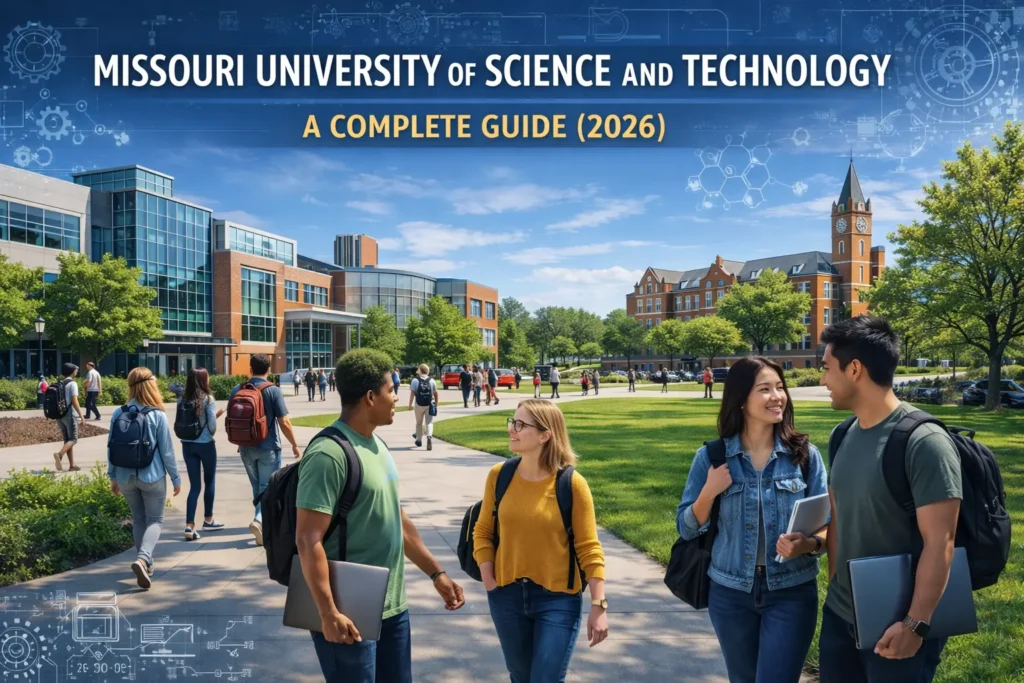
Missouri University of Science and Technology — widely known as Missouri S&T or simply S&T — is a nationally recognized public research university located in Rolla, Missouri. Founded in 1870 as the Missouri School of Mines and Metallurgy, it holds the distinction of being the first technological institution of higher learning established west of the Mississippi River. Today, Missouri S&T operates as a leading member of the University of Missouri System and carries both land-grant and space-grant designations.
The university’s motto, “Mens et Manus” (Mind and Hand), captures its enduring philosophy: rigorous theoretical knowledge combined with practical, hands-on application. With an R1 Carnegie Classification — the highest designation for doctoral research universities — Missouri S&T conducts research at the frontiers of science, engineering, and technology. Its transformation from the Missouri School of Mines and Metallurgy to Missouri University of Science and Technology in 2008 reflects its evolution from a specialized mining school into a comprehensive, multidisciplinary research institution.
Situated on a 284-acre campus in the Ozarks of central Missouri, approximately 100 miles west of St. Louis, Missouri S&T enrolls approximately 7,000 students across undergraduate and graduate programs. The university is home to 327 full-time faculty members and maintains a student-faculty ratio of 17:1. Whether you are a prospective student exploring STEM education, a parent evaluating value and outcomes, or a researcher seeking cutting-edge facilities, this guide covers everything you need to know about Missouri S&T.
| Quick Facts | Details |
| Official Name | Missouri University of Science and Technology |
| Also Known As | Missouri S&T, S&T, MS&T, UMR, University of Missouri-Rolla |
| Founded | 1870 |
| Location | Rolla, Missouri (Rolla, MO) |
| Type | Public Research University (R1), Land-Grant, Space-Grant |
| System | University of Missouri System |
| Campus Size | 284 acres |
| Enrollment | ~7,000 students |
| Student-Faculty Ratio | 17:1 |
| Chancellor | Mohammad Dehghani |
Why Choose Missouri University of Science and Technology? Rankings, Value & Outcomes
For students and families evaluating where to invest in a college education, Missouri S&T presents a compelling case built on academic prestige, exceptional career outcomes, and outstanding return on investment. Here is why S&T consistently ranks among the best universities in the nation for science, engineering, and technology.
National Rankings & Recognition
Missouri S&T has earned recognition from virtually every major college ranking authority in the United States. The university’s consistent placement across multiple lists reflects the depth and quality of its academic programs, faculty research, and graduate outcomes.
| Ranking Organization | Recognition |
| U.S. News & World Report | #192 National Universities; #104 Top Public Schools; #72 Best Undergraduate Engineering |
| The Princeton Review | Nationally recognized for engineering and value |
| Money Magazine | Among the best value colleges in the country |
| Smart Asset | #1 Best Value Public University in Missouri |
| CollegeNet Social Mobility Index | Recognized for upward mobility outcomes |
These rankings speak to S&T’s academic rigor, research output, and its commitment to producing career-ready graduates. The university’s engineering college is particularly well regarded: 61% of faculty research appears in journals ranked in the top 25% of their respective fields globally, a testament to the caliber of scholarship happening in Rolla.
Return on Investment & Career Success
When evaluating a university, return on investment (ROI) is among the most important factors for prospective students and families — and few schools match Missouri S&T’s track record. The data is striking: the median salary for Missouri S&T graduates six years after enrollment is $69,295, a figure that significantly outpaces the national average for college graduates.
Missouri S&T ranks #3 among public universities in the United States for career placement, according to independent analysis. This outstanding outcome is driven by a combination of rigorous academics, hands-on experiential learning, and deep relationships with top employers across engineering, technology, energy, defense, and manufacturing sectors.
| Major / Field | Approximate Starting Salary |
| Computer Science | ~$102,000 |
| Engineering (all disciplines) | ~$95,000 |
| Engineering Technologies | ~$80,000 |
| Physical Sciences | ~$72,000 |
| Overall Median (6 years post-enrollment) | $69,295 |
These salary figures, combined with Missouri S&T’s comparatively affordable tuition — particularly for in-state students — make S&T one of the highest-ROI universities in the United States. Graduates leave with a world-class degree and enter careers with compensation well above the national average, often with minimal student debt relative to their earning power.
Co-op programs and internships are deeply embedded in Missouri S&T’s academic culture. Over the course of their studies, many S&T students complete multiple paid co-op rotations with Fortune 500 companies, government agencies, and national laboratories. These experiences not only build resumes but frequently translate directly into full-time job offers upon graduation.
Academics at S&T: Where Theory Meets Practice
Missouri S&T’s academic identity is built on a foundation of engineering and applied science, but the university offers a rich, multidisciplinary curriculum that extends well beyond its STEM core. With undergraduate programs, graduate degrees, and doctoral programs spanning dozens of disciplines, S&T provides a comprehensive academic experience rooted in intellectual rigor and real-world application.
Top-Ranked Programs and Majors
Engineering dominates the Missouri S&T academic landscape, accounting for approximately 64% of all undergraduate degrees conferred annually. Computer science follows as the second most popular major at roughly 13%, reflecting the explosive demand for technology professionals in the modern economy. Engineering technologies, physical sciences, and business round out the top fields of study.
Within engineering, students can pursue degrees across a wide spectrum of disciplines, including:
- Mechanical Engineering — one of the most popular and highly ranked programs at S&T
- Civil Engineering — with particular strength in structural, environmental, and geotechnical specializations
- Chemical Engineering — leveraging S&T’s heritage in applied chemistry and materials science
- Aerospace Engineering — preparing students for careers in aerospace, defense, and space exploration
- Electrical Engineering — spanning power systems, communications, and microelectronics
- Computer Engineering — bridging hardware and software at the intersection of EE and CS
- Mining Engineering — a nod to the university’s founding mission, now modernized for 21st-century resource management
- Nuclear Engineering — supported by one of only a handful of operational university research reactors in the country
- Environmental Engineering — addressing sustainability, water systems, and environmental remediation
- Systems Engineering — a newer interdisciplinary field preparing graduates for complex project management
Beyond STEM, Missouri S&T offers undergraduate programs in business and information technology (Miner Biz), arts, languages, and humanities — providing well-rounded education to complement technical expertise. Graduate students can pursue master’s degrees and doctoral programs in dozens of fields, with research funding and faculty mentorship available across departments.
Approximately 41% of classes at Missouri S&T enroll fewer than 20 students, ensuring that undergraduates have meaningful access to faculty — a significant advantage at a research university where professors are simultaneously advancing their fields and teaching the next generation.
Hands-On Learning: Design Teams & Undergraduate Research
Missouri S&T is nationally known for its culture of experiential learning — the idea that students learn best by doing. This philosophy is embodied most visibly in the university’s 21 student-led design teams, which compete at the national and international level in engineering challenges spanning virtually every major discipline.
These design teams are not extracurricular clubs — they are serious, funded engineering organizations that provide students with the kind of practical problem-solving experience typically reserved for professional engineers. Teams include:
- Solar Car Team — designs and races a solar-powered vehicle in cross-country competitions
- Formula SAE — builds a formula-style race car for collegiate competition
- Baja SAE — engineers an off-road vehicle to compete in extreme terrain challenges
- Rockets Design Team — builds high-powered rockets for national competitions
- Human Powered Vehicle Team — develops human-powered transportation solutions
- Mars Rover Design Team — builds planetary rovers inspired by NASA missions
- Steel Bridge Team — constructs miniature steel bridges tested for structural performance
- Concrete Canoe Team — showcases civil engineering creativity and materials science
Participation in design teams is widely cited by employers as one of the most valuable differentiators on a Missouri S&T graduate’s resume. Students gain experience in project management, budgeting, fabrication, testing, and teamwork — the full lifecycle of engineering product development.
Beyond design teams, undergraduate research opportunities at Missouri S&T are extensive. Students can work directly with faculty in labs investigating everything from advanced materials and cyber-physical systems to environmental remediation and biomedical engineering. The university’s R1 classification reflects a serious institutional commitment to research at the highest level, and undergraduate students benefit directly from this environment.
One of Missouri S&T’s most distinctive research assets is its Research Reactor — one of only a handful of operational research reactors at any university in the United States. Originally brought online in 1961, the reactor supports research in nuclear engineering, materials science, neutron activation analysis, and related fields. For students interested in nuclear energy, materials science, or national security research, the Missouri S&T reactor is a truly unique resource.
The Kummer Institute: A Historic Investment in Innovation
In 2020, Missouri S&T received the transformative gift of $300 million from Fred and June Kummer — the largest single donation in university history and one of the largest gifts ever made to a public university in the state of Missouri. This historic investment established the Kummer Institute for Student Success, Research, and Economic Development and reshaped Missouri S&T’s trajectory for decades to come.
Fred Kummer, a Missouri S&T alumnus (Class of 1955), built a successful career as a civil engineer and entrepreneur before making this landmark gift to his alma mater. The Kummer Institute is designed to fulfill three core missions:
- Student Success — funding scholarships, fellowships, and support programs to ensure that talented students from all economic backgrounds can access and thrive in an S&T education
- Research & Innovation — accelerating faculty and student research through new funding streams, equipment, and collaborative programs focused on emerging technologies and engineering challenges
- Economic Development — connecting Missouri S&T’s intellectual resources with Missouri businesses and communities to drive regional economic growth, entrepreneurship, and workforce development
The Kummer gift also supported the creation of a new college focused on innovation, entrepreneurship, and the intersection of technology with business and society — a direct response to the evolving needs of the modern economy. Students interested in launching technology ventures, working at the nexus of engineering and business strategy, or leading innovation within large organizations now have dedicated academic resources to support those ambitions.
For prospective students, the Kummer Institute represents something important: Missouri S&T is not resting on its historical legacy. It is actively investing in the future — in student support, in research infrastructure, and in the kinds of educational experiences that prepare graduates for leadership in an increasingly complex technological world.
Admissions: How to Get into Missouri S&T
Gaining admission to Missouri S&T is a straightforward process for well-prepared students, but understanding the requirements, timeline, and what makes a strong application can help prospective Miners put their best foot forward. Here is everything you need to know about applying to Missouri University of Science and Technology.
Application Process & Deadlines
Missouri S&T accepts the Common Application, making it easy for students to apply alongside other colleges on a single platform. The primary undergraduate application deadline is July 1, though students interested in maximum financial aid consideration are encouraged to apply earlier in the admissions cycle — ideally in the fall of their senior year of high school.
The admissions process at Missouri S&T includes the following steps:
- Submit the Common App with all required materials (transcript, test scores if submitting, activities list)
- Pay or waive the application fee
- Submit your high school transcript through your school’s counselor
- Optionally schedule a campus visit or virtual tour through the admissions office
- Connect with an admissions counselor assigned to your region for personalized guidance
Missouri S&T admissions counselors are a genuinely valuable resource — they can answer questions about specific programs, scholarship opportunities, campus life, and the application process. Students are encouraged to reach out early and make use of this resource rather than navigating the process alone.
Campus visits and virtual tours are available year-round. For students who can travel to Rolla, MO, a campus visit is highly recommended — there is no substitute for experiencing the energy of a working research university firsthand, walking through facilities like Bertelsmeyer Hall or Altman Hall, and talking with current students about their experience.
Admissions Requirements & Test-Optional Policy
Missouri S&T has adopted a test-optional admissions policy, meaning that students are not required to submit SAT or ACT scores as part of their application. This policy recognizes that standardized test scores are one of many indicators of academic potential and does not penalize students who choose not to submit scores.
That said, students who have performed well on standardized tests and wish to strengthen their application are welcome — and often wise — to submit their scores. For context, the middle 50% of enrolled students fall within the following ranges:
| Admissions Metric | Data |
| Overall Acceptance Rate | 73% |
| Average High School GPA | 3.8 |
| Middle 50% SAT Range | 1190–1420 |
| Middle 50% ACT Range | 25–31 |
| Selectivity Designation | Highly Selective |
The 73% acceptance rate reflects Missouri S&T’s commitment to accessible STEM education — the university wants to admit students who are genuinely prepared and motivated to succeed in its rigorous academic environment. The “highly selective” designation applied by some college research organizations reflects the self-selecting nature of applicants: most students who apply to S&T are serious about STEM and arrive with strong academic records.
High school coursework matters significantly. Successful applicants typically have strong preparation in mathematics (through pre-calculus or calculus), sciences (physics, chemistry, biology), and English. Students interested in engineering programs should ideally have taken four years of math and at least three years of lab science.
Tips for a Strong Missouri S&T Application
While Missouri S&T does not require an application essay for freshman admission, the application still provides an opportunity to demonstrate who you are beyond your GPA and test scores. Here are several evidence-based strategies for strengthening your application:
Demonstrate Genuine Passion for STEM
Missouri S&T is looking for students who are not just academically capable, but genuinely excited about science, engineering, and technology. In your activities section and any optional essays, be specific about what draws you to your chosen field. Did you build a robot for your school’s competition team? Teach yourself to code? Volunteer for a science outreach program? These experiences matter.
Highlight Practical and Project-Based Experience
Given S&T’s culture of experiential learning and design teams, applications that demonstrate hands-on problem-solving experience stand out. Whether you participated in Science Olympiad, built projects in your garage, completed an engineering internship, or won a regional math competition, practical experience signals that you are the kind of student who will thrive at S&T.
Pursue Challenging Coursework
AP, IB, and dual enrollment courses in STEM subjects demonstrate your readiness for college-level work. If your school offers AP Physics, AP Chemistry, AP Calculus, or AP Computer Science, taking these courses — and ideally earning strong scores on the AP exams — will strengthen your application and potentially earn you college credit.
Visit Campus or Connect Virtually
Demonstrated interest matters at many universities, and a campus visit or meeting with an admissions counselor signals genuine enthusiasm for S&T specifically. It also helps you write more authentically about why Missouri S&T is the right fit for your goals.
Apply Early for Maximum Aid
Financial aid and scholarship funding is often allocated on a rolling basis. Applying in the fall of your senior year — rather than waiting until the July 1 deadline — maximizes your access to merit and need-based aid. Some scholarship programs have their own earlier deadlines, so reviewing the financial aid calendar on the S&T website early in the process is strongly advised.
Tuition, Fees, and Financial Aid at Missouri S&T
One of Missouri S&T’s most compelling arguments to prospective students and families is its exceptional value — a top-tier research university education at a price point significantly lower than many peer institutions. Understanding the full cost of attendance and available financial aid is essential for planning your investment in an S&T degree.
Cost of Attendance
| Cost Component | In-State (Missouri) | Out-of-State |
| Tuition & Fees (2024–25) | $15,930 | $35,118 |
| Housing & Meals (avg) | $13,422 | $13,422 |
| Books & Supplies (est) | ~$1,000 | ~$1,000 |
| Personal Expenses (est) | ~$2,000 | ~$2,000 |
| Total Estimated Cost of Attendance | ~$32,352 | ~$51,540 |
Even at the out-of-state rate, Missouri S&T’s tuition is competitive with many public flagship universities in other states — and the return on that investment, measured in career outcomes and earning potential, is among the best in the country.
Financial Aid & Scholarships
Missouri S&T is committed to making its education financially accessible. Approximately 51% of students receive need-based financial aid, with the average need-based aid package totaling $21,351. The average net price — what students actually pay after grants and scholarships — is $13,799 per year, a number that compares favorably with public universities of similar academic caliber.
Financial aid at Missouri S&T comes in several forms:
- Merit-based scholarships — awarded based on academic achievement, test scores, and specific program enrollment
- Need-based grants — including federal Pell Grants and institutional grants determined by the FAFSA
- Kummer Institute scholarships and fellowships — created through the historic $300 million gift, providing new funding opportunities for undergraduate and graduate students
- Work-study programs — offering on-campus employment opportunities to help offset costs
- Federal and private loans — available to bridge remaining gaps in funding
Missouri S&T also offers a 75% tuition discount for university employees and a 50% discount for their family members, making it an attractive employer for those with college-age dependents.
Prospective students should file the Free Application for Federal Student Aid (FAFSA) as early as possible — ideally in October of their senior year — to maximize access to federal, state, and institutional aid. The Missouri S&T financial aid office is available to help students and families navigate the process and identify all available funding sources.
Value and ROI: The S&T Proposition
Smart Asset has ranked Missouri S&T the #1 Best Value Public University in Missouri, and it is easy to understand why. When you pair below-average tuition with above-average graduate salaries — computer science graduates earning a median of approximately $102,000 and engineers earning $95,000 at career entry — the math is compelling. Students who graduate on time, leverage co-op earnings during their studies, and enter careers at S&T’s median salary levels can realistically recoup their entire educational investment within two to three years of graduation.
This value proposition is particularly strong for Missouri residents, who benefit from in-state tuition at a research university whose academic prestige rivals institutions charging two to three times as much.
Life at S&T: Campus, Community, and Culture
Missouri S&T is far more than laboratories and lecture halls. The university offers a vibrant, welcoming campus community where intellectual curiosity, creative problem-solving, and genuine human connection thrive side by side. Whether you are looking for competitive athletics, artistic expression, community service, or social connection, life at S&T has something to offer.
Campus Life & Student Organizations
With more than 250 registered student organizations, Missouri S&T offers a rich array of opportunities for students to connect around shared interests, identities, and passions. From academic and professional organizations to cultural clubs, service groups, and recreational societies, there is room for every kind of student at S&T.
Highlights of campus life include:
- Student Government Association — representing the student body in university decision-making
- Missouri Miner — the university’s independent student newspaper, offering experience in journalism and media
- KMNR — the student-run radio station, one of the few remaining non-commercial college radio stations in Missouri
- SPECTRUM — S&T’s LGBTQ+ student organization, providing community and advocacy on campus
- Pre-professional societies — including chapters of NSBE, SWE, ASCE, ASME, IEEE, and ACM, providing career networking and professional development
- Cultural organizations — celebrating the university’s international community and the diversity of student backgrounds
- Service organizations — including Habitat for Humanity, Engineers Without Borders, and numerous honor societies
Greek life is an important part of the Missouri S&T social landscape, with 20 fraternities and 4 sororities offering brotherhood, sisterhood, housing, academic support, and leadership development. Approximately 20% of Missouri S&T students participate in Greek organizations.
Housing and Dining
Missouri S&T offers a variety of on-campus housing options to suit different preferences, budgets, and community interests. Incoming freshmen often choose to live in the residence halls to immerse themselves in campus life and build friendships early in their college career.
Housing options on and near campus include:
- Coed residence halls — traditional dormitory-style living with community programming and resident advisors
- Apartment-style housing — offering more independence and kitchen access for upperclassmen
- Fraternity and sorority housing — residential options for Greek-affiliated students
- Theme housing — specialized living communities organized around shared academic interests or identities
The university’s dining services offer multiple on-campus locations serving diverse menus, including options for dietary restrictions and preferences. Living on campus in the first year is encouraged as a way to build community, establish academic routines, and fully experience what Missouri S&T has to offer.
Athletics and Recreation
Missouri S&T competes at the NCAA Division II level as a member of the Great Lakes Valley Conference (GLVC). Student athletes at S&T are the Miners — a name that honors the university’s founding identity as a school of mining engineering — represented by the beloved mascot Joe Miner.
The university fields competitive teams in numerous sports, including football, basketball, baseball, softball, soccer, track and field, cross country, swimming, golf, and tennis. S&T athletics emphasize the balance between competitive excellence and academic achievement: student athletes at S&T consistently earn GLVC Academic All-Conference honors at some of the highest rates in the conference.
For students who prefer recreational sports to varsity competition, Missouri S&T offers extensive intramural and club sports programming. From ultimate frisbee and sand volleyball to esports and rock climbing, there are competitive and casual options for athletes of every skill level.
The university’s recreation facilities include fitness centers, courts, fields, and spaces for individual and group exercise. Staying active is easy in Rolla — both on campus and in the surrounding natural environment.
The Rolla Community & Surrounding Area
Rolla, Missouri is a welcoming small city of approximately 19,000 residents, consistently cited for its safety, affordability, and quality of life. Located in the heart of the Missouri Ozarks, Rolla offers the kind of community where college students are genuinely valued neighbors, not just transient residents.
The cost of living in Rolla is significantly lower than in major metropolitan areas, stretching both student budgets and faculty salaries further than equivalent positions in larger cities. Rent, groceries, transportation, and entertainment are all markedly more affordable than in St. Louis, Kansas City, or most other mid-sized American cities.
For students who enjoy the outdoors, Rolla and its surroundings are a dream. The Missouri Ozarks offer some of the finest natural recreation in the Midwest:
- Ozark National Scenic Riverways — one of America’s first National Scenic Riverways, offering canoeing, kayaking, fishing, and camping along the Current and Jacks Fork Rivers
- Mark Twain National Forest — hundreds of thousands of acres of public land for hiking, mountain biking, and wildlife observation
- Lake of the Ozarks — Missouri’s premier recreational lake, approximately 90 minutes from Rolla
- Johnson’s Shut-Ins State Park — a stunning natural geological formation popular for swimming and exploration
Cultural life in Rolla extends beyond the campus. The Leach Theatre, located within the Castleman Hall building on campus, hosts professional touring performances, concerts, and community events throughout the academic year — bringing world-class arts and entertainment to the Ozarks. The university and city together support a variety of local events, farmers markets, restaurants, and community gatherings that make Rolla feel like home.
St. Louis is approximately 100 miles to the east, providing convenient access to a major metropolitan area with professional sports, world-class museums, the St. Louis Symphony Orchestra, a vibrant restaurant scene, Lambert International Airport, and the full range of urban amenities — close enough for a weekend trip, far enough not to distract from the focused academic environment of Rolla.
faqs
Is Missouri S&T a good school?
Yes — by virtually every measure, Missouri S&T is an excellent university. It holds U.S. News rankings in the top 200 nationally and top 105 among public universities, with its engineering programs ranking inside the top 75 undergraduate engineering programs in the country. More importantly, its career outcomes speak for themselves: graduates earn above-average salaries, find employment quickly, and benefit from one of the strongest ROI profiles of any university in Missouri or the broader Midwest.
What is Missouri S&T known for?
Missouri S&T is known above all for engineering and applied science education. Its design teams, undergraduate research culture, and deep connections with industry employers are legendary in engineering circles. It is also known for its nuclear research reactor, its historic evolution from the Missouri School of Mines, its strong alumni network, and more recently, the transformative $300 million Kummer gift that has dramatically expanded its research and scholarship capabilities.
What is the acceptance rate at Missouri S&T?
The acceptance rate at Missouri S&T is approximately 73%. The university practices what might be described as informed selectivity — it admits the majority of qualified applicants while maintaining strong academic standards. The self-selecting nature of the applicant pool (students serious about STEM who meet S&T’s academic profile) means that admitted students are generally well prepared for the rigorous curriculum.
What GPA do you need to get into Missouri S&T?
The average GPA of admitted students at Missouri S&T is approximately 3.8 on a 4.0 scale. Students with GPAs below this average are still considered, particularly if other elements of their application (rigorous coursework, strong test scores, demonstrated passion for STEM, or meaningful extracurricular involvement) demonstrate readiness for S&T’s academic environment.
Is Missouri S&T test-optional?
Yes. Missouri S&T has adopted a test-optional admissions policy. Students may apply without submitting SAT or ACT scores. Students who have performed well on standardized tests may choose to submit scores to strengthen their application, but no applicant is penalized for choosing not to submit.
How much does Missouri S&T cost?
For the 2024–25 academic year, in-state tuition and fees at Missouri S&T are $15,930. Out-of-state students pay approximately $35,118 in tuition and fees. Adding average room and board of $13,422 brings the total estimated cost of attendance to roughly $32,352 for in-state students and $51,540 for out-of-state students. After financial aid — with an average net price of $13,799 — many students’ actual out-of-pocket costs are considerably lower.
What is the student-faculty ratio at Missouri S&T?
The student-faculty ratio at Missouri S&T is 17:1, with 327 full-time faculty serving approximately 7,000 students. Approximately 41% of classes enroll fewer than 20 students, providing meaningful access to faculty for undergraduates in a research university setting.
What are the most popular majors at Missouri S&T?
Engineering is by far the most popular field of study at Missouri S&T, accounting for approximately 64% of undergraduate degrees. Computer science is the second most popular major at roughly 13%, followed by engineering technologies, physical sciences, and business. Within engineering, mechanical, civil, chemical, electrical, and aerospace engineering are among the most frequently pursued programs.
Conclusion: Is Missouri S&T Right for You?
Missouri University of Science and Technology is a university that rewards ambition, curiosity, and a genuine love of problem-solving. For students who want a world-class STEM education delivered by research-active faculty, in an environment where theory and practice are inseparable, S&T offers something genuinely rare: a research university experience at a price that makes financial sense.
The case for Missouri S&T rests on four pillars. First, academic excellence — top-ranked engineering programs, an R1 research classification, and faculty who are leaders in their fields. Second, hands-on learning — from 21 competitive design teams to an operational nuclear reactor and extensive co-op opportunities, S&T students learn by doing from day one. Third, career outcomes — with starting salaries among the highest in the country for its graduates and a #3 ranking for career placement among public universities, S&T delivers on its promise of career readiness. And fourth, value — with Smart Asset’s designation as Missouri’s #1 Best Value Public University and an average net price of just $13,799, the financial return on a Missouri S&T degree is exceptional.
Layer onto that the energy of the Kummer Institute’s transformative investment in student success and innovation, the community warmth of Rolla and the Missouri Ozarks, and a campus culture built on collaboration and engineering pride, and the picture that emerges is of a university that is simultaneously rooted in a proud 150-year legacy and boldly building toward the future.
If you are a high school student dreaming of an engineering career, a transfer student seeking a rigorous STEM environment, or a parent helping a college-bound child evaluate options — Missouri S&T deserves a serious look. The next step is yours to take:
- Visit the official Missouri S&T website at mst.edu for current program details, faculty profiles, and admissions information
- Schedule a campus visit or virtual tour through the Admissions office to experience Rolla and the S&T campus firsthand
- Connect with an admissions counselor for personalized guidance on programs, scholarships, and the application process
- Begin your Common App and start building the application that could launch your future in STEM

Adrian Cole is a technology researcher and AI content specialist with more than seven years of experience studying automation, machine learning models, and digital innovation. He has worked with multiple tech startups as a consultant, helping them adopt smarter tools and build data-driven systems. Adrian writes simple, clear, and practical explanations of complex tech topics so readers can easily understand the future of AI.