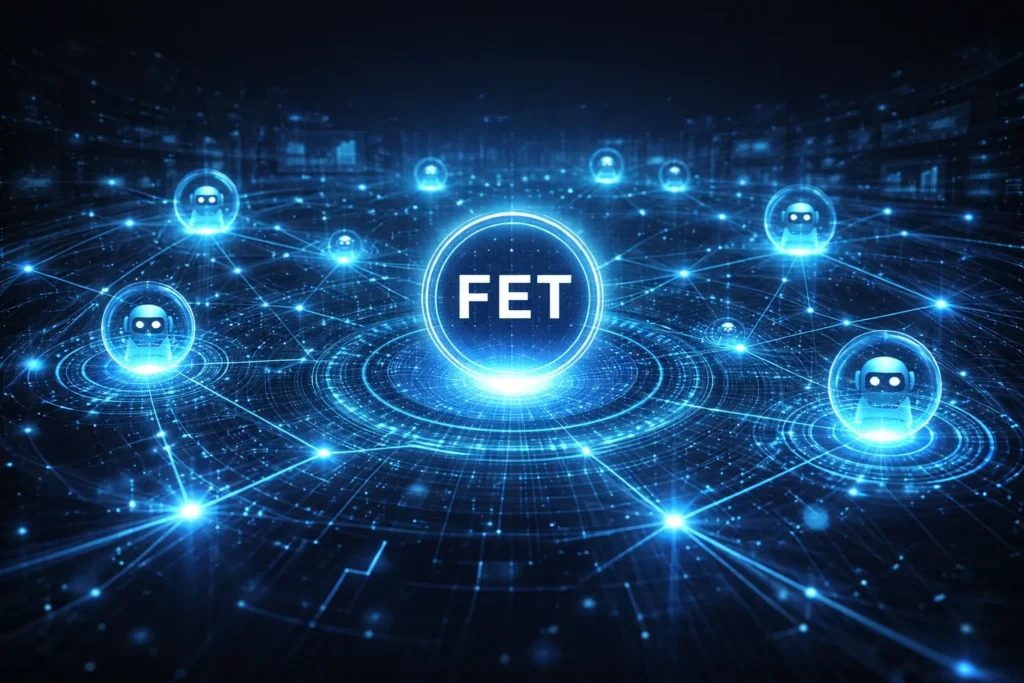
Artificial intelligence and blockchain technology are converging to create a new paradigm in how we build and interact with digital systems. At the forefront of this revolution is Fetch.ai, a decentralized platform that combines machine learning, multi-agent systems, and blockchain technology to create autonomous economic agents that can perform complex tasks on behalf of users and organizations.
In early 2024, Fetch.ai took a monumental step by announcing the formation of the Artificial Superintelligence Alliance (ASI), merging with SingularityNET and Ocean Protocol to create the largest open-source, decentralized network for AI development. This merger positions Fetch.ai and its native FET token at the center of one of the most ambitious projects in the cryptocurrency space.
This comprehensive guide will walk you through everything you need to know about Fetch.ai, from its innovative technology and practical applications to the FET token, the ASI merger, and how to participate in this groundbreaking ecosystem.
What is Fetch.ai? A Simple Explanation
Fetch.ai is a decentralized blockchain platform designed to enable autonomous economic agents (AEAs) to perform tasks, make decisions, and transact on behalf of individuals and organizations. Think of it as a next-generation internet infrastructure where AI-powered digital assistants can autonomously negotiate, collaborate, and execute complex workflows without constant human intervention.
Unlike traditional blockchain platforms that simply record transactions, Fetch.ai creates an entire ecosystem where intelligent software agents can discover each other, communicate, negotiate, and complete tasks ranging from finding parking spots to optimizing energy consumption across smart grids.
Beyond Blockchain: The Power of Autonomous Agents
At the heart of Fetch.ai are Autonomous Economic Agents. But what exactly does that mean? Imagine having a super-intelligent digital assistant that doesn’t just respond to your commands but proactively works on your behalf 24/7. This agent can:
- Monitor markets and execute trades based on predefined strategies
- Search for and negotiate the best prices for services like parking, energy, or transportation
- Communicate with other agents to coordinate complex tasks
- Learn from past interactions to improve future performance
Each autonomous agent in the Fetch.ai ecosystem has three essential elements:
Resources: The data, algorithms, and computational power the agent can access to complete tasks.
Runtime Environment: The infrastructure that allows the agent to execute its code and interact with other agents and systems.
Wallet: A digital wallet containing FET tokens that the agent uses to pay for services, receive payments, and participate in the network.
Real-World Examples: What Can Fetch.ai Do?
Fetch.ai isn’t just theoretical technology. The platform already powers real-world applications across multiple industries:
Decentralized Finance (DeFi)
- Botswap.fi: An automated market maker that uses intelligent agents to optimize liquidity provision and trading strategies
- Mettalex: A decentralized commodities exchange that leverages Fetch.ai agents for price discovery and market making
Transportation & Smart Mobility
- Smart Parking: Agents help drivers find and reserve available parking spaces in real-time, reducing congestion and emissions
- Mobix: A blockchain-based platform using Fetch.ai technology to create incentivized mobility ecosystems
- Partnerships with Mercedes and major automotive companies to integrate autonomous agents into connected vehicles
Energy & Utilities
- EnergiMine: Optimizing energy consumption and grid management through intelligent agent coordination
- Bosch Partnership: Collaborating with the industrial giant to develop AI-powered solutions for smart cities and manufacturing
Supply Chain & Logistics
- Chaîne-X: A blockchain platform for supply chain verification that uses Fetch.ai agents to track and authenticate products throughout their lifecycle
The Technology Behind Fetch.ai: A Layered Architecture
Fetch.ai’s power comes from its sophisticated four-layer architecture. Each layer serves a specific purpose, working together to create a seamless ecosystem for autonomous agents.
Layer 1: AI Agents – The Digital Workers
At the foundation are the AI Agents themselves. These are flexible software programs that can represent anything from a simple service (like a parking spot checker) to complex systems (like a trading algorithm or supply chain coordinator). Agents are autonomous, meaning they can make decisions and take actions based on their programming and machine learning capabilities without requiring constant human oversight.
Each agent has its own identity, wallet, and set of objectives. They can discover other agents, negotiate terms, and execute transactions using smart contracts. This peer-to-peer interaction model enables unprecedented levels of automation and efficiency.
Layer 2: Agentverse – The Development Hub
Agentverse is Fetch.ai’s Software-as-a-Service (SaaS) platform that makes it easy for developers to create, test, and deploy autonomous agents. Think of it as an integrated development environment specifically designed for building AI agents.
The platform provides pre-built templates, code libraries, and tools that significantly reduce the complexity of agent development. Even developers without extensive AI or blockchain experience can create functional agents using the Agentverse platform. This democratization of agent development is crucial for growing the Fetch.ai ecosystem.
Layer 3: AI Engine – The Brain
The AI Engine is where Fetch.ai’s intelligence truly shines. This layer uses advanced Large Language Models (LLMs) to understand user requests in natural language and match them with the appropriate agents to fulfill those requests.
The user-facing component of the AI Engine is DeltaV, an intuitive chatbot interface. Users can simply type what they need in plain English (or other languages), and DeltaV will:
- Interpret the request using natural language processing
- Search the Almanac for relevant agents
- Coordinate multiple agents if needed to complete complex tasks
- Execute the task and return results to the user
Layer 4: Fetch Network – The Foundation
The Fetch Network is the blockchain infrastructure that underpins the entire ecosystem. It consists of several critical components:
The Ledger: Fetch.ai uses a Proof-of-Stake (PoS) consensus mechanism to secure its blockchain. This energy-efficient approach allows FET token holders to stake their tokens and earn rewards while helping to validate transactions and maintain network security.
The Almanac: A decentralized directory service that functions like a phone book for agents. When an agent is deployed, it registers in the Almanac, making it discoverable by other agents and users. The Almanac enables the network effect that makes Fetch.ai so powerful.
Fetch Name Service: Similar to DNS (Domain Name System) for websites, the Fetch Name Service provides human-readable names for agents and addresses, making the system more user-friendly.
Interchain Compatibility: Built on the Cosmos SDK and using CosmWasm for smart contracts, Fetch.ai is designed to be interoperable with other blockchains. This interchain capability allows agents to interact with multiple blockchain networks, not just Fetch.ai’s native chain.
The FET token serves as the native currency of the Fetch Network, used for paying transaction fees, executing smart contracts, and incentivizing network participants.
The FET Token: Utility, Tokenomics, and How to Get It
The FET token is more than just a cryptocurrency for trading; it’s the fuel that powers the entire Fetch.ai ecosystem. Understanding its utility and tokenomics is essential for anyone interested in participating in the network.
What is FET Used For?
Transaction Fees: Every transaction on the Fetch.ai network requires FET tokens to pay for gas fees. This includes agent registrations, smart contract executions, and inter-agent transactions.
Staking and Network Security: FET token holders can stake their tokens to help secure the network through the Proof-of-Stake consensus mechanism. In return, stakers earn rewards, creating a passive income stream. Staking also gives participants a voice in network governance.
Governance: FET holders can vote on proposals that shape the future of the network. This includes decisions about protocol upgrades, parameter changes, and funding for ecosystem development. The more FET you stake, the greater your voting power.
Agent Services: Agents use FET tokens to pay for services from other agents, creating a micro-economy within the Fetch.ai ecosystem. For example, a parking agent might pay a traffic data agent for real-time congestion information.
FET Tokenomics at a Glance
Understanding the economics of FET is crucial for evaluating its long-term potential:
| Metric | Details |
| Total Supply | 2.63 billion FET |
| Token Standard | Native (Fetch Network) & ERC-20 (Ethereum) |
| Consensus Mechanism | Proof-of-Stake (PoS) |
| Initial Distribution | Initial Exchange Offering (IEO) on Binance Launchpad |
| ERC-20 Contract Address | 0xaea46a60368a7bd060eec7df8cba43b7ef41ad85 |
The token distribution was designed to support long-term ecosystem growth:
- Founders and team allocations with vesting schedules to ensure long-term commitment
- Foundation reserves for ecosystem development and partnerships
- Mining and staking rewards distributed over time
- Community and ecosystem incentives
Where and How to Buy FET in 2024-2025
FET is available on numerous cryptocurrency exchanges, both centralized and decentralized. Here’s a comprehensive guide to purchasing FET:
Top Centralized Exchanges:
- Binance: The largest crypto exchange globally, offering FET with multiple trading pairs including FET/USDT, FET/BTC, and FET/ETH
- Coinbase: A user-friendly platform popular in North America, offering FET with fiat on-ramps
- Kraken: Known for security and regulatory compliance, with FET trading pairs
- Gate.io: Offers advanced trading features and high liquidity for FET
CRITICAL: Understanding Native vs. ERC-20 FET
This is extremely important to avoid losing your funds: FET exists in two versions:
1. Native FET: The original token on Fetch.ai’s own blockchain. This version is required for staking and governance participation.
2. ERC-20 FET: An Ethereum-based version that exists on the Ethereum blockchain. This version is commonly used on decentralized exchanges and can be stored in standard Ethereum wallets like MetaMask.
Important Guidelines:
- Always verify which network your exchange supports before withdrawing
- Use the correct wallet address for the network you’re using
- Sending ERC-20 FET to a native Fetch.ai address (or vice versa) will result in permanent loss of funds
- Official bridge services are available to convert between the two versions if needed
Step-by-Step Purchase Guide:
1. Create an account on a reputable exchange (e.g., Binance or Coinbase)
2. Complete identity verification (KYC) as required
3. Deposit funds (fiat currency or other cryptocurrencies like USDT)
4. Navigate to the FET trading pair
5. Place a market or limit order based on your preference
6. Transfer to a secure wallet (recommended for long-term holding)
How to Stake FET
Staking FET allows you to earn passive income while supporting network security. Here’s what you need to know:
Staking Options:
- Exchange Staking: Many centralized exchanges like Binance offer simple staking programs with automatic rewards distribution
- Native Wallet Staking: Using the official Fetch.ai wallet provides you with full control and direct participation in network governance
- Validator Delegation: Choose a validator to delegate your tokens to, sharing in their staking rewards
Key Considerations:
- Staking rewards vary based on network conditions and total staked amount
- Some staking methods have lock-up periods during which you cannot access your tokens
- Research validator performance and commission rates before delegating
- Staked FET can be used for governance voting on network proposals
The Artificial Superintelligence Alliance (ASI): The Merger Explained
In what may be the most significant development in decentralized AI, Fetch.ai announced the formation of the Artificial Superintelligence Alliance in early 2024. This section provides the definitive guide to understanding this groundbreaking merger.
What is the Artificial Superintelligence Alliance?
The Artificial Superintelligence Alliance represents the merger of three leading blockchain AI projects:
- Fetch.ai (FET): Autonomous economic agents and decentralized AI infrastructure
- SingularityNET (AGIX): A decentralized marketplace for AI services
- Ocean Protocol (OCEAN): Data sharing and monetization infrastructure
Later, CUDOS, a decentralized cloud computing network, also joined the alliance, further strengthening the collective capabilities.
The mission of the ASI Alliance is ambitious: to create the largest open-source, decentralized network for developing Artificial General Intelligence (AGI) and, ultimately, Artificial Superintelligence (ASI). This stands in stark contrast to the centralized AI development dominated by Big Tech companies like Google, Microsoft, and OpenAI.
As Humayun Sheikh, CEO of Fetch.ai, stated: “The formation of the Superintelligence Alliance is a seminal moment for decentralized AI. By combining our technologies and communities, we’re creating an unprecedented force that can compete with Big Tech’s centralized AI while maintaining our commitment to open, ethical, and accessible artificial intelligence.”
The FET to ASI Token Merger: A Step-by-Step Guide
One of the most important aspects of the alliance is the token merger. FET has been designated as the merger token and will eventually be rebranded as ASI. Here’s how the conversion works:
| Original Token | Conversion Ratio to ASI |
| FET (Fetch.ai) | 1 FET = 1 ASI |
| AGIX (SingularityNET) | ~0.433350 AGIX = 1 ASI |
| OCEAN (Ocean Protocol) | ~0.433226 OCEAN = 1 ASI |
What This Means for Token Holders:
- FET holders: Your tokens will be converted 1:1 to ASI. In many cases, this conversion happens automatically on exchanges
- AGIX holders: Approximately 2.31 AGIX tokens will be required to receive 1 ASI token
- OCEAN holders: Approximately 2.31 OCEAN tokens will be required to receive 1 ASI token
Action Required:
For most users holding tokens on major exchanges, the conversion will be handled automatically. However, if you hold AGIX or OCEAN in self-custody wallets, you may need to use official migration portals to complete the swap. Always verify migration instructions on the official Fetch.ai and ASI Alliance websites to avoid scams.
FET holders generally do not need to take any immediate action, as FET is the foundation token of the merger.
Why the Merger Matters for FET Holders
The ASI Alliance merger brings significant potential benefits:
- Increased Liquidity: Combining three major tokens creates deeper liquidity pools and potentially higher trading volumes
- Unified Ecosystem: Instead of three separate communities and development efforts, the alliance creates a single, more powerful ecosystem
- Combined Market Capitalization: The merged entity creates one of the largest decentralized AI projects by market cap
- Greater Development Resources: Pooled resources allow for more ambitious technical development and faster innovation
- Competitive Position: The alliance creates a genuine alternative to centralized Big Tech AI, with the resources to compete at scale
- Complementary Technologies: Each project brings unique strengths that create synergies when combined
The Team Behind Fetch.ai (and the ASI Alliance)
The credibility of any blockchain project depends heavily on the team behind it. Fetch.ai is led by industry veterans with impressive credentials:
Humayun Sheikh – CEO and Co-Founder
Humayun Sheikh is perhaps best known as an early investor in DeepMind, the AI research company later acquired by Google for over $500 million. His experience in AI and his vision for decentralized artificial intelligence have been instrumental in shaping Fetch.ai’s direction. As CEO, Sheikh has led the strategic vision of the company and spearheaded the formation of the ASI Alliance.
Toby Simpson – CTO and Co-Founder
Toby Simpson brings deep technical expertise from his time at DeepMind, where he worked on cutting-edge AI systems. As CTO of Fetch.ai, Simpson oversees the technical architecture and development of the platform, ensuring that the vision of autonomous economic agents becomes a reality.
Thomas Hain – Chief Scientific Officer
Professor Thomas Hain is an academic with extensive research experience in machine learning and speech processing at the University of Sheffield and the University of Cambridge. His scientific expertise helps ensure that Fetch.ai’s AI technologies remain at the cutting edge of the field.
This combination of entrepreneurial vision (Sheikh), technical execution (Simpson), and scientific rigor (Hain) provides Fetch.ai with a strong leadership foundation. The team’s connections to DeepMind and leading academic institutions add significant credibility to the project.
FAQS
Is Fetch.ai a good investment?
Like all cryptocurrency investments, Fetch.ai carries significant risks. However, it also offers potential upside based on its innovative technology, strong team, major partnerships, and position within the growing AI and blockchain intersection. The ASI Alliance merger adds another dimension of potential value. Always conduct your own research (DYOR) and never invest more than you can afford to lose. This is not financial advice.
What is the difference between FET and ASI?
FET is the current token of the Fetch.ai network. ASI (Artificial Superintelligence) is the new unified token that represents the merger of Fetch.ai, SingularityNET, and Ocean Protocol. FET will be converted to ASI at a 1:1 ratio, making FET holders the foundation of the new alliance.
Do I need to swap my FET tokens for ASI?
In most cases, if you hold FET on a major exchange, the conversion will happen automatically. If you hold FET in a self-custody wallet, check official Fetch.ai announcements for specific instructions. Generally, FET holders have the most straightforward path as FET is the base token of the merger.
What happens to my AGIX and OCEAN tokens?
AGIX and OCEAN tokens will be converted to ASI at the ratios specified in the merger agreement (approximately 0.433 AGIX or OCEAN = 1 ASI). Check with your exchange or use official migration portals for self-custody tokens.
Which wallet is best for FET?
For ERC-20 FET, MetaMask and other Ethereum-compatible wallets work well. For native FET, the official Fetch.ai wallet is recommended. Hardware wallets like Ledger also support FET for maximum security.
Can I mine Fetch.ai?
No, Fetch.ai uses a Proof-of-Stake consensus mechanism, not Proof-of-Work. Instead of mining, you can stake FET tokens to earn rewards and help secure the network.
Is Fetch.ai on Ethereum or its own blockchain?
Fetch.ai has its own blockchain (the Fetch Network) built on Cosmos SDK. However, an ERC-20 version of FET also exists on Ethereum for compatibility with Ethereum-based applications and exchanges. Always verify which network you’re using when transferring tokens.
How does Fetch.ai use machine learning?
Fetch.ai uses machine learning in multiple ways: agents use ML algorithms to make decisions and optimize their behavior, the AI Engine uses large language models to understand user requests, and the platform supports collective learning where agents can share and improve their knowledge while preserving privacy.
What are the risks of investing in Fetch.ai?
Risks include cryptocurrency market volatility, regulatory uncertainty, technological challenges in delivering the roadmap, competition from other AI blockchain projects, and the general risks associated with early-stage technology projects. The ASI merger also introduces integration risks, though it offers potential benefits as well.
Conclusion: The Future of Fetch.ai and the ASI Alliance
Fetch.ai represents one of the most ambitious and technically sophisticated projects in the blockchain and artificial intelligence space. By combining autonomous economic agents, machine learning, and decentralized infrastructure, it’s creating a new paradigm for how AI systems can operate in an open, permissionless environment.
The key strengths of Fetch.ai include:
- Innovative Technology: The four-layer architecture and autonomous agent framework represent genuine technological innovation
- Experienced Team: Leadership with DeepMind connections and academic credentials provides credibility
- Real-World Applications: Partnerships with Bosch, Mercedes, and others demonstrate practical utility
- Strategic Position: The ASI Alliance merger creates unprecedented scale in decentralized AI
- Growing Ecosystem: DeFi applications, mobility solutions, and energy optimization show diverse use cases
The formation of the Artificial Superintelligence Alliance marks a pivotal moment not just for Fetch.ai, but for the entire concept of decentralized artificial intelligence. By uniting three major projects under a single banner, the alliance creates a genuine counterweight to Big Tech’s centralized AI development while maintaining commitment to open-source principles and ethical AI.
For those interested in participating in this ecosystem, whether as developers building agents, token holders supporting the network through staking, or users benefiting from autonomous agent services, Fetch.ai offers numerous entry points.
As always with cryptocurrency investments and emerging technologies, conducting thorough research is essential. Monitor official channels, check current prices on trusted platforms like CoinGecko and CoinMarketCap, and engage with the community to stay informed about developments.
The convergence of AI and blockchain is still in its early stages, and Fetch.ai is positioning itself at the forefront of this revolution. Whether the project achieves its ambitious vision of decentralized superintelligence remains to be seen, but the technological foundation, team expertise, and strategic positioning make it one of the most compelling projects in the AI crypto space.
The future of artificial intelligence may well be decentralized, autonomous, and open-source. And if it is, Fetch.ai and the ASI Alliance are building the infrastructure to make it happen.

Adrian Cole is a technology researcher and AI content specialist with more than seven years of experience studying automation, machine learning models, and digital innovation. He has worked with multiple tech startups as a consultant, helping them adopt smarter tools and build data-driven systems. Adrian writes simple, clear, and practical explanations of complex tech topics so readers can easily understand the future of AI.