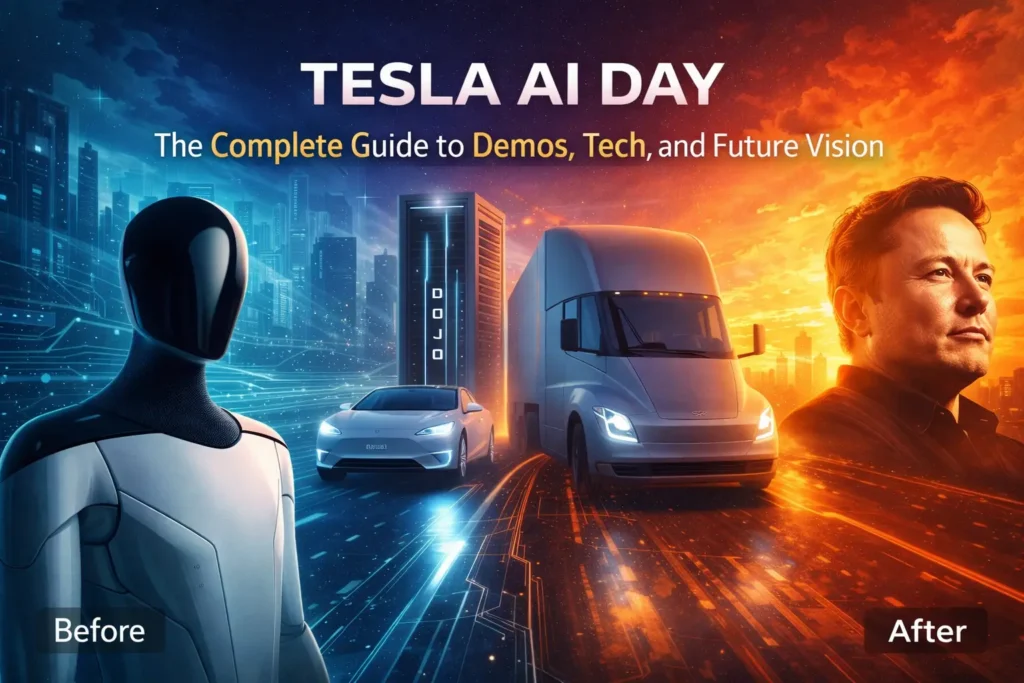
Tesla AI Day stands apart from typical product launches. Rather than unveiling new vehicles for consumers, this technical showcase reveals the bleeding edge of artificial intelligence and robotics development. The event serves dual purposes: recruiting top-tier AI engineers and robotics specialists while demonstrating to investors and the public that Tesla has evolved beyond automotive manufacturing into a comprehensive AI platform company.
This guide covers the complete Tesla AI Day story—from the Optimus humanoid robot prototype to Full Self-Driving neural networks and the Dojo supercomputer that powers it all. Whether you’re an engineer evaluating career opportunities, an investor analyzing Tesla’s strategic direction, or simply curious about the future of AI and robotics, you’ll find the technical depth and strategic context you need.
What is Tesla AI Day? Purpose and Evolution
Tesla AI Day represents a fundamental departure from traditional corporate events. While companies like Apple stage product launches aimed at consumers, Elon Musk’s presentation focuses on highly technical demonstrations designed to attract engineering talent. The technical deep dive format intentionally targets AI researchers, robotics engineers, and computer scientists who might join Tesla’s development teams.
Beyond recruitment, AI Day functions as a vision keynote that reframes how the market perceives Tesla. These presentations argue that Tesla should be valued not as an automotive manufacturer but as an AI company building the infrastructure for autonomous systems and general-purpose robotics.
A Brief History of AI Day
The Tesla AI Day series has evolved significantly since its inception:
- AI Day 2020: Introduced the custom FSD Chip and neural network architecture powering Autopilot, establishing Tesla’s in-house AI capabilities
- AI Day 2021: Unveiled Project Dojo supercomputer plans and announced the Optimus humanoid robot concept (initially presented by a dancer in a robot costume)
- AI Day 2022: Demonstrated working Optimus prototypes performing untethered walks, scaled FSD Beta to 160,000 users, and revealed operational Dojo training tiles
How to Watch Tesla AI Day Live
Tesla typically hosts AI Day in the fall at its Palo Alto facility, streaming the event live on the Tesla website and YouTube channel. Presentations usually begin in the evening Pacific Time to accommodate engineers who might tune in after work hours.
Update Alert: Tesla AI Day 2023 and beyond have not been officially announced. This page will be updated with confirmed dates, registration links, and streaming information as Tesla releases details. Bookmark this resource for the latest information.
Deep Dive: Optimus – Tesla’s Humanoid Robot
The journey from concept to prototype represents one of the most dramatic reveals in Tesla AI Day history. At the 2021 event, Elon Musk introduced the Tesla Bot concept with a dancer performing in a robot suit—a presentation that drew skepticism from robotics experts. Just one year later, the 2022 showcase silenced critics with functioning prototypes walking untethered across the stage.
Optimus aims to tackle dangerous, repetitive, or physically demanding tasks currently performed by humans. The general-purpose robot design targets applications ranging from factory work to household assistance, with Tesla positioning the humanoid as a solution to labor shortages and workplace safety concerns.
Optimus Technical Specifications and Demos
The 2022 prototype demonstrated significant engineering achievements across multiple systems:
| Specification | Details |
|---|---|
| Height | 5’8″ (173 cm) |
| Weight | 161 lbs (73 kg) |
| Walking Speed | 5 mph maximum |
| Carrying Capacity | 45 lbs (20 kg) |
| Actuators | 28 total (11 in hands alone) |
| Degrees of Freedom | Over 200 |
| Power Source | 2.3 kWh battery pack |
| Runtime | Full day of work on single charge |
| Computing | Tesla FSD Computer (same as vehicles) |
The untethered operation demonstration marked a crucial milestone. Unlike earlier prototypes that required external power or support structures, the 2022 Optimus walked independently, manipulated objects with articulated hands, and responded to environmental inputs without tethers or cables. This untethered walk proved the integration of power management, balance control, and real-time decision-making systems.
Design Philosophy: Why the Human Form?
Tesla’s decision to build a humanoid robot rather than a specialized industrial design stems from practical considerations. The world’s infrastructure—doorways, stairs, tools, vehicles—has been optimized for human dimensions and capabilities over millennia. A general-purpose robot that can navigate this human-designed environment without requiring extensive modifications offers immediate deployment advantages.
The hand design illustrates this philosophy. With 11 degrees of freedom per hand, Optimus can grasp tools, turn doorknobs, and manipulate objects designed for human use. This dexterity allows the robot to operate existing equipment rather than requiring custom interfaces or specialized tools.
Industry experts have noted this approach’s significance. Robotics companies like Sanctuary.ai have similarly pursued humanoid designs specifically because they can integrate into existing workflows without infrastructure overhauls. The cognitive AI required to operate in human environments, combined with physical form factors that match those environments, creates a more versatile platform than purpose-built industrial robots.
Optimus vs. The Competition
Understanding Optimus requires context within the broader robotics landscape:
Boston Dynamics Atlas excels at dynamic movement—performing backflips, parkour, and navigating complex terrain. However, Atlas remains a research platform with limited commercial availability and an estimated cost exceeding $100,000 per unit. The hydraulic actuation system, while powerful, adds complexity and maintenance requirements.
Sanctuary.ai Phoenix emphasizes cognitive capabilities and human-like reasoning. Phoenix integrates advanced AI systems for decision-making in unpredictable environments. The company focuses on general intelligence rather than just mechanical capability, positioning their robot for service industry applications.
Optimus’s Competitive Advantage centers on manufacturing scalability and cost targets. Tesla aims for a price point under $20,000—potentially one-fifth the cost of comparable platforms. Leveraging Tesla’s automotive manufacturing expertise, Optimus uses electric actuators similar to those in vehicle components, simplifying production and reducing costs. The vertical integration strategy, from chip design to final assembly, mirrors Tesla’s approach to electric vehicles.
This cost advantage could prove decisive for mass adoption. At $20,000, businesses could justify robot purchases for tasks currently performed by human workers, while competitors’ six-figure price tags limit deployment to specialized research or high-value applications.
The Brain and Nervous System: FSD and Dojo
The technologies powering Tesla’s autonomous vehicles and robots share fundamental architecture. Full Self-Driving neural networks trained on the Dojo supercomputer represent the “brain” that processes sensor inputs and generates real-time decisions. Understanding this interconnected system reveals how Tesla’s AI capabilities extend across product lines.
Dojo serves as the training ground where neural networks learn from massive datasets. Those trained models then run on Tesla’s FSD Computer—a custom chip designed for real-time inference in vehicles and robots. This closed-loop system allows continuous improvement: vehicles collect data during operation, Dojo processes that data to improve models, and updated models deploy back to the fleet.
Full Self-Driving (FSD) Beta: State of Play
Tesla’s Full Self-Driving technology relies on a vision-only system that processes inputs from cameras mounted around vehicles. Unlike competitors such as Waymo that employ lidar sensors, Tesla’s camera vision approach mimics human perception—using visual data to understand the three-dimensional world.
The core technological breakthrough involves occupancy networks, which create detailed 3D representations of the environment from 2D camera feeds. These neural networks predict not just where objects currently exist but forecast how they’ll move, enabling proactive driving decisions. The system processes video streams in real-time, understanding context like traffic flow patterns and pedestrian behavior.
Beta Program Expansion Timeline:
- Early 2021: Approximately 2,000 users in initial beta testing
- Mid-2022: Scaled to 160,000 participants
- Present: Continues expanding with version updates improving performance
The FSD Beta designation carries important implications. Despite the “Full Self-Driving” name, the system operates as a Level 2 driver-assistance technology requiring constant driver supervision. Drivers must keep hands on the wheel and remain ready to take control instantly. This differs fundamentally from Level 4 or 5 autonomy, where vehicles operate without human intervention.
Regulatory and Safety Challenges: The technology faces ongoing scrutiny from agencies including the National Highway Traffic Safety Administration. NHTSA investigation into Autopilot and FSD Beta performance in various scenarios continues. Critics point to instances where the system has made unexpected decisions or failed to recognize hazards. Tesla counters that the data shows FSD Beta users experience fewer accidents per mile than drivers without the system, though independent verification of these claims remains limited.
Comparisons to competitors like Waymo highlight different strategic approaches. Waymo restricts operations to carefully mapped geographic areas using lidar-based systems, achieving higher autonomy levels within those constraints. Tesla pursues a vision-only approach deployable anywhere, accepting current limitations in exchange for broader applicability as the technology improves.
Project Dojo: Tesla’s AI Supercomputer
Dojo represents Tesla’s answer to the computational demands of training advanced neural networks. The custom architecture optimizes specifically for the machine learning workloads required by computer vision and autonomous decision-making systems.
Architecture Breakdown:
The system builds hierarchically from custom silicon to massive computing clusters:
D1 Chip → The foundational building block, designed in-house by Tesla specifically for neural network training. Each chip contains specialized processing units optimized for the matrix operations central to deep learning.
Training Tile → 25 D1 chips arranged in a tile configuration, connected by high-bandwidth links that minimize data transfer bottlenecks. A single training tile achieves performance equivalent to approximately six conventional GPU server racks.
ExaPOD → Multiple training tiles combined into cabinet-scale systems capable of exaflop-level performance (one billion billion floating-point operations per second).
The outcome matters more than the technical specifications. Dojo achieves dramatically faster AI training at approximately one-tenth the cost of equivalent GPU-based systems. This cost efficiency allows Tesla to iterate more rapidly on neural network architectures and train on larger datasets than would be economically feasible with commercial hardware.
Tesla’s roadmap includes the D2 Chip, expected to deliver further performance improvements. The company continues expanding Dojo capacity, building additional ExaPODs to support both FSD development and the neural networks controlling Optimus robots.
The auto-labeling capability demonstrates Dojo’s practical impact. Training neural networks requires labeled datasets—millions of images tagged with information about objects, lanes, and hazards. Dojo processes raw video from Tesla’s fleet, automatically generating training labels that would otherwise require extensive human effort. This automation accelerates the improvement cycle from data collection to model deployment.
The Big Picture: Tesla’s Strategic Shift to AI
The narrative connecting Optimus humanoid robots, Full Self-Driving vehicles, and Dojo supercomputers reveals Tesla’s broader transformation. These aren’t isolated projects but components of a unified AI stack designed to solve general problems in perception, decision-making, and physical interaction with the world.
The FSD Computer runs in both vehicles and Optimus robots. The neural networks trained on Dojo power both autonomous driving and robotic manipulation. The sensor processing techniques developed for navigating roads apply to robots navigating factories or homes. This technological convergence positions Tesla as an AI platform company rather than merely an automotive manufacturer.
Elon Musk’s statement that Tesla represents “an AI company” crystallizes at AI Day demonstrations. The events showcase capabilities that extend far beyond electric vehicles into fundamental technologies for autonomous systems.
From Cars to Robotics and Beyond
The Robotaxi vision illustrates how FSD technology enables entirely new business models. Rather than selling vehicles to individual owners, Tesla could operate autonomous ride-sharing networks where cars generate revenue continuously. This shifts the economic model from one-time vehicle sales to recurring service revenue, potentially multiplying the value extracted from each manufactured car.
General-purpose robots represent an even more expansive opportunity. At AI Day 2022, presenters discussed the concept of a “quasi-infinite economy” enabled by humanoid robots. If machines can perform most physical labor at costs below human wages, the economic constraints traditionally limiting production capacity dissolve. The implications span from manufacturing and construction to eldercare and domestic work.
The scale of this transformation depends on execution. Building one prototype differs vastly from manufacturing millions of units at the targeted $20,000 price point. The gap between laboratory demonstrations and reliable real-world deployment has challenged robotics companies for decades. Tesla’s advantage lies in manufacturing infrastructure and experience scaling complex electromechanical systems—expertise directly applicable to robot production.
Investment and Market Implications
AI Day presentations fundamentally aim to shift how investors value Tesla. Traditional automotive companies trade at price-to-earnings ratios reflecting mature manufacturing businesses with thin margins. Technology companies, particularly those controlling platform infrastructure, command substantially higher valuations based on growth potential and software economics.
By positioning as an AI company, Tesla argues for tech sector valuation metrics. The FSD Beta software generates recurring revenue through subscription fees. Dojo represents proprietary infrastructure competitors cannot easily replicate. Optimus opens entirely new markets beyond transportation.
Investors analyze these claims through different lenses. Bulls see Tesla establishing dominant positions in autonomous vehicles and robotics before competitors develop comparable capabilities. Bears question whether the technologies will achieve the reliability, scalability, and regulatory approval required for the projected business models.
The market’s response to AI Day announcements provides some indication of persuasiveness. Stock prices typically show movement following events, though separating AI Day impact from broader market trends and other Tesla news proves difficult. Long-term valuation ultimately depends on execution—transitioning prototypes into products and demonstrations into deployable systems.
FAQ
When is the next Tesla AI Day?
While not officially announced, Tesla historically held AI Day events annually in the fall (typically September or October). The company has not confirmed whether the series will continue or specified dates for future events. This page will be updated immediately when Tesla announces the next AI Day, including date, time, and streaming information.
Can I buy a Tesla Optimus robot?
No. As of the most recent AI Day demonstration, Optimus remains in prototype development. Tesla has not announced a consumer release timeline or begun taking orders. The company’s stated goal targets a future price point under $20,000 when mass production begins, but no specific date has been provided for commercial availability.
What was the biggest announcement at AI Day 2022?
The first untethered demonstration of the Optimus humanoid robot prototype represented the most significant reveal. This showed dramatic progress from the previous year’s concept announcement, with functioning hardware performing autonomous walking and object manipulation without external power sources or support structures.
Is Tesla’s Full Self-Driving really “full” self-driving?
No. Despite the marketing name, FSD operates as a Level 2 driver-assistance system requiring active driver supervision at all times. Drivers must maintain attention to the road and be prepared to take control immediately. The system does not achieve Level 4 or Level 5 autonomy where vehicles can operate without human intervention. Tesla uses “Beta” designation to indicate the technology remains under development.
What is the purpose of the Dojo supercomputer?
Dojo is designed specifically to train Tesla’s AI neural networks exponentially faster and at lower cost than commercial GPU-based systems. The custom architecture optimizes for computer vision and autonomous decision-making workloads required by FSD and Optimus. Dojo processes data from Tesla’s vehicle fleet to continuously improve driving models and develops the neural networks controlling humanoid robots.
How does Tesla AI Day differ from other tech company events?
Unlike consumer-focused product launches, AI Day targets technical recruitment and investor communication. The highly technical presentations showcase underlying technology and engineering challenges rather than finished products. The format aims to attract AI researchers and robotics engineers to Tesla while demonstrating the company’s capabilities to investors and industry observers.
Stay Updated
Tesla’s AI development continues to evolve rapidly. This guide will be updated with new AI Day announcements, Optimus development milestones, FSD Beta version releases, and Dojo expansion news. Bookmark this page for the most comprehensive, current information about Tesla’s AI and robotics initiatives.

Adrian Cole is a technology researcher and AI content specialist with more than seven years of experience studying automation, machine learning models, and digital innovation. He has worked with multiple tech startups as a consultant, helping them adopt smarter tools and build data-driven systems. Adrian writes simple, clear, and practical explanations of complex tech topics so readers can easily understand the future of AI.