
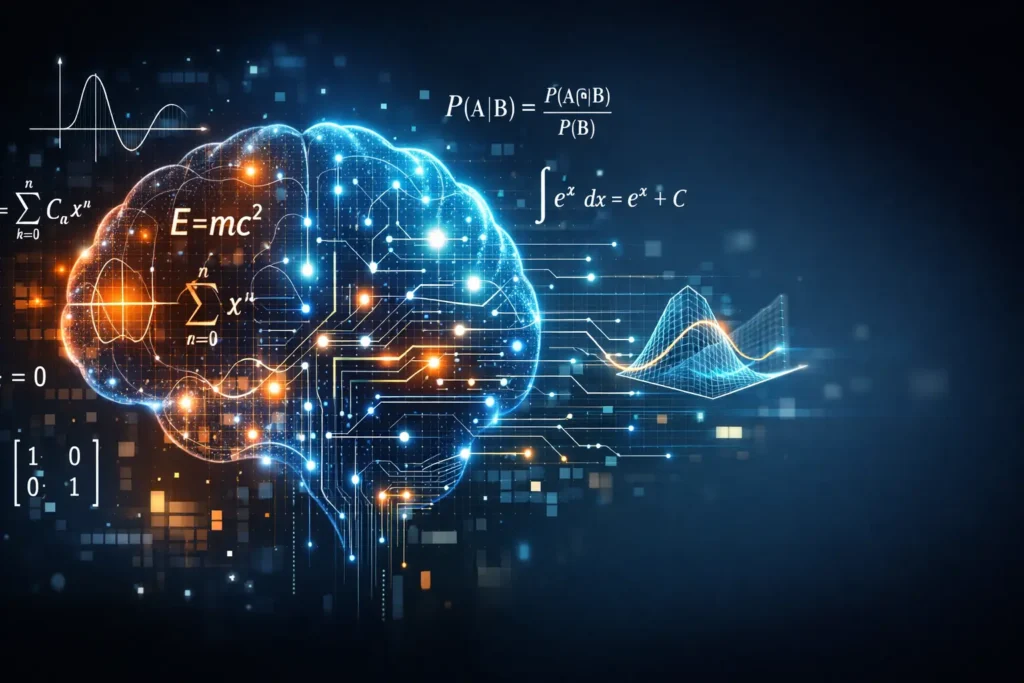
If you’ve ever stared at a complex equation and thought, “There has to be a smarter way to do this,” you’re already thinking in the same direction as math AI. Over the last few years, artificial intelligence has moved from solving toy math problems to assisting with proofs, optimizing financial models, accelerating scientific research, and even reshaping how students learn mathematics.
This isn’t hype-driven futurism. Math AI is already embedded in tools professionals use daily—often without realizing it. From recommendation algorithms to risk models, from symbolic solvers to neural networks approximating equations no human could solve manually, mathematics and AI are no longer separate disciplines. They’re deeply intertwined.
This guide is written for people who want clarity, not buzzwords. Whether you’re a student, educator, engineer, analyst, or simply curious about how math AI works in practice, you’ll find grounded explanations, real-world use cases, and honest guidance drawn from hands-on experience—not abstract theory.
By the end, you’ll understand what math AI really is, how it’s applied, where it excels, where it fails, and how to use it intelligently without overtrusting it.
What Is Math AI? A Clear, Practical Explanation from Beginner to Advanced
At its core, math AI refers to artificial intelligence systems designed to understand, generate, solve, or optimize mathematical structures. That sounds abstract, but in practice it breaks down into three approachable layers.
At the most basic level, math AI acts like a very fast, very patient assistant. It can compute large numerical problems, solve systems of equations, or check algebraic steps instantly. Tools like Wolfram Alpha fall into this category, providing computational math results that once required hours of manual work.
The second layer involves pattern recognition. Here, machine learning models don’t “solve” math in the traditional sense. Instead, they learn mathematical relationships from data. Think regression models, optimization algorithms, and neural networks approximating functions when closed-form solutions are impractical.
The third—and most powerful—layer is symbolic reasoning and proof assistance. Advanced math AI systems can manipulate symbols, explore proof paths, verify logic, and even propose conjectures. This is where AI begins collaborating with mathematicians rather than merely replacing calculators.
A useful analogy is this: traditional math tools are like precise rulers and calculators. Math AI is more like an apprentice who has studied millions of solved problems and can suggest approaches, check reasoning, and explore possibilities at scale.
Importantly, math AI doesn’t replace mathematical thinking. It amplifies it. The strongest results come when human intuition guides AI computation, not the other way around.
Why Math AI Matters Right Now (And Why It’s Not Optional Anymore)
There was a time when advanced mathematics was constrained by human speed. Today, that constraint is gone. What limits progress now is how well we frame problems—and that’s where math AI becomes essential.
In finance, models are no longer static equations. They’re adaptive systems that respond to live data. In engineering, simulations that once took weeks now run in hours. In education, personalized math learning is replacing one-size-fits-all curricula.
What’s changed isn’t mathematics itself, but scale. Math AI allows us to:
- Explore solution spaces too large for human reasoning alone
- Detect patterns invisible to manual analysis
- Test assumptions rapidly and iteratively
- Move from theoretical models to deployable systems faster
This shift mirrors what spreadsheets did for accounting. Accountants didn’t disappear; they became more strategic. The same transformation is happening with mathematics.
Ignoring math AI today is like refusing to use calculators in the 1980s. You can do it—but you’ll be slower, less competitive, and increasingly disconnected from modern workflows.
Benefits and Real-World Use Cases of Math AI Across Industries
Education and Learning Mathematics More Effectively
In classrooms, math AI is changing how students interact with concepts. Instead of passively following steps, learners receive instant feedback, alternative solution paths, and adaptive difficulty levels.
Before math AI, struggling students often fell behind quietly. After math AI, misconceptions are flagged immediately, allowing targeted correction. Advanced students, meanwhile, can explore deeper problems without waiting for class progression.
This isn’t about replacing teachers. It’s about giving educators insight into how students think mathematically, not just whether they got an answer right.
Finance, Economics, and Risk Modeling
Modern financial systems rely heavily on math AI for optimization, forecasting, and risk assessment. Portfolio optimization, fraud detection, and algorithmic trading all depend on AI-driven mathematical models.
The “before” state involved static assumptions and delayed reactions. The “after” state involves adaptive models that recalibrate continuously. The tangible result is reduced risk exposure, faster decision-making, and better capital allocation.
Engineering, Physics, and Scientific Research
In engineering and physics, math AI shines in simulation-heavy domains. Solving partial differential equations, optimizing structural designs, or modeling fluid dynamics are tasks where AI-assisted math dramatically reduces time to insight.
Researchers use math AI to test hypotheses computationally before committing to expensive physical experiments. This has accelerated innovation in materials science, aerospace, and energy systems.
Software Development and Data Science
Behind every machine learning model lies mathematics—linear algebra, probability, optimization. Math AI assists developers by automating gradient calculations, tuning parameters, and validating assumptions.
This allows practitioners to focus less on manual derivation and more on system-level thinking, which is where real value is created.
A Step-by-Step Practical Guide to Using Math AI Effectively
Step 1: Define the Mathematical Problem Clearly
Math AI performs best when the problem is well-defined. Vague prompts produce shallow results. Clear objectives, constraints, and variables matter more than model choice.
Instead of asking, “Solve this equation,” frame it as, “Solve this equation under these assumptions, and explain the reasoning.”
Step 2: Choose the Right Category of Tool
Not all math AI tools are equal. Some excel at symbolic manipulation, others at numerical approximation, others at learning from data. Misalignment here leads to frustration.
Symbolic problems need symbolic engines. Data-driven problems need machine learning models. Hybrid problems require both.
Step 3: Validate, Don’t Blindly Trust
One of the most overlooked steps is verification. MathAI can produce confident-looking results that are subtly wrong. Always cross-check critical outputs using alternative methods or sanity checks.
Professionals treat mathAI like a junior analyst—helpful, fast, but not infallible.
Step 4: Iterate and Refine
The real power of mathAI emerges through iteration. Adjust constraints, test edge cases, and explore “what if” scenarios. This is where insights compound.
Step 5: Translate Results into Action
Mathematical results only matter when applied. Whether it’s a business decision, engineering design, or learning outcome, connect the math back to its real-world implications.
Math AI Tools Compared: What Actually Works in Practice
Computational Engines
Tools like Wolfram Alpha excel at symbolic and numerical computation. They’re ideal for students, educators, and professionals needing precise answers quickly.
Pros include accuracy and depth. Cons include limited flexibility in open-ended reasoning.
General AI Assistants
Platforms such as ChatGPT are useful for explaining concepts, walking through steps, and exploring intuition. They’re strongest as explanatory partners rather than final authorities.
Specialized Research Systems
Advanced mathAI used in research environments focuses on theorem proving and symbolic reasoning. These tools are powerful but require domain expertise to use effectively.
The key takeaway: no single tool does everything. Experienced users combine tools strategically based on task requirements.
Common Math AI Mistakes (And How to Avoid Them)
A frequent mistake is treating mathAI as an oracle. This leads to overconfidence and missed errors. Another is using advanced tools for simple problems, adding unnecessary complexity.
Many users also confuse explanation quality with correctness. A well-worded solution isn’t always a correct one.
The fix is discipline. Always ask: Does this result make sense? If you can’t explain it in plain language, dig deeper.
The Future of Math AI: Collaboration, Not Replacement
Looking ahead, math AI will become more interactive, more transparent, and more collaborative. We’re moving toward systems that explain not just what the answer is, but why it holds.
The most valuable skill won’t be doing math faster—it will be asking better mathematical questions.
Conclusion: Using Math AI with Confidence and Clarity
MathAI isn’t magic, and it isn’t a threat. It’s a multiplier. Used thoughtfully, it enhances understanding, accelerates work, and opens doors to problems once considered unsolvable.
The opportunity now is to develop fluency—not just in mathematics, but in collaborating with intelligent systems. Start small, stay skeptical, and build intuition through practice.
That’s how math AI becomes a competitive advantage rather than a confusing novelty.
fAQs
What is math AI used for most today?
Primarily for problem-solving, optimization, education, and scientific modeling.
Can math AI replace mathematicians?
No. It augments human reasoning but still relies on human insight and validation.
Is math AI accurate?
Often, but not always. Verification is essential.
Do students benefit from math AI?
Yes, when used as a learning aid rather than a shortcut.
Is math AI difficult to learn?
Not conceptually. The challenge lies in asking precise questions.

Adrian Cole is a technology researcher and AI content specialist with more than seven years of experience studying automation, machine learning models, and digital innovation. He has worked with multiple tech startups as a consultant, helping them adopt smarter tools and build data-driven systems. Adrian writes simple, clear, and practical explanations of complex tech topics so readers can easily understand the future of AI.