
Introduction
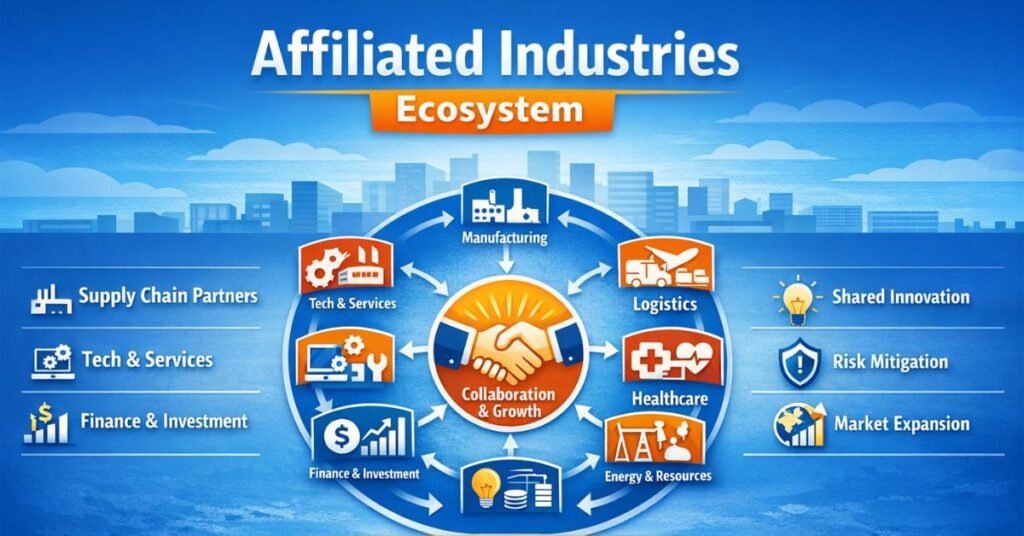
If you’ve ever wondered why some companies seem to grow faster, adapt quicker, and survive market shocks better than others, the answer often lies beyond their own four walls. The secret is affiliated industries—the interconnected network of businesses that support, complement, or amplify one another. From technology and logistics to finance and manufacturing, modern success is rarely a solo act.
Affiliated industries matter because no business truly operates in isolation anymore. A smartphone company depends on chip makers, app developers, logistics providers, marketers, and payment processors. A hospital relies on pharmaceutical companies, medical device manufacturers, insurers, and software vendors. When these relationships are aligned, innovation accelerates, costs drop, and customer experiences improve.
In this guide, you’ll learn exactly what affiliated industries are, why they’re so powerful, and how businesses of all sizes can identify, leverage, and grow through them. We’ll break the concept down in simple terms, explore real-world use cases, walk through a step-by-step approach to building industry affiliations, and highlight tools, mistakes, and best practices—so you can apply these ideas immediately and confidently.
Understanding Affiliated Industries (Beginner-Friendly Explanation)
At its core, affiliated industries refers to groups of industries that are economically, operationally, or strategically connected. These connections can be direct or indirect, formal or informal, but they share one defining trait: success in one industry influences success in the other.
Think of affiliated industries like neighbors in a well-planned city. A bakery thrives because there’s a nearby flour mill, a logistics service delivering ingredients, a packaging supplier, and a café culture that attracts foot traffic. None of these businesses are identical, but they’re deeply linked.
Affiliations can take many forms:
- Supply-based: Raw material providers linked to manufacturers
- Service-based: Marketing, IT, finance, or legal services supporting core industries
- Technology-based: Software platforms enabling operations across sectors
- Distribution-based: Logistics, retail, and e-commerce networks
A strong example is the tech ecosystem. Companies like Apple don’t just sell devices—they rely on semiconductor manufacturers, app developers, cloud services, accessory makers, and media companies. These affiliated industries expand Apple’s value far beyond hardware.
Understanding affiliated industries helps businesses anticipate market shifts, uncover partnership opportunities, and reduce risk by not relying on a single revenue stream or supplier.
Why Affiliated Industries Matter More Than Ever Today
In today’s economy, speed and adaptability matter more than size. Affiliated industries create both. When industries collaborate instead of operating in silos, innovation moves faster and costs are shared instead of duplicated.
One reason affiliated industries are so important now is complexity. Products and services are no longer simple. A single online purchase involves payment gateways, fraud prevention systems, cloud hosting, inventory management, shipping providers, and customer support software. Each layer belongs to a different but affiliated industry.
Another reason is risk mitigation. When one sector slows down, affiliated industries often stabilize each other. During global supply chain disruptions, businesses with diversified affiliations found alternatives faster than those relying on a single partner or region.
Affiliated industries also encourage knowledge transfer. When healthcare collaborates with AI and data analytics firms, patient outcomes improve. When agriculture partners with IoT and satellite imaging companies, yields increase while costs drop.
In short, affiliated industries turn competition into collaboration and isolated businesses into resilient ecosystems that grow together.
Benefits and Use Cases of Affiliated Industries
The benefits of leveraging affiliated industries go well beyond surface-level partnerships. When done right, these relationships create long-term competitive advantages that are difficult for competitors to copy.
Key Benefits
First, there’s operational efficiency. Sharing resources, tools, or data across affiliated industries reduces duplication and waste. A manufacturer working closely with a logistics partner can streamline inventory and reduce delivery times.
Second is innovation acceleration. New ideas often emerge at the intersection of industries. Fintech is a classic example, born from finance and technology working together rather than separately.
Third is market expansion. Affiliations open doors to new audiences. A software company partnering with a consulting firm gains access to enterprise clients it couldn’t reach alone.
Real-World Use Cases
- E-commerce ecosystems: Online retailers rely on payment processors, warehouses, shipping companies, and digital marketing agencies.
- Healthcare networks: Hospitals, insurers, pharma companies, and health-tech startups collaborate to improve care delivery.
- Construction and real estate: Developers depend on architects, material suppliers, legal services, and financing institutions.
A powerful example is how Amazon built an empire by aligning retail, logistics, cloud computing, and digital media—each an affiliated industry reinforcing the others.
Step-by-Step Guide to Identifying and Leveraging Affiliated Industries
Building value through affiliated industries isn’t about random partnerships. It’s a strategic, step-by-step process that starts with understanding your own business deeply.
Step 1: Map Your Core Value Chain
Begin by listing everything required to deliver your product or service—from raw inputs to customer support. This immediately reveals upstream and downstream affiliated industries.
Step 2: Identify Dependency and Influence Points
Ask where delays, costs, or quality issues arise. These pressure points often signal where stronger affiliations could create major improvements.
Step 3: Research Adjacent Industries
Look beyond obvious partners. A retail brand might benefit from data analytics firms or customer experience consultants, not just suppliers.
Step 4: Evaluate Alignment and Incentives
The best affiliations work when both sides benefit. Shared goals, complementary strengths, and aligned timelines matter more than size or reputation.
Step 5: Formalize and Optimize
Once partnerships form, document expectations, communication channels, and KPIs. Treat affiliations as living systems that evolve over time.
Businesses that follow this structured approach build ecosystems instead of one-off deals, creating stability and long-term growth.
Tools, Comparisons, and Expert Recommendations
Managing relationships across affiliated industries requires visibility and coordination. The right tools make a massive difference.
Free vs. Paid Tools
Free tools like spreadsheets, shared documents, and basic CRM platforms are suitable for early-stage businesses testing partnerships.
Paid tools offer deeper integration:
- CRM platforms for partner management
- ERP systems for supply chain coordination
- Collaboration tools for cross-industry communication
Recommended Tool Categories
- CRM & Partner Management: Track contacts, contracts, and performance
- Supply Chain Software: Monitor inventory and supplier timelines
- Data Analytics Platforms: Identify trends across industries
The trade-off is simple: free tools save money upfront but cost time later. Paid platforms require investment but unlock scale, automation, and insight—critical for businesses relying heavily on affiliated industries.
Common Mistakes Businesses Make with Affiliated Industries (and How to Fix Them)
One common mistake is treating affiliated industries as transactional relationships. When partnerships are only about price, trust erodes and innovation stalls. Fix this by focusing on shared outcomes, not just contracts.
Another mistake is over-dependence on a single affiliate. This creates vulnerability. Diversifying partners across regions or specialties builds resilience.
Poor communication is another frequent issue. Different industries speak different “languages.” Regular check-ins, shared dashboards, and clear documentation prevent misunderstandings.
Finally, many businesses fail to measure affiliation performance. If you’re not tracking cost savings, speed improvements, or revenue impact, you can’t optimize. Set clear metrics and review them quarterly.
The Future of Affiliated Industries in a Connected Economy
As markets become more digital and global, affiliated industries will only grow in importance. Emerging technologies like AI, automation, and blockchain are already blurring industry boundaries.
Companies that understand and embrace affiliation early will adapt faster to regulation changes, customer expectations, and technological shifts. Those that resist will find themselves isolated and outpaced.
Affiliated industries aren’t a trend—they’re the operating system of modern business.
Conclusion
Affiliated industries explain why some businesses scale smoothly while others struggle despite strong products. Growth today comes from connection, collaboration, and shared value—not isolation.
By understanding what affiliated industries are, recognizing their benefits, following a clear strategy, and avoiding common mistakes, businesses can build ecosystems that are resilient, innovative, and profitable.
If you haven’t mapped your affiliated industries yet, now is the time. Start small, think strategically, and treat partnerships as long-term investments—not short-term transactions.
FAQs
What are affiliated industries in simple terms?
They are industries connected through supply chains, services, technology, or shared customers.
Are affiliated industries the same as subsidiaries?
No. Subsidiaries are owned companies, while affiliated industries can be independent.
Why do affiliated industries reduce risk?
They diversify dependencies and provide alternative resources during disruptions.
Can small businesses benefit from affiliated industries?
Absolutely. Strategic partnerships often matter more for small firms than large ones.
How do I identify my affiliated industries?
Start by mapping your value chain and identifying supporting and adjacent sectors.

Michael Grant is a business writer with professional experience in small-business consulting and online entrepreneurship. Over the past decade, he has helped brands improve their digital strategy, customer engagement, and revenue planning. Michael simplifies business concepts and gives readers practical insights they can use immediately.