
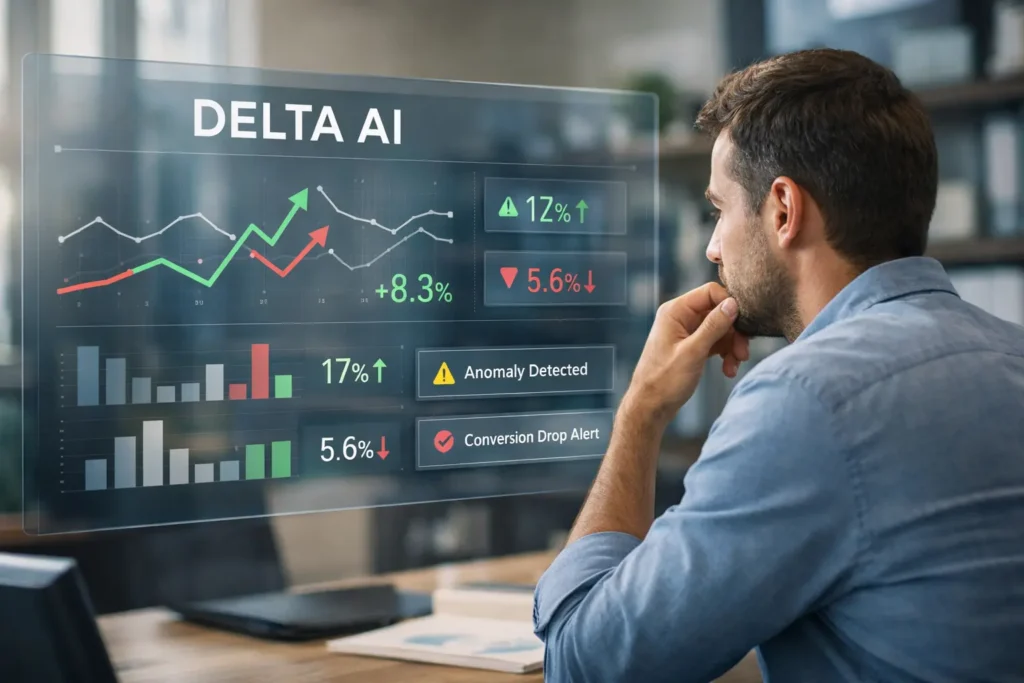
If you’ve ever watched a team drown in dashboards yet still miss the moment to act, you already understand the problem Delta AI is trying to solve. We’re not short on data. We’re short on direction. Delta AI has emerged as a response to that gap—an approach that focuses on change over time (the “delta”), not just static snapshots. Instead of asking “What does the data say right now?”, Delta AI asks a more useful question: “What changed, why did it change, and what should we do next?”
That shift matters because modern organizations operate in motion. Customer behavior shifts weekly. Supply chains flex daily. Models decay quietly. Decisions made on yesterday’s averages often fail today. Delta AI brings intelligence closer to the moment of change—where value is created or lost.
This guide is written for founders, operators, analysts, marketers, product leaders, and anyone responsible for outcomes—not just reports. You’ll learn what Delta AI really is, how it works in practice, where it delivers outsized value, and how to implement it without drowning in tools or theory. Expect concrete examples, honest trade-offs, and field-tested advice.
What Is Delta AI? A Clear Explanation From First Principles
At its core, Delta AI is an AI-driven decision framework that prioritizes meaningful change—deltas—in data, behavior, and outcomes. Traditional analytics answers “what happened.” Predictive AI tries to answer “what will happen.” Delta AI bridges the two by focusing on what changed since last time, whether that change matters, and how to respond now.
Think of it like driving. A speedometer tells you your current speed. Useful—but incomplete. DeltaAI is the feeling of acceleration, braking, or a sudden swerve. Those changes determine your next move. In business, the same logic applies: a 2% dip in conversion might be noise—or it might signal a broken checkout, a pricing mismatch, or a competitor’s launch. DeltaAI is designed to tell the difference.
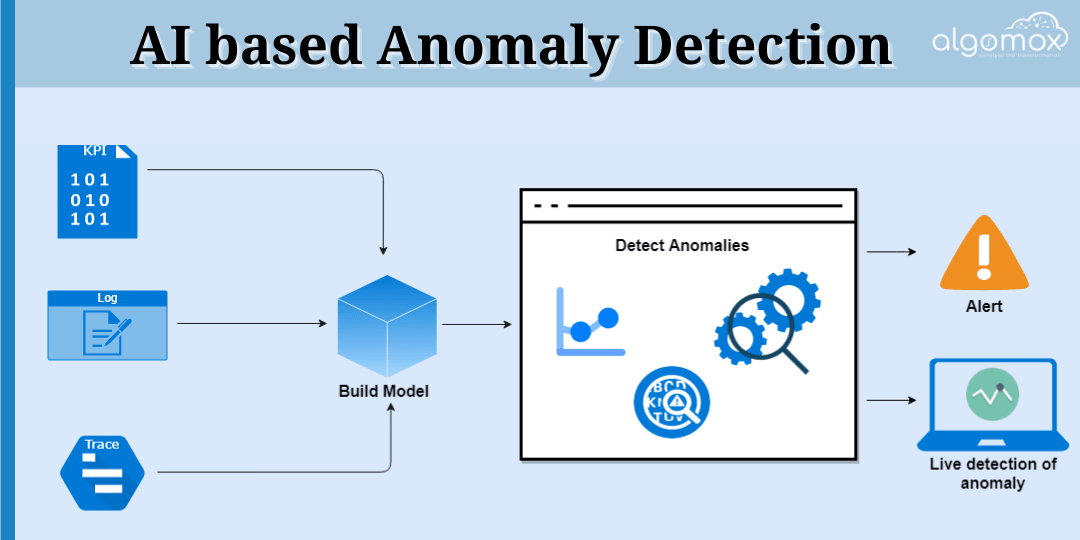
Technically, Delta AI blends:
- Continuous data ingestion (streams + batches)
- Change detection (statistical, rules-based, and ML-driven)
- Contextual modeling (seasonality, cohorts, constraints)
- Action layers (alerts, recommendations, automated responses)
The result isn’t just insight; it’s timely, contextual action. Beginners can start with simple deltas (week-over-week changes). Advanced teams layer causal inference, reinforcement learning, and closed-loop automation. The framework scales with maturity.
Why Delta AI Outperforms Static Analytics and One-Off Models
Static dashboards are comforting. They’re also dangerous. They lull teams into reacting late. Delta AI flips the posture from passive monitoring to active vigilance. It doesn’t wait for monthly reviews; it flags anomalies as they emerge and explains them in plain language.
From experience, the biggest gains come from three shifts:
- From averages to movements: Averages hide volatility. Deltas reveal it.
- From alerts to explanations: “Metric dropped” is noise. “Metric dropped due to mobile Safari checkout latency” is action.
- From human-only response to human-in-the-loop: Delta AI proposes; humans approve, refine, or automate.
Teams that adopt this mindset reduce decision latency, cut preventable losses, and capture upside earlier. It’s not about replacing judgment—it’s about aiming it where it matters most.
Benefits and Real-World Use Cases of Delta AI
Delta AI shines anywhere timing and context matter. Below are patterns that repeat across industries.
Marketing & Growth
Before Delta AI, teams react after spend is wasted. After Delta AI, they catch creative fatigue early, spot channel drift, and reallocate budgets in days—not weeks. The outcome: higher ROAS and fewer fire drills.
Product & UX
Delta AI detects friction the moment it appears—drop-offs after a release, performance regressions by device, or feature misuse by cohort. Instead of arguing opinions, teams fix what changed.
Sales & Revenue Operations
Pipeline health isn’t a static number. Delta AI flags unusual slowdowns, deal slippage patterns, or rep-level deviations—early enough to intervene.
Operations & Supply Chain
From demand spikes to vendor delays, Delta AI surfaces operational deltas that affect cost and service levels. The payoff is resilience, not just efficiency.
Finance & Risk
Fraud, leakage, and forecasting errors reveal themselves as deltas. Catching them early protects margin and trust.
The common thread is before vs. after: less guesswork, faster response, better outcomes.
A Step-by-Step Practical Guide to Implementing Delta AI
Implementation doesn’t require a moonshot. The best results come from disciplined, incremental steps.
Step 1: Define Meaningful Deltas
Not every change matters. Start by defining thresholds that reflect real impact—customer churn risk, revenue variance, SLA breaches. Tie deltas to decisions someone can actually make.
Step 2: Establish Baselines and Context
Deltas without context cause false alarms. Build baselines that respect seasonality, growth, and known events. Context turns noise into signal.
Step 3: Choose Detection Methods
Begin with simple statistical checks. Layer ML when patterns grow complex. The goal is reliability, not novelty.
Step 4: Explain the Change
Delta AI must answer “why.” Use feature attribution, cohort analysis, and narrative summaries that non-technical stakeholders trust.
Step 5: Close the Loop
Decide what happens next: alert a human, recommend an action, or automate a response. Measure outcomes and refine.
Pro tip: Start with one high-value metric and expand. Delta AI compounds when trust is earned.
Tools, Comparisons, and Expert Recommendations
You don’t need a single “Delta AI platform.” In practice, teams assemble a stack.
Lightweight (Beginner)
Spreadsheets + BI alerts + simple scripts. Pros: fast, cheap. Cons: brittle, limited scale. Best for proof of value.
Mid-Tier (Growing Teams)
Data warehouses, streaming tools, anomaly detection services, and workflow automation. Pros: balance of power and cost. Cons: integration work.
Enterprise (Advanced)
Custom pipelines, real-time ML, decision engines, and governance layers. Pros: speed and control at scale. Cons: complexity.
My advice: optimize for time-to-decision, not tool prestige. The best stack is the one your team actually uses.
Common Mistakes—and How to Fix Them
The most common failure isn’t technical; it’s conceptual.
- Alert fatigue happens when deltas aren’t tied to decisions. Fix it by pruning metrics ruthlessly.
- Overfitting occurs when models chase noise. Fix it with conservative thresholds and human review.
- Black-box distrust kills adoption. Fix it with explanations and plain-language summaries.
- Automation too early creates risk. Fix it by proving recommendations before automating.
What most teams miss: Delta AI is a practice, not a plugin. It improves with feedback and ownership.
Conclusion: Turning Change Into Advantage
Delta AI reframes how organizations see the world—not as static reports, but as living systems in motion. By focusing on meaningful change, it helps teams act earlier, smarter, and with confidence. Start small, earn trust, and let the practice grow. The payoff isn’t just better metrics; it’s better decisions.
If you’re ready to move from hindsight to foresight—without losing context—Delta AI is a practical place to begin.
FAQs
What makes Delta AI different from predictive analytics?
It prioritizes detecting and explaining change, not just forecasting outcomes.
Is Delta AI only for large enterprises?
No. Startups benefit early because speed matters more when margins are thin.
Do I need real-time data?
Not always. Even daily deltas can unlock value if decisions are timely.
How do I avoid false positives?
Contextual baselines and human-in-the-loop review are key.
Can Delta AI be automated end-to-end?
Yes—but only after recommendations are proven safe and effective.

Adrian Cole is a technology researcher and AI content specialist with more than seven years of experience studying automation, machine learning models, and digital innovation. He has worked with multiple tech startups as a consultant, helping them adopt smarter tools and build data-driven systems. Adrian writes simple, clear, and practical explanations of complex tech topics so readers can easily understand the future of AI.