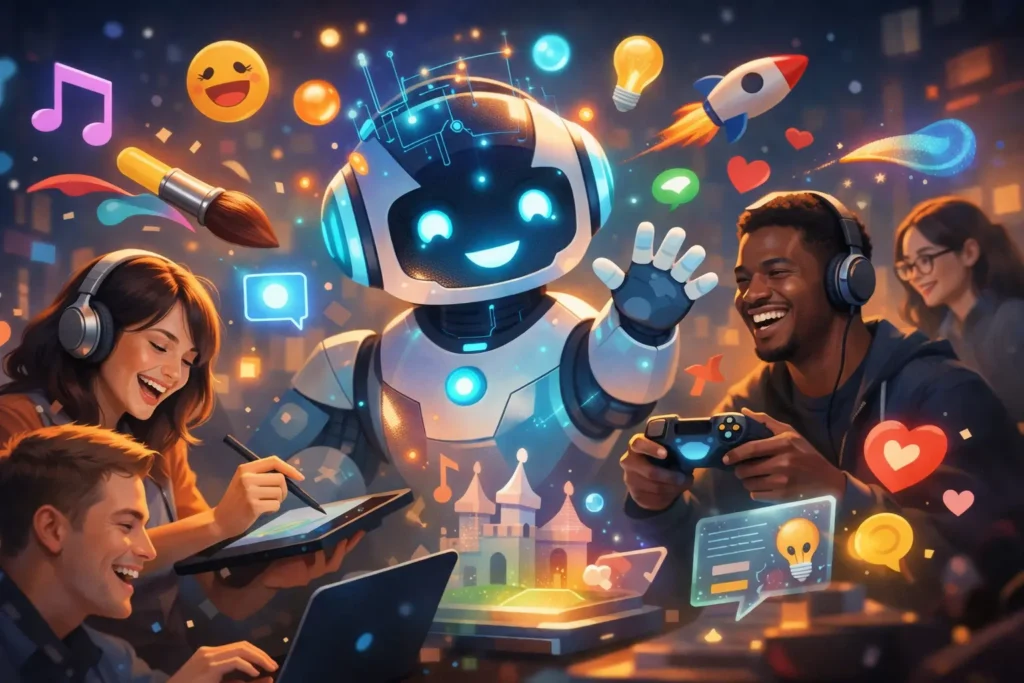
If you rewind just a few years, artificial intelligence felt distant and intimidating—something locked away in research labs, corporate dashboards, or sci-fi movies. Today, the story is very different. AI has quietly become part of everyday life, and not just in serious, productivity-driven ways. Increasingly, people are discovering AI fun—the playful, creative, and surprisingly human side of artificial intelligence.
This shift matters more than most people realize. Fun is often how new technology earns trust. It lowers the barrier to entry, sparks curiosity, and helps people learn without feeling overwhelmed. Whether someone is generating a silly image, chatting with an AI persona, remixing music, or turning homework into a game, AI fun is becoming the gateway through which millions experience artificial intelligence for the first time.
This article is written for curious beginners, creative professionals, educators, marketers, parents, developers, and anyone who has wondered, “Is AI just about work—or can it actually be enjoyable?” You’ll learn what AI fun really means, why it’s exploding right now, how people are using it in real life, which tools actually deliver on the promise, and how to avoid common mistakes that drain the joy out of the experience.
By the end, you won’t just understand AI fun—you’ll know how to use it intentionally, responsibly, and creatively in ways that genuinely add value to your life.
What AI Fun Really Means (And Why It’s More Than Just Entertainment)
At its core, AI fun is about using artificial intelligence in ways that feel playful, engaging, and creatively rewarding rather than purely functional. It’s the difference between using AI to generate a quarterly report and using it to write a parody song about your office culture. Both involve the same underlying technology, but the emotional experience is entirely different.
A useful way to think about AI fun is to compare it to learning a musical instrument. You can approach a guitar with rigid exercises and technical drills, or you can start by playing simple songs you love. The second approach doesn’t just feel better—it often leads to deeper mastery over time. AI fun works the same way. Playfulness accelerates understanding.
AI fun often shows up in forms like conversational chatbots, image generation, games, storytelling tools, meme creators, voice cloning experiments, and learning apps that feel more like play than study. These experiences don’t require technical expertise, which is exactly why they spread so quickly.
What’s often overlooked is that AI fun isn’t trivial. It teaches people how AI thinks, where its limits are, and how to communicate with it effectively. Someone who plays with AI prompts for fun will often outperform a purely technical user when it comes to real-world applications. Fun builds intuition, and intuition builds competence.
Most importantly, AI fun reframes artificial intelligence as something you collaborate with, not something you fear. That mental shift is foundational to responsible, confident AI adoption.
Why AI Fun Is Exploding Right Now
The rise of AI fun didn’t happen by accident. Several forces converged at exactly the right moment.
First, modern AI tools became accessible. You no longer need programming knowledge or expensive software to experiment. Platforms like OpenAI dramatically lowered the entry barrier, allowing anyone with an internet connection to interact with advanced AI models through simple text prompts.
Second, culture changed. Social media normalized experimentation. People share AI-generated art, jokes, and stories the same way they once shared photos or memes. Fun becomes contagious, and AI lends itself perfectly to that kind of virality.
Third, people are burned out. After years of productivity pressure, hustle culture, and optimization fatigue, there’s a hunger for tools that feel playful rather than demanding. AI fun meets that emotional need while still offering value.
Finally, AI systems themselves improved. Early tools felt clunky and frustrating. Today’s models are conversational, responsive, and often surprisingly witty. When technology responds in human-like ways, people naturally engage with it more playfully.
All of this means AI fun isn’t a trend—it’s a phase change. We’re watching AI move from novelty to companion, and fun is the bridge that makes that transition possible.
Real-World Benefits and Use Cases of AI Fun
It’s easy to dismiss AI fun as a distraction, but that misses its real impact. In practice, playful AI use delivers measurable benefits across industries and age groups.
For individuals, AI fun lowers anxiety around technology. Someone who starts by generating funny images or chatting casually with an AI often gains confidence to explore more serious applications later. The “before” state is hesitation and confusion. The “after” state is curiosity and competence.
For creators, AI fun unlocks creative momentum. Writers use AI to brainstorm absurd story ideas. Designers generate visual variations without pressure. Musicians experiment with lyrics they’d never normally write. Fun removes creative blocks and replaces them with playful exploration.
In education, AI fun transforms learning. Students engage longer when lessons feel like games or conversations. Language learners using apps like Duolingo with AI-powered interactions often practice more consistently than those using traditional methods. Fun drives repetition, and repetition drives mastery.
Businesses benefit too. Marketing teams use playful AI experiments to test messaging. HR departments use AI chatbots for onboarding games. Even customer support improves when interactions feel lighter and more human.
Perhaps most importantly, AI fun builds digital literacy. People who play with AI learn how prompts shape outcomes, where bias appears, and why critical thinking still matters. That awareness is essential in a world where AI touches nearly everything.
A Practical, Step-by-Step Guide to Experiencing AI Fun
Getting started with AI fun doesn’t require a plan—but approaching it intentionally helps you get more out of the experience.
The first step is choosing a low-pressure entry point. Conversational AI is often the easiest. Tools like ChatGPT invite experimentation through natural language. You can ask silly questions, roleplay scenarios, or challenge the AI to explain complex topics in absurd ways. The goal isn’t efficiency—it’s curiosity.
Next, experiment with creative outputs. Image generators like Midjourney or DALL·E turn imagination into visuals. Start with playful prompts rather than perfection. The joy comes from surprise, not control.
As you grow comfortable, introduce light structure. Try themed challenges, like generating a short story every day for a week or remixing famous quotes into modern slang. Structure keeps fun from turning into aimless scrolling.
Finally, reflect on what you learn. Notice how wording changes results. Notice where the AI struggles. These observations turn play into skill without draining the fun.
The most important rule is to remove stakes. AI fun works best when failure is amusing, not frustrating.
Tools That Actually Deliver AI Fun (And Which Ones Don’t)
Not all AI tools are equally fun, and that’s okay. Some are built for precision, not play.
Free tools are usually the best starting point. Chat-based platforms, simple image generators, and educational games allow experimentation without commitment. Their main advantage is accessibility, though they may have limits on speed or output quality.
Paid tools often unlock deeper fun for power users. Platforms like Runway or Canva integrate AI features into creative workflows, making play productive. These tools shine when fun overlaps with professional output.
The biggest mistake people make is choosing tools that are too advanced too soon. Complex interfaces kill curiosity. If a tool makes you feel stupid, it’s the wrong starting point.
From experience, the most fun AI tools share three traits: instant feedback, forgiving mistakes, and room for surprise. If those elements are missing, fun quickly fades.
Common Mistakes That Ruin AI Fun (And How to Avoid Them)
One of the most common mistakes is treating AI fun like a performance. People worry about creating share-worthy results instead of enjoying the process. This pressure kills playfulness. The fix is simple: create things you’ll never share.
Another mistake is over-optimizing prompts. While prompt engineering has value, obsessing over it too early turns fun into work. Let yourself be vague sometimes. Ambiguity often produces the most delightful results.
Many users also expect AI to be perfect. When it makes mistakes, they feel disappointed instead of amused. Remember that imperfection is part of the charm. AI fun thrives on unpredictability.
Finally, people often isolate AI fun from real life. They play, laugh, and move on without applying insights elsewhere. The real magic happens when you carry that playful mindset into learning, work, or creativity.
The Bigger Picture: Why AI Fun Matters Long-Term
AI fun isn’t just about entertainment. It’s shaping how society relates to artificial intelligence. Play builds familiarity, and familiarity builds trust. Trust leads to thoughtful adoption instead of blind reliance or irrational fear.
From firsthand experience, people who engage with AI playfully tend to develop healthier relationships with technology. They understand its limits, respect its strengths, and remain critical without being cynical.
In the long run, AI fun may be one of the most important factors in creating an AI-literate population. It invites people in gently, teaches through experience, and keeps curiosity alive.
Conclusion: Embracing AI Fun With Intention
AI fun is not a distraction from “serious” artificial intelligence—it’s the doorway into it. Through play, people learn faster, engage deeper, and build confidence that carries into real-world applications.
The core insight is simple: when AI feels fun, people stick with it. They explore. They question. They grow. Whether you’re using AI to create, learn, teach, or just laugh, that sense of play is what turns a tool into a companion.
If you’re curious, start small. Ask a strange question. Generate a ridiculous image. Treat AI like a sandbox, not a scoreboard. The value will follow.
FAQs
What does “AI fun” mean?
AI fun refers to using artificial intelligence in playful, creative, or entertaining ways rather than purely for work or technical tasks. This can include chatting with AI, generating art or music, playing AI-powered games, creating jokes or stories, or learning through interactive tools. The focus is on enjoyment, curiosity, and creativity while still benefiting from intelligent technology.
Is AI fun just for entertainment, or does it have real value?
AI fun goes beyond entertainment. While it’s enjoyable, it also helps people learn how AI works, improve digital skills, and build confidence using new technology. Many users discover creative ideas, enhance problem-solving abilities, and even transition from playful experimentation into practical or professional AI use over time.
Can beginners use AI fun tools without technical skills?
Yes, AI fun tools are designed to be beginner-friendly. Most require no coding or technical background at all. Users can interact with AI using simple text prompts, images, or voice commands. This accessibility is one reason AI fun has become so popular among students, creatives, and everyday users.
Is AI fun safe to use?
AI fun is generally safe when used responsibly. Users should avoid sharing personal or sensitive information and should understand that AI-generated content may not always be accurate. Choosing reputable platforms and maintaining basic digital awareness ensures a safe and positive experience while enjoying AI-powered tools.
How can AI fun be used for learning or creativity?
AI fun supports learning by making it interactive and engaging. It can help users practice languages, brainstorm ideas, write stories, explore art styles, or understand complex topics through conversation. Creativity thrives when AI is used as a collaborative partner, offering inspiration, variations, and new perspectives without replacing human imagination.

Adrian Cole is a technology researcher and AI content specialist with more than seven years of experience studying automation, machine learning models, and digital innovation. He has worked with multiple tech startups as a consultant, helping them adopt smarter tools and build data-driven systems. Adrian writes simple, clear, and practical explanations of complex tech topics so readers can easily understand the future of AI.