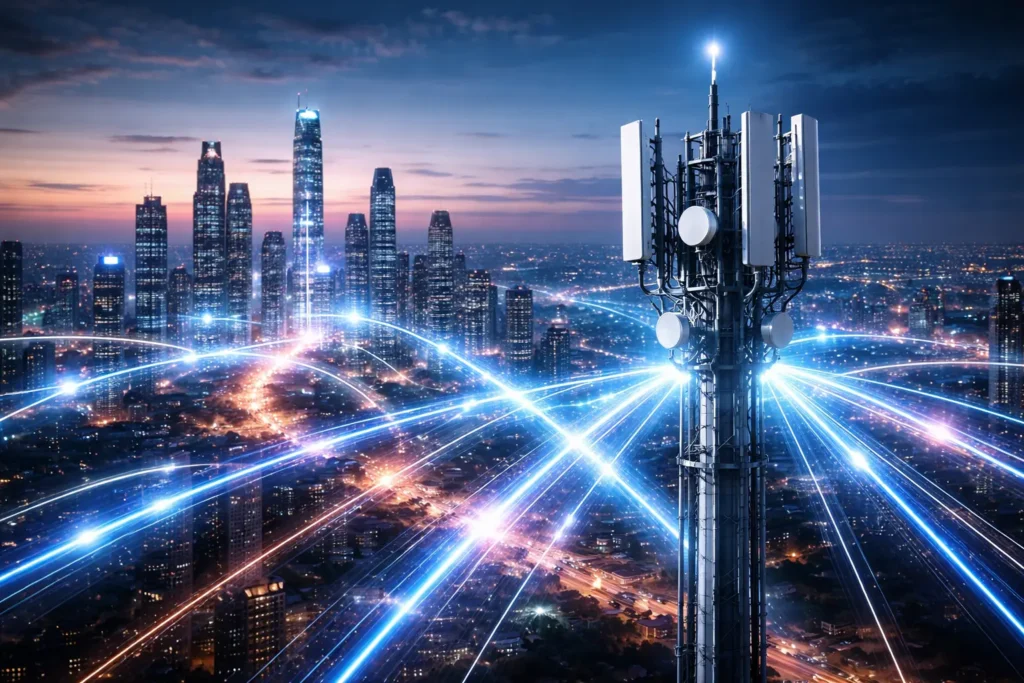
The world is in the middle of a generational shift in wireless connectivity. 5G Technology — the fifth generation of cellular technology — is not simply a faster version of 4G. It is a foundational platform that promises to reshape industries, enable entirely new categories of applications, and connect billions of devices that have never been connected before.
From the smartphones in our pockets to the autonomous vehicles on our roads, from remote surgical robots to smart city sensors, 5G is the invisible infrastructure underpinning the next era of digital innovation. This guide explains exactly what 5G is, how it works, what it enables, and what challenges still remain.
Defining 55G TechnologyG: More Than Just Faster Smartphones
5G Technology is the fifth generation of mobile network standards, succeeding 4G LTE as the global backbone for wireless communication. Standardized by the 3rd Generation Partnership Project (3GPP) under the IMT-2020 framework, 5G was designed from the ground up to deliver not just higher speeds, but dramatically lower latency, vastly greater capacity, and the ability to support a density of connected devices previously impossible.
The core value proposition of 5G goes well beyond speed. While peak download rates can reach 20 Gbps — roughly 100 times faster than a typical 4G connection — the more transformative advances lie in its sub-millisecond latency, its ability to serve over one million devices per square kilometer, and its flexible architecture that can be tailored to wildly different use cases. Simply put: 5G makes the network smarter, not just faster.
How 5G Works: The Key Technologies
5G is not a single technology but a collection of innovations in radio, antenna design, network architecture, and spectrum management. Together, these advances deliver performance leaps that previous generations could not achieve.
The New Radio Air Interface (5G NR)
At the heart of 5G is the 5G New Radio (5G NR) air interface — the protocol governing communication between devices and base stations. Developed by 3GPP as a replacement for the 4G LTE radio interface, 5G NR uses advanced Orthogonal Frequency Division Multiplexing (OFDM) techniques that allow it to operate across a much wider range of spectrum bands and adapt its transmission parameters to different environments and use cases. This flexibility is what enables a single 5G standard to support everything from a rural sensor network to a dense urban stadium with 80,000 concurrent users.
Mastering the Spectrum: Low-Band, Mid-Band (C-Band) & High-Band (mmWave)
One of the most important — and most misunderstood — aspects of 5G is its use of spectrum. 5G operates across three distinct frequency ranges, each with its own trade-offs between coverage area and data speed. The table below summarizes the key differences:
| Spectrum Band | Frequency Range | Peak Speed | Coverage Range | Penetration | Best For |
| Low-Band (Sub-1 GHz) | 600 MHz – 900 MHz | ~100 Mbps | Very Wide (miles) | Excellent | Rural coverage, building interiors |
| Mid-Band (C-Band) | 2.5 GHz – 4.2 GHz | ~1 Gbps | Moderate (miles) | Good | Urban/suburban areas, enterprise |
| High-Band (mmWave) | 24 GHz – 100 GHz | Up to 20 Gbps | Very Short (~300m) | Poor | Dense urban, stadiums, venues |
Most commercial 5G networks today rely primarily on mid-band spectrum, specifically C-Band (around 3.5 GHz), which delivers the best balance of performance and coverage. Low-band 5G is widely deployed for broad geographic reach, while mmWave — despite its extraordinary speeds — remains limited to specific high-density locations due to its short range and poor ability to penetrate walls.
Advanced Antenna Technologies: Massive MIMO and Beamforming
Traditional cellular antennas broadcast signals in all directions, wasting energy and creating interference. 5G introduces two related innovations that fundamentally change this. Massive MIMO (Multiple Input, Multiple Output) deploys arrays of dozens or even hundreds of antenna elements at a single base station, enabling it to serve many users simultaneously on the same frequencies — dramatically increasing spectral efficiency and overall network capacity.
Beamforming takes this further by using those antenna arrays to focus radio signals as precise beams directed at specific users, rather than broadcasting in all directions. The result is a stronger, more reliable signal for each user, less interference for neighboring devices, and more efficient use of precious spectrum. These two technologies are arguably the biggest reason why 5G can support so many more simultaneous connections than 4G.
Building a Denser Network: The Role of Small Cells
The high-frequency bands that give 5G its speed have a fundamental physical limitation: their signals do not travel far and are easily blocked by buildings, trees, and even rain. To compensate, 5G networks rely on a dense deployment of small cells — compact, low-power base stations that can be mounted on streetlights, utility poles, and building facades. Unlike the tall macrocell towers of 4G, small cells cover a radius of just tens to a few hundred meters, but by deploying them densely throughout a city or campus, operators can create continuous, high-capacity coverage. Network densification is both the key enabler and the primary deployment challenge of 5G mmWave.
A Smarter Core: Network Slicing and Edge Computing
Perhaps the most architecturally significant innovation in 5G is what happens in the core network. The 5G Core (5GC) is built on a cloud-native, service-based architecture using Network Functions Virtualization (NFV) and Software-Defined Networking (SDN). This means the network is essentially software running on standard servers, rather than purpose-built hardware — making it far more flexible, scalable, and cost-efficient.
This software-defined architecture enables two game-changing capabilities. Network slicing allows a single physical 5G network to be partitioned into multiple isolated virtual networks, each with its own dedicated performance characteristics. A hospital can have a slice with ultra-low latency for robotic surgery, while a stadium uses a different slice optimized for high bandwidth streaming — all on the same infrastructure. Edge computing, or Multi-access Edge Computing (MEC), places computing resources physically closer to where data is generated, reducing the round-trip time to a distant data center and enabling latency-sensitive applications that would be impossible over a standard network architecture.
5G vs. 4G: What Are the Real Differences?
Understanding what 5G actually improves over 4G LTE is essential for evaluating its impact. The gains are real, but they are not uniformly distributed across all deployments.
| Metric | 4G LTE | 5G (Typical) | 5G (Peak/Theoretical) |
| Peak Download Speed | ~150 Mbps | 500 Mbps – 1 Gbps | Up to 20 Gbps |
| Latency (Round-trip) | 20–40 ms | 5–10 ms | < 1 ms |
| Device Density | ~100K/km² | Up to 1M/km² | 1M/km² |
| Spectrum Efficiency | Baseline | 3–5x higher | Up to 10x |
| Network Architecture | Hardware-based EPC | Cloud-native 5GC | Fully virtualized |
| Primary Design Goal | Mobile broadband | Multi-service platform | Multi-service platform |
In real-world use, the most meaningful improvements for most consumers are noticeably faster download speeds and more responsive connections in crowded areas. For enterprise and industrial use cases, the combination of ultra-low latency, network slicing, and massive device density unlocks capabilities that are genuinely impossible on 4G.
The Three Pillars of 5G: Transforming Industries
The ITU’s IMT-2020 framework defines 5G around three service families, each targeting a fundamentally different set of use cases. These three pillars explain why 5G matters far beyond faster phone speeds.
Enhanced Mobile Broadband (eMBB): The Consumer Experience
eMBB is the pillar most consumers will experience first. It delivers the high-speed, high-bandwidth connectivity that enables rich media experiences on mobile devices — 4K and 8K video streaming, augmented and virtual reality (AR/VR), cloud gaming, and high-speed mobile internet in dense public spaces like airports, stadiums, and transit hubs.
Fixed Wireless Access (FWA) is one of the most immediately impactful eMBB applications. By using 5G to deliver home broadband without physical cable installation, operators can bring high-speed internet to households that have never had access to fiber or cable — making 5G a genuine tool for closing the digital divide in underserved areas.
Ultra-Reliable Low-Latency Communications (URLLC): Mission-Critical Applications
URLLC is where 5G becomes genuinely transformative beyond consumer use. The combination of sub-10ms (and eventually sub-1ms) latency with near-perfect reliability unlocks applications where the cost of failure is measured in human lives or critical infrastructure.
5G Technology in Healthcare
Remote surgery and telemedicine are the headline applications. With URLLC-grade connectivity, a surgeon can operate a robotic system from hundreds of miles away with feedback that is effectively instantaneous. Beyond surgery, 5G enables real-time patient monitoring, connected ambulances that begin diagnosis before arriving at the hospital, and AR-assisted medical procedures.
5G in Automotive (V2X)
Vehicle-to-Everything (V2X) communication is essential for safe autonomous vehicles. Cars must communicate with each other, with traffic infrastructure, and with pedestrians in real time to avoid collisions. The latency of 4G networks is far too high for these split-second decisions. 5G URLLC provides the responsiveness that connected and autonomous vehicles require, enabling a new generation of intelligent transportation systems.
5G in Industrial Automation
On the factory floor, 5G enables wireless industrial control with the reliability previously only possible over wired Ethernet. Robotic arms, automated guided vehicles (AGVs), and precision manufacturing equipment can be coordinated wirelessly with real-time feedback loops — making factories more flexible, reconfigurable, and efficient. This is the foundation of Industry 4.0 and smart manufacturing.
5G in Public Safety
Emergency services benefit from URLLC through improved mission-critical communications, real-time video feeds from body cameras and drones, and connected command centers that can coordinate responses across agencies. The resilience of 5G network slicing means a dedicated public safety slice can be maintained even when consumer traffic is overwhelming the network.
Massive Machine-Type Communications (mMTC): The Internet of Things
mMTC addresses the challenge of connecting an enormous number of low-power, low-data-rate devices — the sensors, actuators, and trackers that make up the Internet of Things (IoT). While 4G networks can support IoT devices, they were not designed for the density, battery efficiency, and cost-point requirements of massive IoT deployments.
5G’s mMTC capabilities support up to one million connected devices per square kilometer, each able to operate for years on a small battery. This enables smart city infrastructure (environmental sensors, smart parking, smart lighting), precision agriculture (soil moisture sensors across thousands of acres), supply chain logistics (real-time asset tracking), and utility smart grid management at a scale and cost that simply was not feasible before.
Spotlight: 5G RedCap (Reduced Capability)
An important emerging development within mMTC is 5G RedCap (also known as NR-Light), introduced in 3GPP Release 17. RedCap fills the gap between the very low-end NB-IoT sensors and the full-capability 5G devices. It targets mid-tier IoT applications — industrial wireless sensors, wearables, video surveillance — that need more performance than NB-IoT but do not need the full power of a flagship 5G modem. RedCap devices are smaller, cheaper, and more power-efficient than standard 5G devices, making them ideal for the next wave of industrial and commercial IoT deployments.
Public vs. Private 5G Networks: Which Is Right for Business?
One of the most significant but least understood aspects of 5G for enterprise customers is the distinction between public, private, and hybrid network deployments. The choice has major implications for performance, security, cost, and control.
| Characteristic | Public 5G Network | Private 5G Network | Hybrid Network |
| Ownership | Mobile operator | Enterprise or vendor | Shared/leased |
| Coverage Area | Wide (national) | Specific campus/site | Flexible |
| Security & Isolation | Shared infrastructure | Fully isolated | Configurable |
| Customization | Limited (slicing available) | Full control | Moderate |
| Latency | Variable | Very low (on-premise) | Low-moderate |
| Upfront Cost | Low (subscription) | High (infrastructure) | Moderate |
| Best For | General mobile connectivity | Manufacturing, defense, ports | Enterprise campuses |
Private 5G networks — also called Non-Public Networks (NPNs) — are deployed and managed by an organization on its own premises, using dedicated spectrum (either licensed, shared, or unlicensed). They deliver the full performance benefits of 5G with the security, reliability, and customization that critical enterprise operations demand. Industries leading private 5G adoption include manufacturing, logistics, mining, ports, and defense.
Hybrid deployments combine a private 5G core for sensitive or latency-critical applications with a public 5G connection for general connectivity — offering the best of both worlds for large enterprise campuses or multi-site organizations.
The Current State of 5G: Deployment and Availability
As of 2025, 5G is a mainstream technology in most major markets. Over 100 countries have commercial 5G services, with operators in the United States, South Korea, China, the United Kingdom, and much of Western Europe having achieved broad urban and suburban coverage.
The dominant deployment model globally is 5G Non-Standalone (NSA), which uses the existing 4G core network while adding 5G radio access on top. This allowed operators to launch 5G services quickly while leveraging existing infrastructure. However, the industry is actively transitioning to 5G Standalone (SA) deployments, which use the full cloud-native 5G Core. SA is essential for unlocking the advanced capabilities of 5G — particularly network slicing and the ultra-low latency of URLLC — and represents the true second phase of 5G’s rollout.
Rural coverage remains the most significant gap. The physics of mmWave and the economics of dense small cell deployment make rural 5G challenging. Low-band 5G provides coverage in these areas but with performance closer to advanced 4G than the multi-gigabit speeds of urban mmWave. Bridging this gap is an active policy priority in many countries, with spectrum auctions, subsidies, and regulatory frameworks being used to incentivize rural investment.
Challenges and Considerations for 5G Adoption
5G represents a genuine technological leap, but a balanced assessment must acknowledge the real challenges that accompany its rollout. Understanding these challenges is essential for businesses, policymakers, and consumers making decisions about 5G investment and adoption.
Infrastructure Cost and Deployment Complexity
Building a 5G network — particularly one that leverages mmWave — requires a dramatically denser infrastructure footprint than 4G. Deploying tens of thousands of small cells in urban environments involves significant capital expenditure, complex site acquisition, planning permissions, and backhaul provisioning. These costs are a primary reason why full 5G coverage remains years away in many markets, and why some operators have moved more cautiously than initial announcements suggested.
Cybersecurity and Privacy
The expanded attack surface of 5G networks — more connected devices, more software-defined components, more edge computing nodes — creates new cybersecurity challenges. The shift to cloud-native, virtualized infrastructure introduces vulnerabilities that differ from those of traditional hardware-based telecom networks. The involvement of equipment vendors from different geopolitical contexts has also raised national security concerns in several countries, driving regulatory scrutiny of supply chain security. Organizations deploying private 5G or integrating 5G into critical infrastructure must treat security as a first-order design requirement, not an afterthought.
Spectrum Interference and Regulatory Issues
The deployment of certain 5G frequency bands has not been without controversy. The rollout of C-Band 5G in the United States triggered concerns from the aviation industry about potential interference with radio altimeters — instruments critical for safe landings in low-visibility conditions. While the scientific consensus is that properly implemented 5G poses minimal risk when adequate guard bands are maintained, the episode highlighted the complexity of spectrum management and the importance of proactive coordination between industries and regulators.
The Digital Divide
There is a real risk that 5G, if left entirely to market forces, deepens rather than closes the digital divide. Dense urban areas with high disposable income are the natural priority for commercial operators, meaning that rural communities and lower-income urban neighborhoods may wait significantly longer for meaningful 5G coverage. Realizing the inclusive potential of 5G — particularly its ability to deliver broadband to underserved areas via FWA — will require deliberate policy interventions alongside commercial deployment.
Device Compatibility and Consumer Confusion
Not all “5G” is equal in performance, and the marketing around 5G has sometimes obscured this reality. A 5G phone on a low-band network may perform only marginally better than 4G. The full multi-gigabit experience requires a mmWave-capable device in a mmWave coverage area — a combination that remains relatively rare outside of specific urban locations and venues. Consumer and enterprise buyers should carefully evaluate what type of 5G coverage and what device capabilities are actually available in their relevant locations.
Health Concerns
Public concern about potential health effects of 5G has been widespread. The scientific consensus, as assessed by organizations including the World Health Organization, is that 5G radio frequencies — non-ionizing radiation — do not pose a health risk at the power levels used in commercial deployments, which are well below established safety guidelines. Extensive research conducted across previous generations of wireless technology, which operate on similar physical principles, supports this conclusion. Misinformation campaigns have significantly amplified fears beyond what the evidence warrants.
The Future of 5G: 5G-Advanced and the Road to 6G
5G is not a finished standard — it is a continuously evolving platform. The 3GPP release cycle continues to add new capabilities, and the next major phase is already underway.
5G-Advanced (Release 18 and Beyond)
5G-Advanced, standardized in 3GPP Release 18 (completed in 2024), is the evolution phase of 5G sometimes referred to as “5.5G.” It introduces significant enhancements including improved AI and machine learning integration directly into the network, enhanced positioning and sensing capabilities (enabling the network itself to act as a sensor for environmental awareness), better support for uplink performance to serve applications like live video broadcasting and collaborative AR, and further improvements to energy efficiency. RedCap evolution also continues in 5G-Advanced, with even lower-complexity devices planned for Release 19 and beyond. For operators and enterprises, 5G-Advanced represents a meaningful mid-cycle upgrade that will deliver measurable improvements without requiring a full infrastructure replacement.
The Path to 6G
Research into 6G — the sixth generation of wireless — is active in academic institutions, standards bodies, and major technology companies globally. While 6G remains in the research phase with commercialization not expected before the early 2030s, early visions point to terahertz (THz) spectrum use, sub-100 microsecond latency, integrated sensing and communication, and deeper integration with artificial intelligence at every layer of the network. In the near term, however, the industry’s focus remains squarely on maximizing 5G’s potential — both through continued Standalone deployments and through the enhancements of 5G-Advanced.
faqs
How fast is 5G?
Peak theoretical speeds reach 20 Gbps, but real-world performance depends heavily on the spectrum band and network conditions. Mid-band 5G (C-Band) typically delivers 300 Mbps to 1 Gbps in practice. Low-band 5G is closer to 50–200 Mbps. mmWave can exceed 2–4 Gbps in ideal conditions but requires line-of-sight proximity to a transmitter.
What is the difference between 5G SA and 5G NSA?
5G Non-Standalone (NSA) uses the existing 4G LTE core network with 5G radio access layered on top — a faster path to deployment but limited in capability. 5G Standalone (SA) uses a fully cloud-native 5G Core, enabling the full capabilities of 5G including network slicing, MEC, and true URLLC performance. Most operators launched with NSA and are actively transitioning to SA.
What is C-Band 5G?
C-Band refers to mid-band spectrum in the 3.4–4.2 GHz range (and sometimes defined more broadly up to 6 GHz). It is the primary workhorse band for 5G globally because it offers a strong balance between coverage area and performance. C-Band 5G delivers gigabit-class speeds across city-scale coverage areas — the practical backbone of most commercial 5G networks.
Will my 4G phone work on a 5G network?
Yes. All 5G networks maintain backward compatibility with 4G LTE devices. Your 4G phone will continue to work normally on a 5G network, just without the 5G performance benefits. To access 5G speeds, you need a 5G-capable device with the appropriate modem for the spectrum bands available in your area.
Does 5G work indoors?
Low-band and mid-band 5G generally penetrate buildings reasonably well, similar to 4G. mmWave 5G has very poor indoor penetration and is primarily effective outdoors with a clear line of sight to a small cell. For consistent indoor 5G coverage in enterprise environments, private 5G networks with indoor small cells are the recommended approach.
Will 5G replace Wi-Fi?
Not in the near term. 5G and Wi-Fi (specifically Wi-Fi 6/6E) are complementary technologies optimized for different environments. Wi-Fi remains more cost-effective and higher-performing for fixed indoor deployments. 5G excels in outdoor mobile scenarios and for devices that need to roam across large areas. In some enterprise settings, private 5G may eventually replace Wi-Fi for specific applications, but widespread replacement is unlikely in the next decade.
Is 5G safe?
The scientific consensus, backed by the World Health Organization and major health agencies globally, is that 5G is safe. The radio frequencies used by 5G are non-ionizing, meaning they do not carry enough energy to break chemical bonds or damage DNA. Commercial deployments operate well below established safety exposure limits. Decades of research on previous generations of wireless technology support the safety of these technologies at permitted exposure levels.
What is a private 5G network?
A private 5G network is a dedicated cellular network deployed by an organization on its own premises, using spectrum it owns or leases. Unlike public networks operated by mobile carriers, a private 5G network is fully controlled by the enterprise, offering superior security, isolation, customization, and performance for on-site operations. Private 5G is increasingly deployed in manufacturing facilities, ports, airports, hospitals, and large industrial campuses.
What are the main disadvantages of 5G?
The most significant real-world disadvantages are: high infrastructure cost (particularly for dense mmWave deployments), limited rural coverage driven by deployment economics, poor mmWave indoor penetration, the need for new 5G-capable devices to access full benefits, ongoing cybersecurity challenges from the expanded attack surface, and the risk of deepening the digital divide if deployment remains concentrated in affluent urban markets.
When will 5G be available in rural areas?
Low-band 5G coverage already reaches many rural areas in markets with active deployment programs. However, the high-performance mid-band 5G experience remains concentrated in urban and suburban areas. Broader rural availability depends on regulatory incentives, spectrum policy, and operator investment timelines, which vary significantly by country. In many markets, Fixed Wireless Access using mid-band 5G is being actively deployed as an interim solution to bring broadband to rural households.
Conclusion: 5G as a Platform, Not a Product
5G is best understood not as a product to be purchased but as a platform on which the next decade of digital transformation will be built. Its significance is not captured by any single metric — not peak speed, not latency, not device density — but in the combination of all these capabilities deployed through a flexible, software-defined architecture.
For consumers, 5G means faster, more reliable mobile connectivity and the eventual arrival of truly immersive AR and VR experiences. For businesses, it means a wireless network capable of supporting the most demanding industrial applications with the reliability previously reserved for wired connections. For society, it offers a genuine opportunity to connect the unconnected — if deployment is guided by policy that prioritizes broad access alongside commercial returns.
The technology is real, the deployments are accelerating, and the use cases are moving from pilot programs to production systems. Understanding 5G — not just the headline speeds but the full depth of what it enables — is increasingly essential for any organization or individual navigating the connected economy of the 2020s and beyond.

Adrian Cole is a technology researcher and AI content specialist with more than seven years of experience studying automation, machine learning models, and digital innovation. He has worked with multiple tech startups as a consultant, helping them adopt smarter tools and build data-driven systems. Adrian writes simple, clear, and practical explanations of complex tech topics so readers can easily understand the future of AI.